Would you pay $220 to attend the wedding of complete strangers? Me neither, but a Paris startup called Invitin would be delighted to arrange it. You get to dress up and hobnob with the glittering throng, eating cake, drinking champagne, and taking home memories that will last an Instagram cycle. The bride and groom get a little help defraying expenses and earn bragging rights for novelty.
“I thought: ‘woah, that’s quite something’, having people you don’t know at your wedding,” said Jennifer, who with her fiancé Paulo became the first to sign up. “But we took the flyer, went away to think about it, and decided why not? If we can see the profiles beforehand on the app and choose who to accept, it could be something quite original to do.”
And there was a practical benefit. The 100-person wedding party included five paying strangers, three of them bachelors. “We have a lot more single women friends coming to our wedding than single men, so we thought this could balance things out a bit,” Jennifer said.

Paying to attend strangers’ weddings is further proof (as if any more were needed) that we humans will go to any lengths to spice up our days.
Why else would thousands of people humiliate their best friends in over-the-top dog grooming competitions? Or join in contests like Moo-la-palooza (slogan: “the Moo heard round the world”), where you are judged on your ability to sound like a cow? Or embrace extreme ironing, where you perform this humdrum chore under hazardous circumstances?
As the Extreme Ironing Bureau likes to say, “This sport combines the thrills of an extreme outdoor activity with the satisfaction of a well-pressed shirt.”

Now, I know what you’re thinking: it’s not our fault. We humans were never meant to have this much leisure time on our hands, so it’s no wonder we find ridiculous ways to spend it. Not so, says anthropologist James Suzman. Our remote ancestors had tons of free time. Way more than we do today, in fact.
Half a million years ago, explains Suzman, when the newfangled notion of cooking food became the hottest craze, we could safely eat more plants and animals, letting us “extract far more energy with less effort.” Gorillas and other large primates spend up to seventy hours a week foraging and eating, but once we started cooking,“ Homo sapiens adults living in a relatively hostile environment can typically feed themselves and an equal number of unproductive dependents on the basis of between fifteen and seventeen hours a week.”
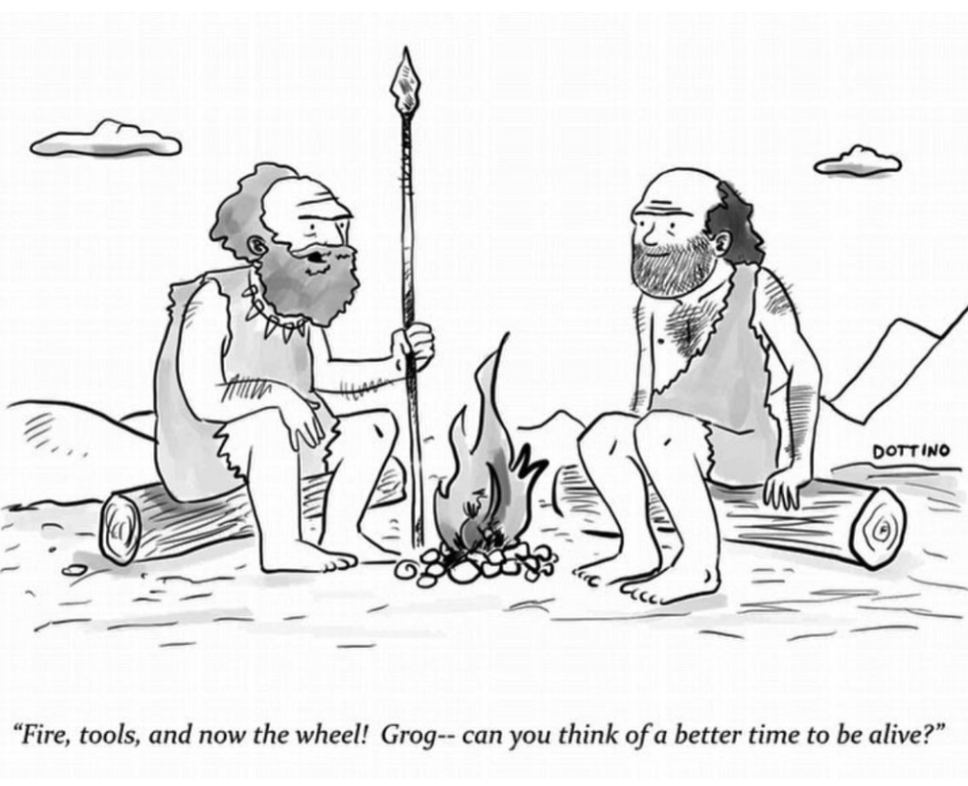
Seventeen hours a week? What did our ancient ancestors do with the other 151 hours? They invented language, civilization, and the Chicken Dance, and kept going from there. And as our world got more complex, our work hours kept getting longer.
Luckily, today’s average worker only needs to labor 11 hours a week to produce as much as one who was putting in 40 hours a week in 1950. Now that’s progress! How are we all enjoying those 11 hour work weeks? Anybody? For most of us, the hours we’ve managed to free up by our efficiency are simply filled with … more work.
Which is why retirement is so tricky for most people.
My husband, Rich, who was fortunate enough to take early retirement decades ago, has supported many friends through the surprisingly tough transition. This week he came across Riley Moynes’ book, The Four Phases of Retirement, which neatly defines the pitfalls of the process.

“The first phase is relaxation, where you’re going to read a book, go on cruises, or whatever,” Rich told me. “That’ll last about a year. And then out of the blue, you’re hit with depression, anxiety, loss of purpose, loss of relevance. A lot of people get stuck in that second phase; you see that happen over and over again. And then, if you can move out of being stuck, you start to explore ways to make your life meaningful.”
This third phase, warns Moynes, involves hard work, experimentation, and often a string of failures. But the payoff is worth it. “The fourth level,” explained Rich, “is finding that meaningful activity and pursuing it; that’s where your true happiness comes from. But that doesn’t mean that you go from A to B to C to D in a smooth sequence. You can slip back into B at any time if you’re not careful. So you have to pay attention.”
How do you find your inspiration — what the Japanese call “ikigai”? (It’s pronounced ee-key-guy and means “a reason to live.”) Spanish-born author Héctor Garcia, who now lives in Tokyo, decided to explore this concept by talking with centenarians in Ogimi Village, Okinawa Prefecture, one of the Blue Zone areas famous for longevity.

“When we asked what their ikigai was, they gave us explicit answers, such as their friends, gardening, and art. Everyone knows what the source of their zest for life is, and is busily engaged in it every day,” says Garcia. “Avoiding social isolation is linked to the motivation and confidence to lead active lives.”
One way to stay active involves geographic change. “Living in a foreign country — what you call having a Home 2.0 — makes you mentally sharp,” Rich told me. “You’re not doing things by rote, you’re doing things by actually thinking them through. And so your cognitive abilities get stronger.” Why is this important? I hate to reduce the wisdom of the ages to a coffee cup slogan, but as Caribou Coffee likes to remind us, “Life is short. Stay awake for it.”
Every age — your era and your time of life — has its challenges, and sometimes just getting through the morning headlines requires every shred of courage we can muster. But if we have learned anything from our journey through life, it’s that we can do hard things. Every past struggle, whatever its outcome, however it may have damaged us, taught us something that may prove useful in the present crisis.
When 65-year-old Churchill took on the Nazis in WWII, he wrote, “I felt as if I was walking with destiny, and that all my past life had been but a preparation for this hour and for this trial.”
Fortunately fate does not require all of us to stand up to challenges of that magnitude. But like Churchill, we can find it heartening to remember we have spent a lifetime developing the skills, from street smarts to spiritual fortitude, that we’ll carry with us into the next arena in which we are to be tested.
One of those skills is the ability to distinguish between amusing entertainments and stuff that’s just plain bonkers. When I was researching goofy ways we humans fill up our leisure hours, I came across collecting belly button lint (your own, not anybody else’s but still, ugh!), fire eating (what could possibly go wrong?), and underwater pumpkin carving (because … why?).
I’m beginning to think maybe dancing at a stranger’s wedding may not be such a loony idea after all. I’m sure your dog would agree it makes more sense than doing stuff like this:

.

Leave a Reply