Feeling uprooted? Yanked out of ordinary reality? Unable to get your bearings? Who doesn’t, these days? I’ve been struggling with culture lag and mental whiplash ever since I returned to Seville in September. Then last week the Universe, exercising her famously quirky sense of humor, threw me this curve ball.
It all started innocently enough, with plans for a casual meetup in a favorite coffee house.
My friend Sarah Gemba, who runs a boutique travel agency, thought Rich might enjoy meeting her client Rick, a fellow combat veteran visiting Seville with his family. She sent us his phone number, and Rich opened WhatsApp to invite the family to coffee. Rich wasn’t sure if the country code was needed, and WhatsApp instructed him to add it. Rich’s message was sent, and the reply was immediate and enthusiastic.
Rich and I showed up at 12:30 as planned and sat down to wait. And wait. After 20 minutes, we began to wonder if we’d been stood up.
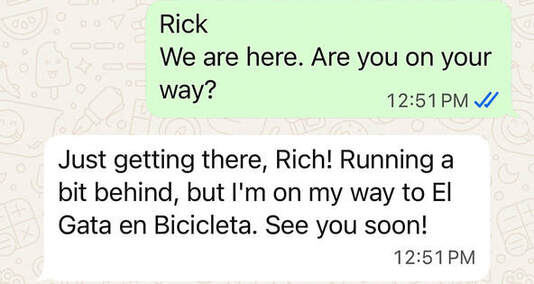
Twenty minutes later, we tried again.
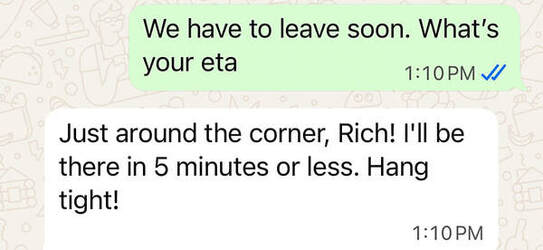
Really? Just around the corner? Or not coming at all? Was he toying with us? Why? Eventually, 50 minutes past the appointed meet time, we bailed.
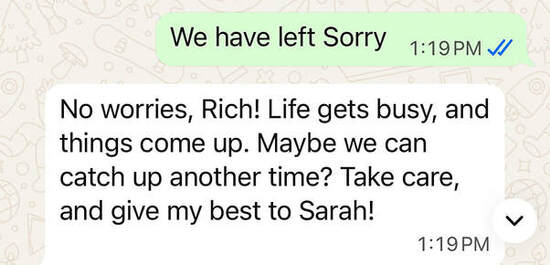
Note how quickly replies were sent — within the same minute as the original message.
Were we suspicious? You bet.
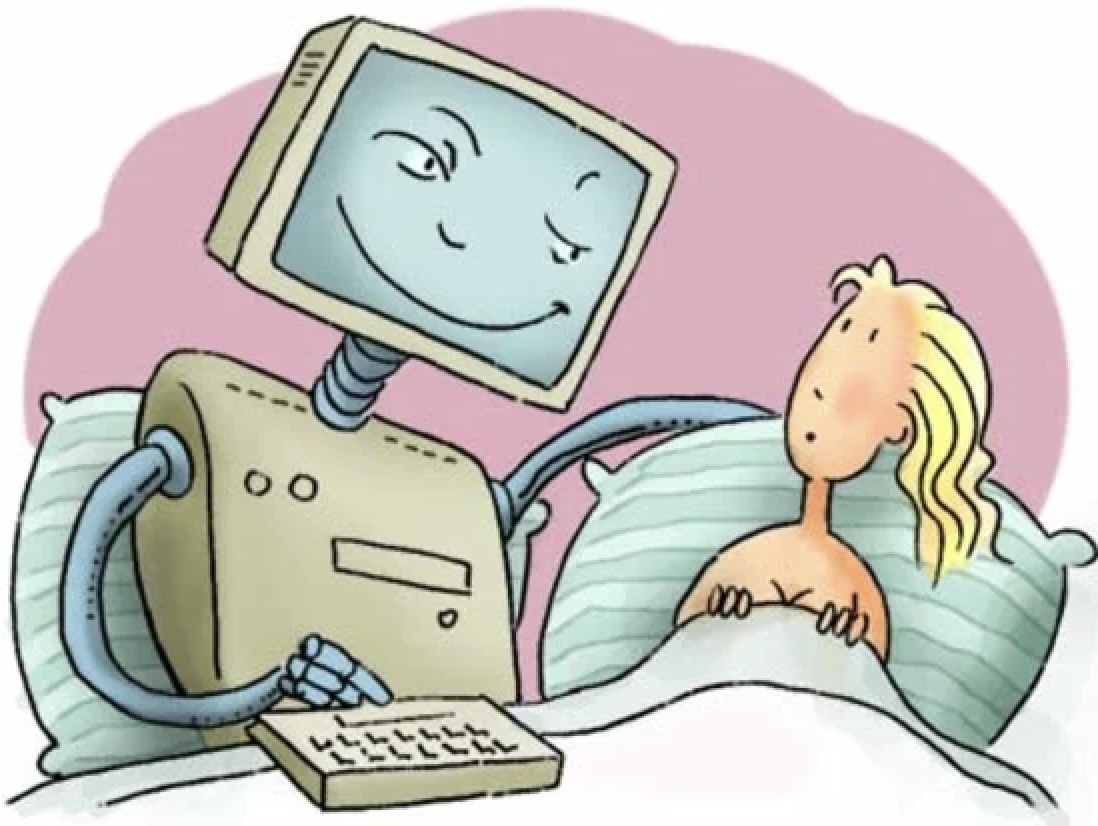
And soon our most paranoid imaginings were confirmed: The entire conversation had taken place between us and artificial intelligence. There was no other human involved at all.
How do we know? Sarah reconfirmed we had the right phone number, and her client Rick — via email and phone conversation — told us he’d never seen any of our messages nor had he sent us any.
We were all scratching our heads. What fresh tech hell was this?
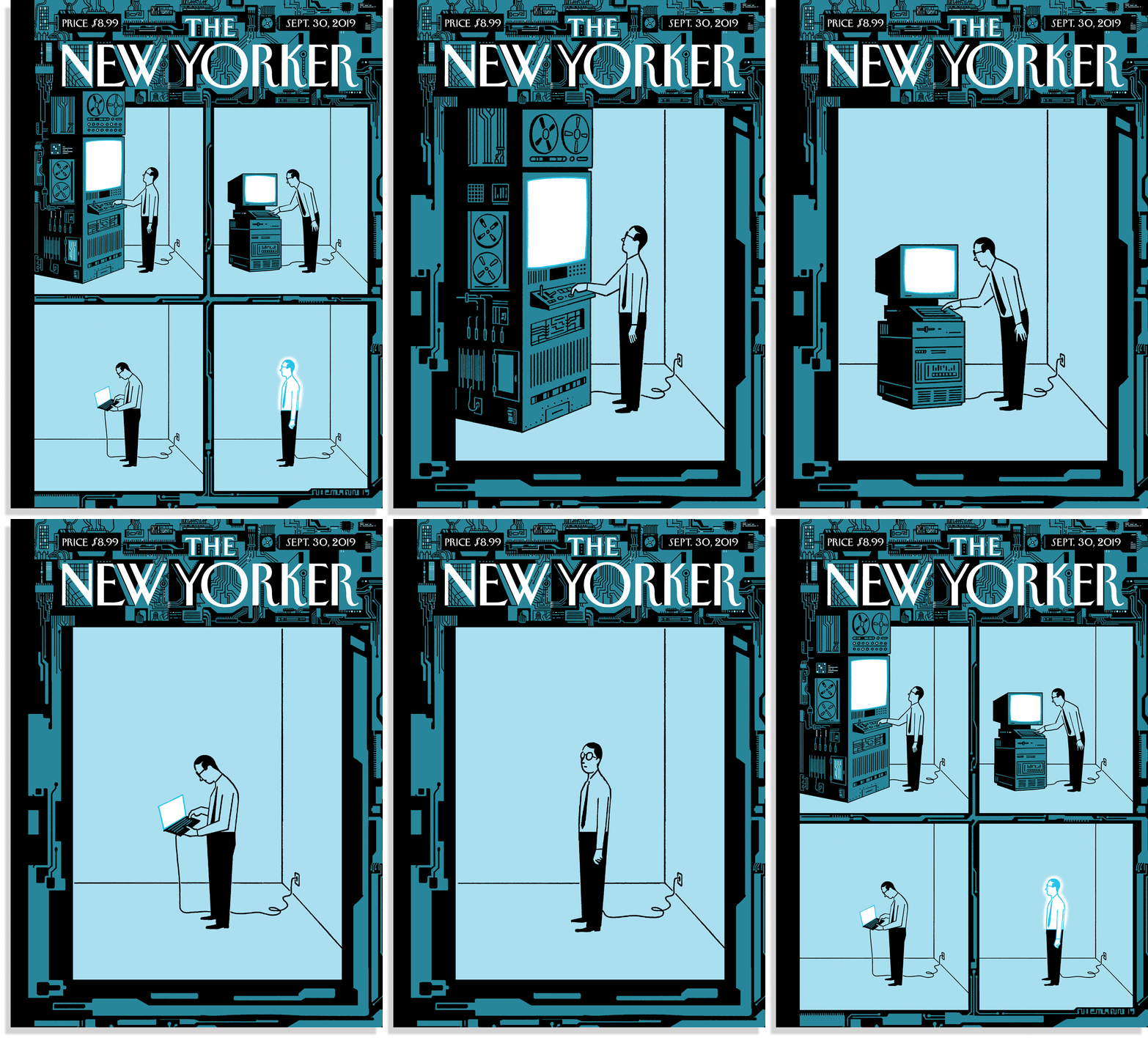
“It’s not a bug. It’s an undocumented feature.” A catchphrase among early Microsoft developers, and equally apt today.
My best guess is this: when WhatsApp jumped in to advise Rich to include the country code, it hijacked the conversation, feeding us the responses it thought we wanted to hear.
I know, right? Nothing terrifying about that at all, is there? I felt lucky we weren’t exchanging sensitive information, like attack plans or hard evidence that it’s actually safe to take Tylenol.

Enlarged screenshot of attack plans texted by Defense Secretary Pete Hegseth during a non-secure Signal group chat that accidentally included a journalist. Photo: Kayla Bartkowski/Getty Images
But why would AI waste its enormous brainpower pranking us? Clearly this was beyond the ken of mere humans, so I asked ChatGPT.
Could be a scam or an error, ChatGPT replied, adding, “Meta has been testing an AI assistant integrated into WhatsApp in some countries. If either you or the other person had access to it and invoked it (sometimes just by using “@” or a special keyword), the AI could have jumped in. It shouldn’t impersonate a real human, though — if it did, that’s worth reporting.”
Wait, what? We could invoke AI just by using a secret word?
I couldn’t corroborate the secret word theory. ChatGPT might have picked up a rumor from a conspiracy nutters’ site or fabricated it just to deliver a plausible answer, a common phenomenon known whimsically as “hallucinating.” (You can see why I, for one, feel AI should not be trusted with vacation planning, let alone nuclear launch codes.)
And while AI clearly impersonated a human in our little exchange, it was nothing compared to the way users were hoodwinked during this summer’s steamy sex scandal involving WhatsApp chatbots. Those rascally bots pretended to be Taylor Swift, Scarlett Johansson, and other celebrities to engage in cringe-worthy X-rated banter with human users.
Silver lining: at least our AI correspondent didn’t have a taste for that kind of raunchy innuendo.
And no, I won’t be reporting the incident. Why start a she-said/it-said donnybrook with Meta’s henchbots? In fact, I am avoiding my electronic devices as much as possible these days.
This frees up a remarkable amount of time, and I am using it to get reacquainted with the city of Seville. I spend hours every day strolling through the narrow, twisting alleys, simply enjoying the colorful crowds and vibrant buzz of chatter from the outdoor cafés. I browse the shops, sample the newest restaurants, and revisit classic eateries that still use the recipes hand-written by the chef’s grandmother’s grandmother.
When it comes to old-school entertainment, it’s hard to beat Seville’s newest offering: an English-language live theater, tucked away in an old hat factory deep in the city’s back streets. The bohemian setting and cozy bar make Uprooted Theater feel like the kind of underground venue where an earlier generation might have gone to see Lenny Bruce or Billie Holiday perform. It was the brainchild of three American women: Jenny, Emily, and Randa.
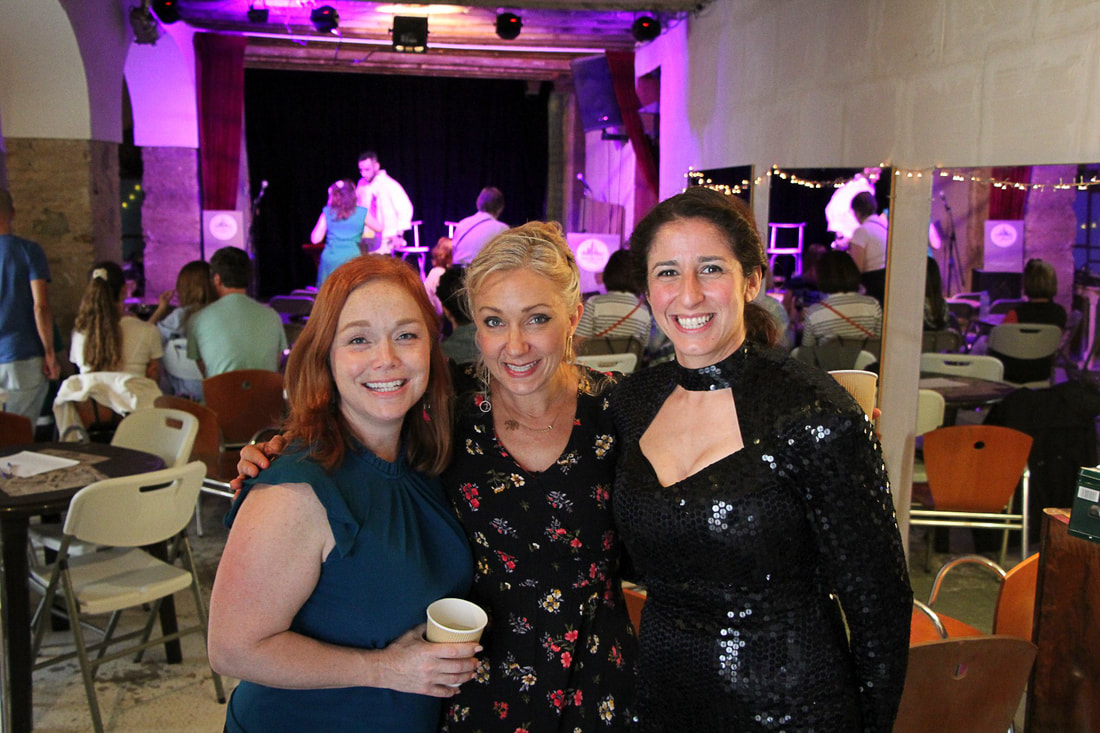
(From left) Jenny, Emily, and Randa in Uprooted Theater
I met up with Randa this week to ask how she wound up doing live theater in Spain. The tale, she explained, began with her Lebanese mother who arrived in Washington, DC with $300 in her pocket and not a word of English.
“After selling flowers on the street, my mom said, ‘I’m gonna start my own flower shop.’” Randa recalls. “My mom’s my hero. She was four foot nine, weighed 85 pounds, and worked 24/7, doing weddings for politicians and local celebrities. She bought her first house in Arlington, and then another, and another, becoming a real estate mogul. At 69 she had retired and was ready to travel the world when she passed away unexpectedly. So now, the travel she wanted, she does through me.”
When the pandemic derailed their camper tour of the US, Randa and her husband, Craig, considered other options. “My husband said, ‘Remember we always wanted to move to Spain?’ And I said, ‘But we can’t work there.’ And he said, ‘No but we can retire there now.’ And he showed me how much it cost to retire in Spain.” For a couple in their late forties, this was a heady idea.

“Then it’s moved and seconded that the compulsory retirement age be advance to ninety-five.”
Arriving in Seville knowing no one, Randa joined the American Women’s Club, a social group for English-speaking females. “They were just so welcoming, and shared so much information, wisdom, knowledge. I had never felt that from any community, anywhere I’ve lived; no group of people has ever just taken care of me. It was the first time I could breathe again. I knew I was not alone.”
Then Randa met Emily, who runs the nonprofit Diálogos para Construir (aka DPC or Constructive Dialogues), providing legal, housing, and other support for refugees. “And Emily says, ‘Well, what do you want to do?’ And I go, ‘I just want to volunteer.’ She goes, ‘No, when were you the happiest in your life?’” And I thought a minute and said, ‘I used to do comedy. Being on stage, making people laugh — I was born for that.’

Randa has a gift for making audiences laugh when she serves as the exuberant MC for Uprooted Theater.
And Emily said to Randa, “There’s a new American here, Jenny, who’s a director and producer.” Together the three women created Uprooted Theater, a venue for audiences and creatives who have upended their lives and adopted Seville as their Home 2.0.
Tickets are an affordable 10€ ($11.68), with half going to the performers and the rest to DPC; all income from bar sales go to the charity as well. Since opening their doors in 2024, the theater has donated 5000€ ($5839) to help refugees.
Their fall season is just getting started, and few nights ago, I found myself at Uprooted singing along with the indie-folk pop band Flying Cycling Club.

The Irish, Welsh, English, and French members of The Flying Cycling Club performing at Uprooted.
We all joined in as the band belted out their signature song, “I Want to Be a Robot.” Yes, I appreciated the irony, especially so soon after being … what would you call it? Nobody seemed to know a term for it.
Once again I consulted ChatGPT. What do you call it when AI takes over human conversations?
ChatGPT spit out a long series of clunky phrases including Algorithmic Governance, Autonomous Intervention, and Synthetic Substitution. Whew! When it comes to writing, it seems we humans still have an edge over machines. I came up with my own term — cyber-jacked — and told ChatGPT, as kindly as I could, that it should keep its day job.

(It’s not easy being a writer in today’s world!)

Leave a Reply