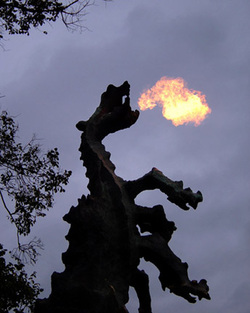


Statue of Krakow’s dragon. By Eirne/Wikimedia
I have nothing against the comforts and easy pleasures of a lighthearted holiday, but I’ll always choose adventure travel over a vacation. I simply
feel more alive heading out into unknown territories that are the cultural equivalent of the spaces on the old maps marked “Here there be dragons.”
But until I got to Kraków, Poland, it had never occurred to me that there might
literally
be dragons. Which just shows you how little I knew.
Kraków’s dragon was called Smok Wawelski, and back in the day he was always ravaging crops, livestock, and maidens. When all the local knights had died fighting him,
a poor but crafty cobbler’s apprentice named Skuba came up with a clever plan
. He filled a lamb’s carcass with sulphur and laid it temptingly in front of the dragon’s cave. Smok gobbled it up and was seized with such a monstrous thirst that he ran down to the river and drank without ceasing until he exploded. Problem solved!
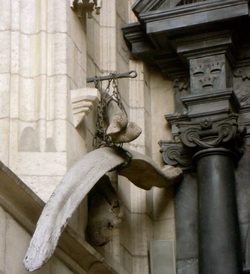
Smok’s bones at Wawel Cathedral
And
I know every word of this is true, because I have seen Smok’s bones,
mounted at the entrance to the cathedral in the Wawel Castle complex. Naturally there weren’t many bones left after he exploded, and as our guide was telling the story, Rich was craning his neck in an unsuccessful attempt to see them. Finally he leaned over and whispered, “Where are the bones?” Unfortunately, he whispered this into the ear of a strange woman with my color hair who happened to be standing next to him at the time. A few awkward moments ensued until the woman’s male companion, evidently deciding Rich was a
harmless
lunatic, pointed to the rafters and said, “Up there.”
Chained high on the wall were three bones of gargantuan size, two massive joints and what looked like a long, curved rib. Now,
I know you’ll find this hard to credit, but some naysayers have seen fit to question the authenticity of these bones
, suggesting they might be from a blue whale, a rhinoceros, and/or a wooly mammoth rather than an actual dragon. However the chances of those bones being taken down and subjected to scientific scrutiny are precisely zilch, because according to legend, so long as they remain in place, Kraków is safe from destruction. Are they working? You bet. Otherwise, how would you account for the fact that during World War II, when just about every major city in Poland was bombed to rubble, Kraków survived more or less intact?
Feeling the Force of the Wawel Chakra Stone?
Well,
there is
one
other reason that could account for the city’s survival: the Wawel Chakra Stone
. If you’re a little hazy on the whole chakra thing, they’re sites of highly concentrated physical and spiritual energy. The human body has seven, from the root chakra at the base of the spine to the thousand-petaled lotus of enlightenment at the top of the head. The Earth also has seven chakras, marked by stones that radiate transformative and protective power. One is said to be inside a wall in Wawel Castle, where it’s busy cleansing the earth’s aura and reanimating the seventh chakras of those who touch the wall.
Do you have to ask?
Of course, I tried it!
I placed my palm against the wall and leaned in. Nothing whatsoever happened. Or did it? For all I know, my spiritual batteries are fully topped up, all thousand petals of my lotus are open, and my seventh chakra is doing a happy dance – but all in ways too subtle for me to notice.
Rich was a tad skeptical.
I will never know if those are real dragon bones or whether the chakra stone gave my aura a bit more zing. But I am certain that visiting Wawel Castle
let me step outside the boundaries of my ordinary life and open myself up, if only briefly, to some of the mysteries of the universe.
And who knows, maybe as I continue exploring unknown territories, the protective powers of the Wawel Chakra Stone will be keeping me safe along the way.

Leave a Reply