I’ve learned to believe a lot of impossible things since I moved to Seville: eating more often helps you stay thin, for instance, ham lowers your cholesterol, and afternoon siestas make it easier for you to sleep at night. But I had to scoff last week when my friend Rena said, over a couple of frosty brews, “Have you heard? Now they’re saying that beer is better at rehydrating you than water.”
“Right. And grapefruit is more fattening than chocolate.”
“No, seriously. There was some study…”
Obviously Rena was delusional, or someone had been pulling her leg. All the same, when I got back to my home office, I looked it up. And there it was: “Beer after sport is ‘good for the body” announced the mainstream press. Campus bloggers crowed, There is a God. Beer rehydrates better than water (seriously).”
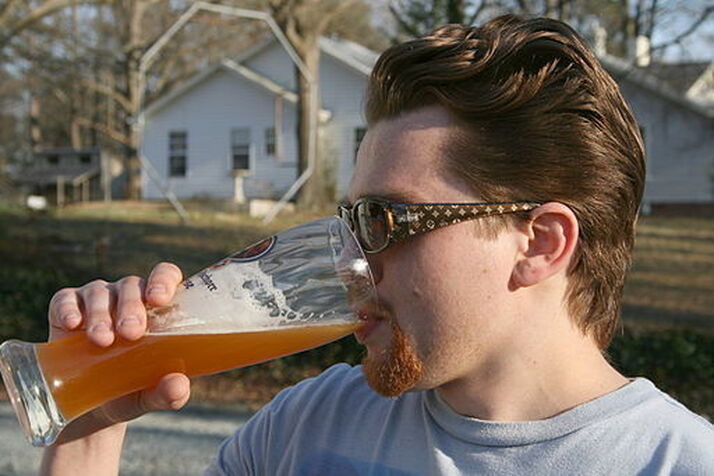
The groundbreaking humanitarian study was, of course, conducted in Spain. Professor Manuel Garzon of Granada University had students do strenuous exercise on a day with high temperatures (40 degrees Celsius/104 Fahrenheit), then gave half of them a pint of water, the others a pint of beer.
In a press conference afterwards, Garzon announced that those in the beer group were rated as rehydrating – to quote the technical term he used – “slightly better.” It turns out beer has electrolytes and calories which replenish those we’ve sweated away; water does not. Hence beer’s slight edge when it comes to helping the body to recuperate after athletic excess.
But before you decide to replace your water cooler with a keg, I should point out that this applies only to a single pint after a strenuous workout. In larger quantities, beer serves as a diuretic, making you lose fluids. At what point does beer stop helping you hydrate? Clearly additional research is needed, and I’m sure scientists won’t have any trouble recruiting volunteer subjects.
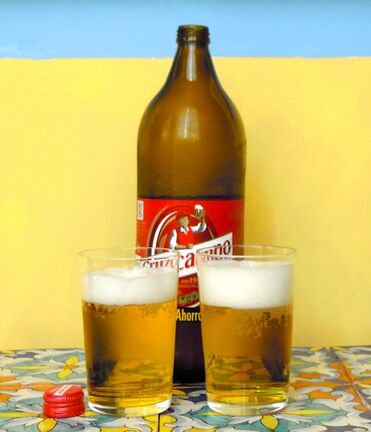
Of course, in a way, the entire population of Spain is a good test study. When I first moved to Seville, I expected nights out would be spent sipping the kind of earthy red wines Hemmingway wrote about. Instead, I found the brutally hot summer weather makes nearly everyone here opt for beer, the colder the better. A tiny, hole-in-the-wall bar called the Tremendo was the first in Seville to invest in equipment for chilling beer to just above popsicle temperature, and although others have now followed suit, on steamy nights people still line up outside the Tremendo for the pleasure of that first icy swallow.
When I was a newbie in Seville and expressed a preference for a glass of white wine at the start of an evening’s revelry, Spanish friends would inevitably make jocular comments about how I was heading fast toward inebriation. I thought they were insane, of course, until I noticed that their words held a kernel of truth. Beer did ease me into a sociable evening more gently than wine. I developed a theory that because we live in a climate that leaves us all chronically dehydrated much of the year, beer’s higher liquid-to-alcohol ratio works to our advantage. That may be part of it, but now I know that it also helps balance electrolytes and replenish lost calories. In fact, it’s practically a health drink.

So Rena, I’m sorry I ever doubted you. Beer is better than water when you’re in urgent need of rehydration. And now that Seville’s temperatures are soaring to levels similar to the conditions of the Granada study, I’m forecasting a flurry of frosty pints in the near future. In the meantime, I’ll be looking forward to the next health breakthrough made by Spain’s selfless scientists. I’m keeping my fingers crossed they’ll find a way to convince us all that chocolate really is less fattening than grapefruit. Cheers.
Leave a Reply