I’ve been back in the US four months now, and I’m still struggling with sticker shock. Going to the store for a small bag of groceries: $100. Movie tickets: $16. And gasoline: don’t get me started.
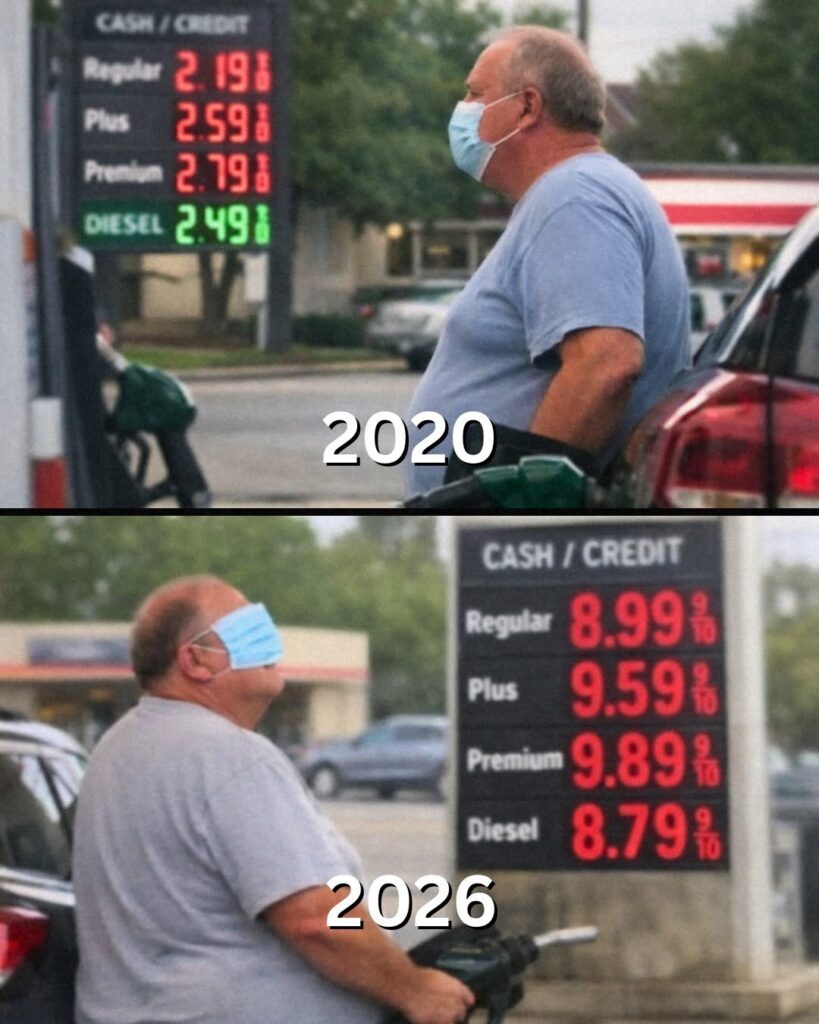
Ordinarily, gas prices are like the old joke about the weather: everybody talks about it, but nobody does anything about it. But one NY gas station decided to make customers an offer they couldn’t refuse: a 20% discount if they’d show off their best dance moves.
One of the many reasons I love this story is the way it shows ordinary folks in the middle of an unremarkable day finding joy in a little spontaneous cavorting. It’s pretty clear these dancers aren’t taking themselves too seriously, and the clerk herself is cracking up. Those brief but beautifully wacky moments of self-expression paid dividends that went far beyond a discount at the pump.
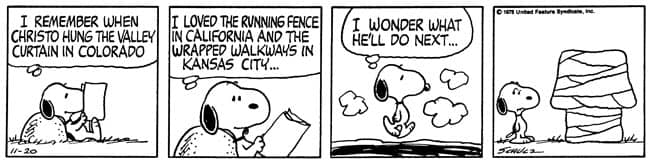
That’s what dance and all other art forms are meant to do: lift us out of our everyday selves and transform the way we experience the world. And nobody knew that better than Christo, the Romanian artist famous for vast installations involving miles of fabric transmogrifying the most unlikely bits of landscape into eye-popping creative expression.
In collaboration with his Moroccan-born French wife, Jeanne-Claude, he began by wrapping small objects in fabric and string, then later shifted to his monumental works, wrapping whole buildings or stringing curtains across the landscape. I have to admit, seeing the Arc de Triumph in Paris, Berlin’s Reichstag, or even a row of magnificent old trees swathed in fabric and tied up with ropes always feels weirdly like watching a hostage video. It helps to remind myself that, like Buddhist sand mandalas, his installations were always temporary, usually removed after two weeks, liberating the wrapped object and vanishing without a trace.
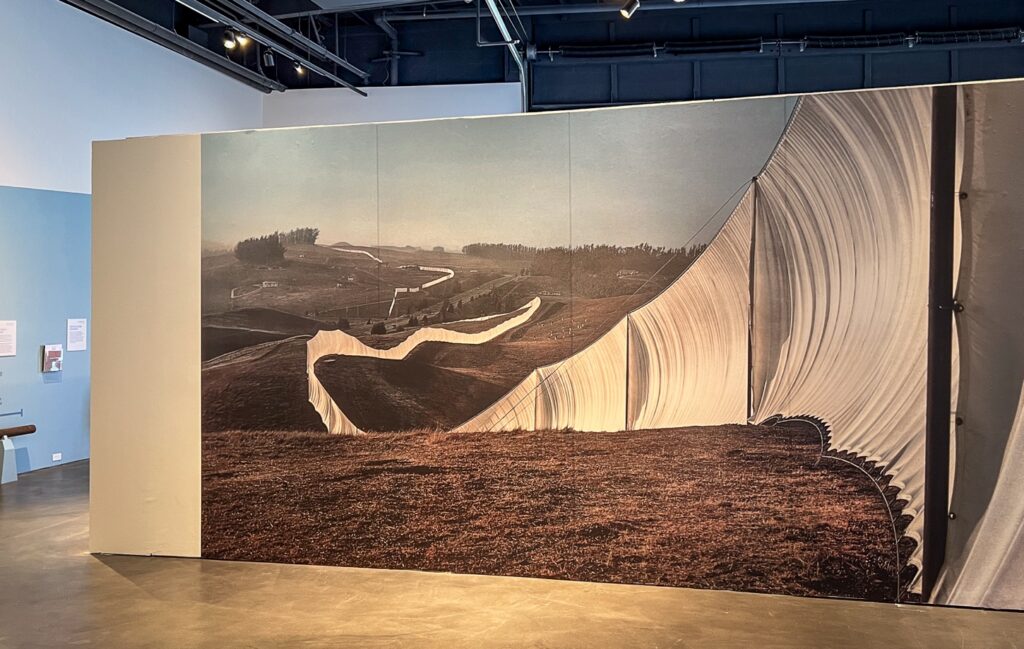
Fifty years ago, Christo and Jeanne-Claude installed one of their most iconic works, the 24.5 mile Running Fence here in Marin County and neighboring Sonoma County. Composed of 2,050 steel poles and 240,000 square yards of the tough yet billowy fabric used for car airbags, the fence wound its way through small farms and villages along the California coast to disappear into the sea. This week Rich and I popped into the Museum of Sonoma County in Santa Rosa to check out the exhibition marking its half-century anniversary.
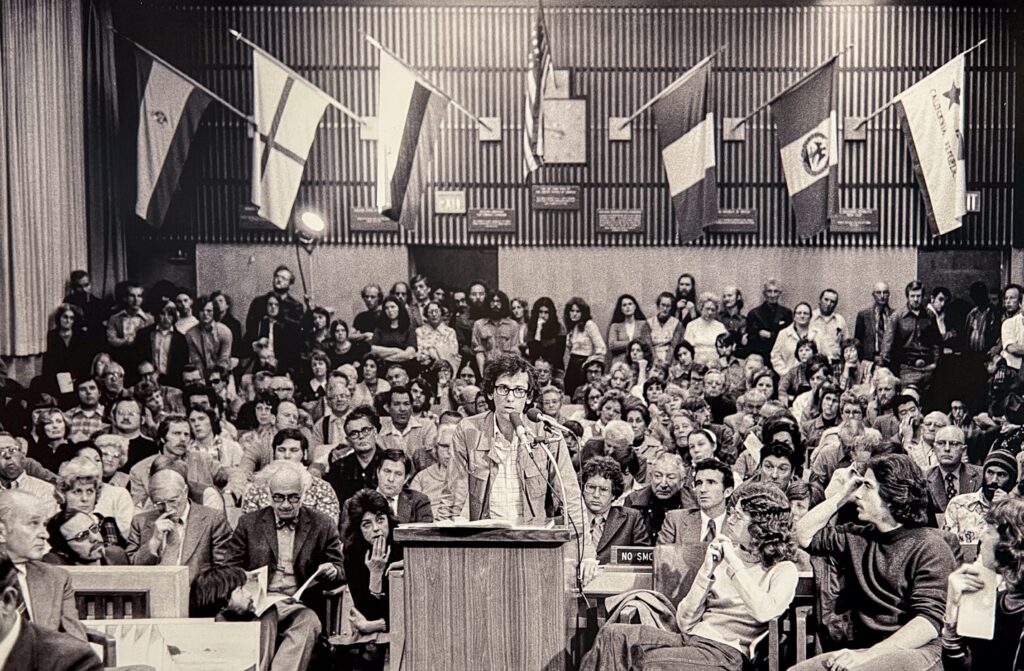
Not surprisingly, many locals and journalists looked askance at the project, describing it as “a gargantuan roll of toilet paper.” Controversy raged; approval took four years, eighteen public hearings, three appearances in California Superior Court, a 450-page environmental impact report, and two complicated county permits. “The whole process becomes an esthetic,” Christo said enthusiastically. “I put myself in dialogue with other people.”
In 1976 Christo and Jeanne-Claude finally won permission from Marin and Sonoma counties to proceed, creating a configuration that conformed to individual agreements they’d worked out with neighbors along the route, many of whom became friends in the process. The artists paid every penny of the costs — a hefty $3 million — out of their own pockets. They never accepted public or private funding, preferring to raise money by selling sketches and photos of their projects.
“I like to be absolutely free, to be totally irrational with no justification for what I like to do,” Christo said. “I will not give up one centimeter of my freedom for anything.” Heady words!
In keeping with that philosophy, Christo ignored the California Coastal Commission, which refused to issue a permit to plunge the far end of the fence into the sea. However, given the enormous international acclaim the piece was already earning, officials wisely let the couple off with a small fine. Art critics and aficionados call Running Fence an iconic masterpiece. Some neighbors remain skeptical of the whole enterprise. As one put it, “That’s art? A lousy curtain coming through here?”
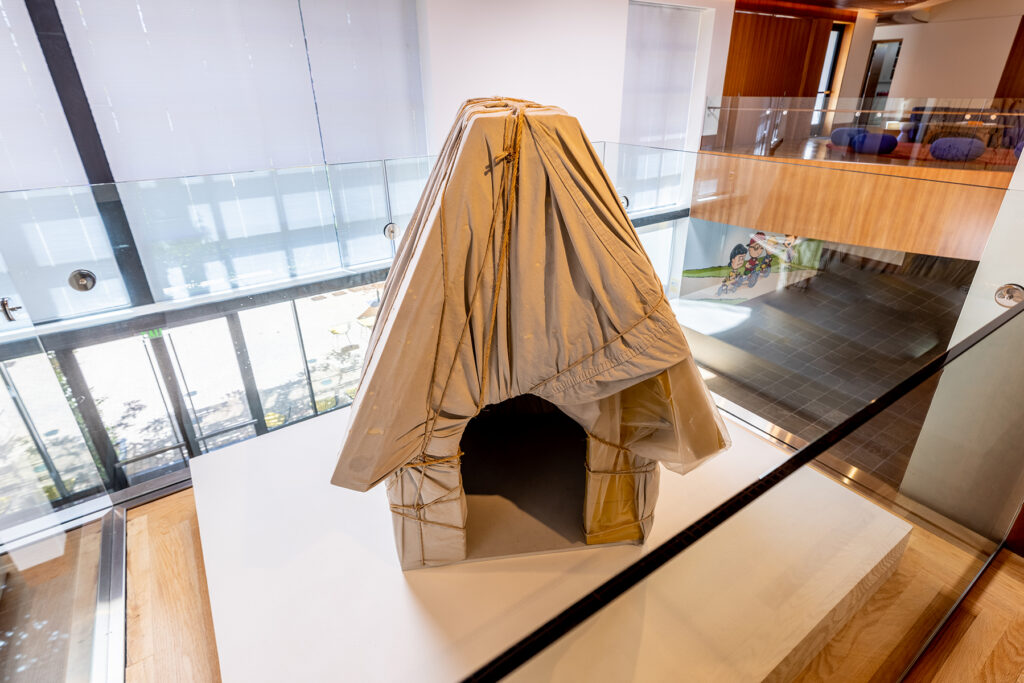
Standing before the huge photo of Running Fence, I thought about the fleeting nature of joy. Christo, Jeanne-Claude, and hundreds of workers had labored long and hard to create a lavish spectacle meant to spark delight and awe. Two weeks later they tore it down, but the feelings it inspired live on. As the great composer Wagner put it, “Joy is not in things, it is in us.”
According to Helen Keller, “Joy is the holy fire that keeps our purpose warm and our intelligence aglow.” Theologian and author Henri Nouwen reminds us, “Joy does not simply happen to us. We have to choose joy and keep choosing it every day.” And despite the worrying nature of modern times, we have much to rejoice over in 2026.
Like what?
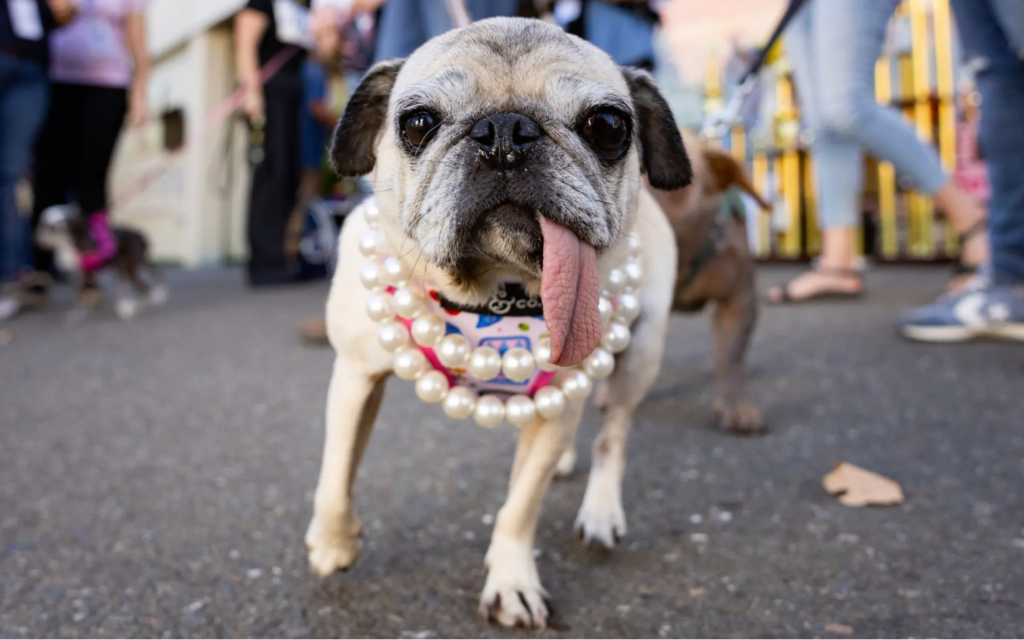
OK, to name but a few: The Artemis II mission put NASA back into deep-space flight after a 55-year pause. For the first time in history, America is getting more energy from solar power than coal. The ozone gap in the Antarctic is shrinking. And this week, 6-year-old pug Jinny Lu — who started life as an abandoned, freezing puppy in the mountains of South Korea — won the World’s Ugliest Dog Contest in the Sonoma County Fair. Congratulations, Jinny! Happy days, indeed.
Another piece of positive news: scientists are discovering how and why our dogs can pick up on our moods. Groundbreaking research is being conducted by Laura Cuaya and Raúl Hernández-Pérez, who are partners in work and in life; BBC science writer Victoria Gill calls them “a canine-cognition power couple.” (Who knew that was a thing?) “This research,” says Gill, “is building a picture of exactly how thousands of years of living alongside humans has made this possible by molding and changing dogs’ brain circuitry.”
Cuaya and Hernández-Pérez spersuaded eight really good dogs — including their own border collies, Odin and Kun-Kun — to hold very, very still in a brain scanner while looking at photos of human faces. The scans showed that human smiles lit up the same region of the canine brain that reacts to the offer of a tasty treat.
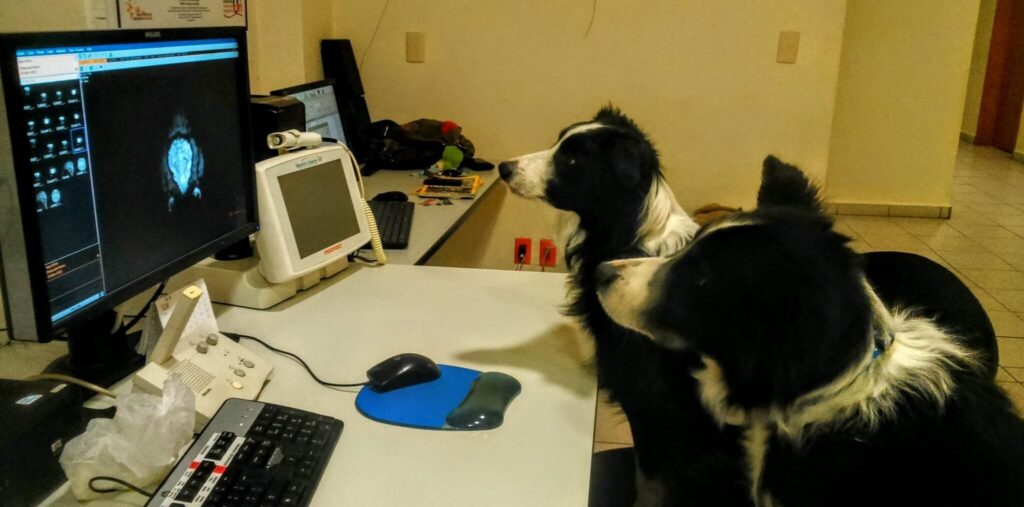
A second, larger experiment showed the dogs could also distinguish between fear and sadness. All this suggests that whatever emotions you’re feeling today, your dog really is picking up on your vibe.
We can take considerable comfort in knowing that we humans are surrounded by a warm, fuzzy species ready to connect with our feelings. Whether you’re flinching at the price of gasoline or laughing over some outrageous art installation, your dog is ready to second that emotion. And if necessary, they will step up and join you in the dance, even if nobody’s offering them a treat or a discount, just because they care.




Leave a Reply