As you may have noticed, I’m a big fan of quirky travel adventures. To me, there’s nothing more exhilarating than taking a step into the unknown – even if it’s simply poking my nose into some unexplored corner of the city I’ve lived in for more than a decade. I recently stumbled across a kindred spirit in French journalist Joël Henry, who in 1990 launched the
Laboratory of Experimental Tourism
and a brief but vivid fad for crazy travel experiments.
The idea was born of idle musings over lunch on a barge-restaurant called “Why Not?” By the time the cheese platter was passed around, Henry and his friends had redefined travel as a sort of game in which it’s the creativity of the journey and not the destination that counts. His concept, which eventually formed the basis
a Lonely Planet book
, embraces anything from spending a day in an airport without going anywhere (something I’ve done all too often against my will and have no desire to repeat) to buying your city’s Monopoly game and letting rolls of the dice send you to visit various sites, including utility companies and jail.
When asked about his most meaningful journey, Henry talks about what he calls “cecitourism,” which is traveling blindfolded with a trusted guide. “I visited Luxembourg this way, guided by my wife Maïa during 24 hours. I was blind when I got into the city and blind when I left it. So the only things I know of it are its noises, smells and what Maïa described to me. But incredibly I keep a very clear and precise [image] of it.”
Yikes – 24 hours in the dark? I don’t think so. But I did enjoy my brief blindfolded experience in the Betty Ott
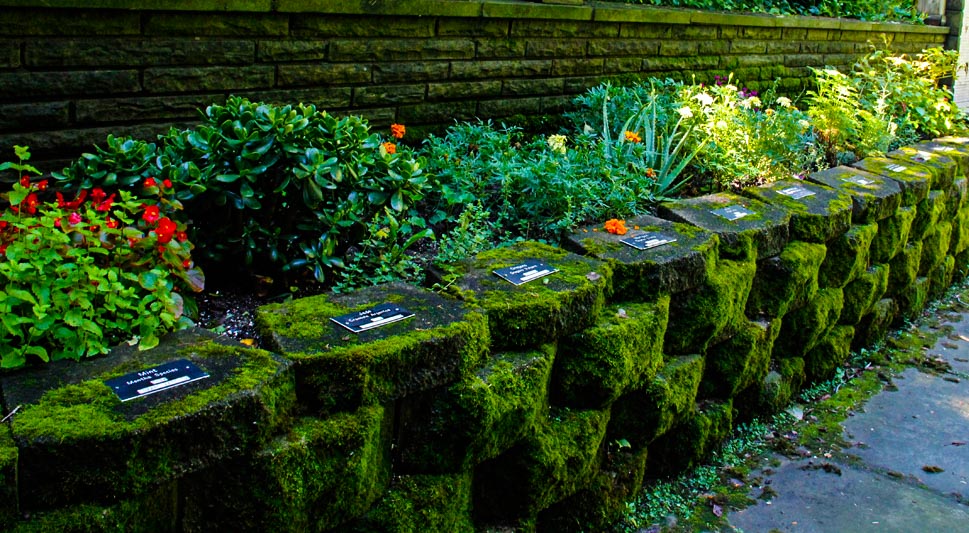
Talking Garden for the Blind
in Cleveland’s Rockefeller Park. Happening upon the place on day, I asked Rich to keep an eye on me as I tied a scarf over my eyes and fumbled my way through the raised plant beds — a fascinating twenty minutes. With that under my belt, I am prepared to consider the
Blindfold Tour of Prague’s Krivoklat Castle
, in which you’re escorted through the castle with eyes covered, feeling the walls and absorbing the atmosphere; you then remove the blindfold and do it all again so you can compare your visual impressions with your imagination. That could be fun, but I still draw the line at California’s dine-in-the-dark Opaque restaurants. “The table,” wrote one food critic, “is
a minefield of messy disasters (yes, my hand went into the butter) … But it certainly makes a good yarn to tell your friends later
.” Sadly, you won’t be able to take a single selfie.
Another of Henry’s favorites is “erotourism,” a romantic adventure in which a couple travels separately to a foreign city and then tries to find each other. Having done this with his wife on five occasions, Henry says, “Each time we were convinced that this time, we wouldn’t find each other, and each time we did.” Given my truly terrible sense of direction, I can only imagine how long it would take me to hook up with Rich in a foreign city. Months at least; possibly decades.
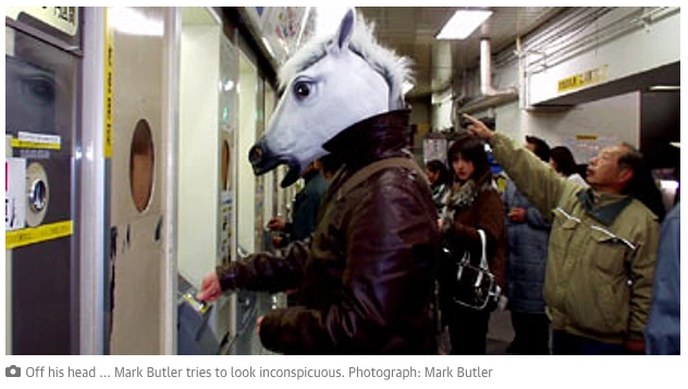
But the great thing about travel experiments is that you get to design them to suit yourself. Mark Butler decided to
travel through Japan wearing a horse head costume
to test local etiquette. George Mahood
journeyed the length of England penniless and nearly naked
to appraise the kindness of strangers. Sasha and Ludo Jambrich created
a honeymoon experiment that included hitchhiking — in their wedding attire
— to free accommodations in multiple countries. Rich thought this was brilliant, and I can only thank my lucky stars he didn’t hear about this until after we were married.
Even without the hitchhiking honeymoon, we’ve done our share of travel experiments. The longest was our three-month train trip, designed to determine whether
a couple of sexagenarians could still have the kind of grand travel adventures we’d enjoyed in our youth
— only with less sleeping on the ground and better wine. Two weeks ago we tried
luggage-free travel
and liked it so much we’re planning to do more. But travel experiments don’t need to be seriously challenging; most of ours are simple activities, such as hopping on a bus in a strange European city and riding to the end or jumping off in a neighborhood that looks interesting (and reasonably safe). We’ve also based trips on favorite books (
Tales of the Alhambra
), authors (
Dashiell Hammett’
s San Francisco) and legends (
Rennes-le-Château
).
For us, every travel experiment concludes with a what-have-we-learned session, usually held over a glass of wine in a congenial café. Because the point of these experiments – the point of all journeys, really – is to discover something new about the world and about ourselves. “
Peculiar travel suggestions are dancing lessons from God
,” says
Kurt Vonnegut.
And who could resist an offer like that?
Have you ever tried a travel experiment? Do you have one in mind for the future?
YOU MIGHT ALSO ENJOY
20 WAYS TO USE YOUR STAYCATION AS TRAVEL PRACTICE
HOW TO GET LUCKY ON NEW YEAR’S EVE
WE’LL ALWAYS HAVE LISBON (THE CASABLANCA TOUR)
Leave a Reply