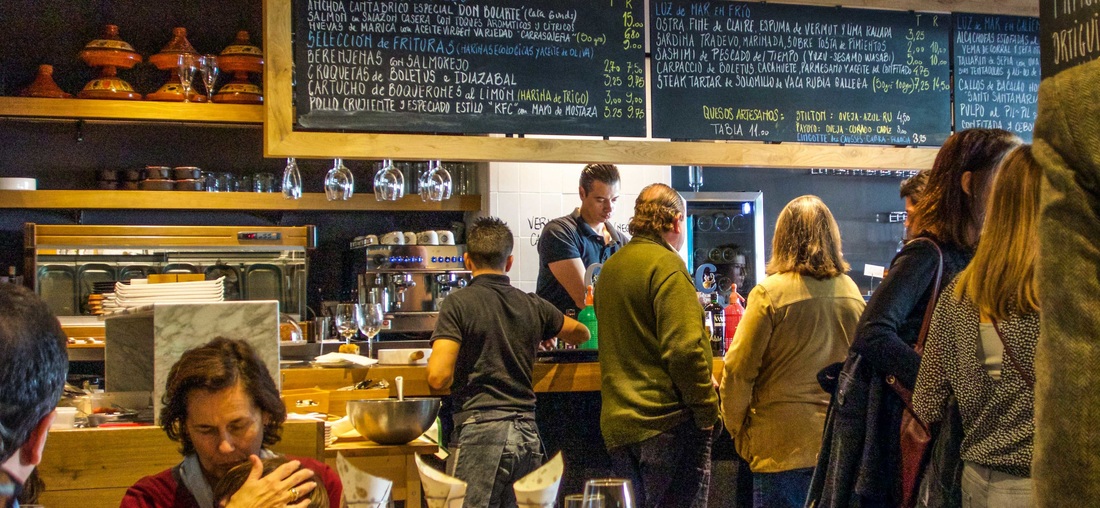

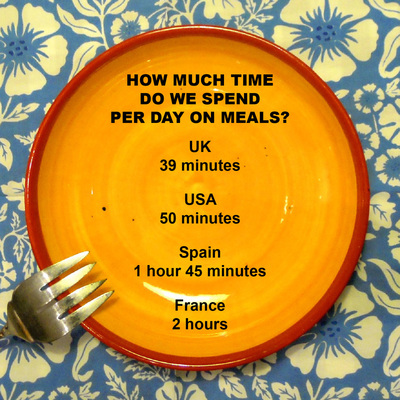

One of the things I love about Spain is that nobody can agree on anything — and everyone seems fine with that. Take tapas, for instance, those delicious small plates of food that are so popular here in Seville (and just about everywhere these days). The word comes from
tapar
, “to cover,” but does it refer to setting a slice of bread over a wine glass to keep out flies and dust? Covering a glass of inferior wine with a slab of strong, salty cheese to mask the taste and boost your thirst? Reducing public inebriation by ensuring that you eat whenever you imbibe? In America, a cultural icon this important would be the subject of a definitive study and a host of fact-checking websites. Here in Seville, it’s an issue that only seems to come up when you’re actually in a tapas bar, which is not a setting conducive to serious critical analysis.
One thing we can say for sure about tapas: the small plates encourage us to eat modest portions in a leisurely manner. It’s an easy form of portion control that’s built into the
Mediterranean diet
— yes, that diet, the one innumerable studies have shown can help us live longer, healthier lives with less chance of developing dementia. To say nothing of letting us enjoy much, much better food along the way.
So why isn’t everyone benefitting from this blissful union of traditional wisdom and modern science?
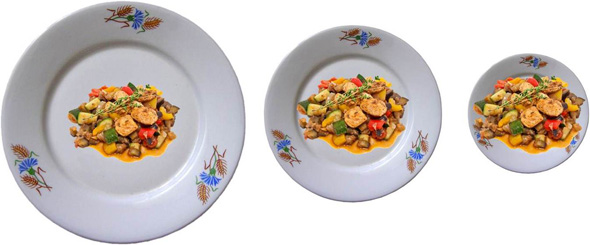
For a start, today’s super-sized dinner plates are tricking us into eating ever-larger portions at every meal. No, I’m not suggesting that inanimate objects have learned how to exert mind control over humans (not yet, anyway), but the very size of these plates triggers something in us known as the
Delboeuf illusion
. It’s a simple equation: the bigger the surface, the smaller stuff looks sitting on it. Here’s the classic visual experiment involving two black dots of equal size.
The bigger the white circle, the smaller the black dot appears. How does that translate to your supper?
A bigger plate gives us a strong visual cue that the portion is too small to satisfy our hunger, triggering thoughts of bolstering our meager meal with a nice big helping of mashed potatoes smothered in gravy. Such cues are remarkably difficult to resist, as changes in our eating habits attest.
Since 1960 American
dinner plates have become 36 percent larger
; from being 7 to 9 inches across they’ve expanded to about 11 to 12 inches. During that same period the average bodyweight in the US rose 17%, from 140 to 164 pounds for women and from 166 to 194 pounds for men. Of course, there are many social, cultural, psychological, and economic factors affecting your avoirdupois. But if your portions get bigger, and your calorie intake gets bigger, there’s a pretty good chance your waistline will follow the trend.
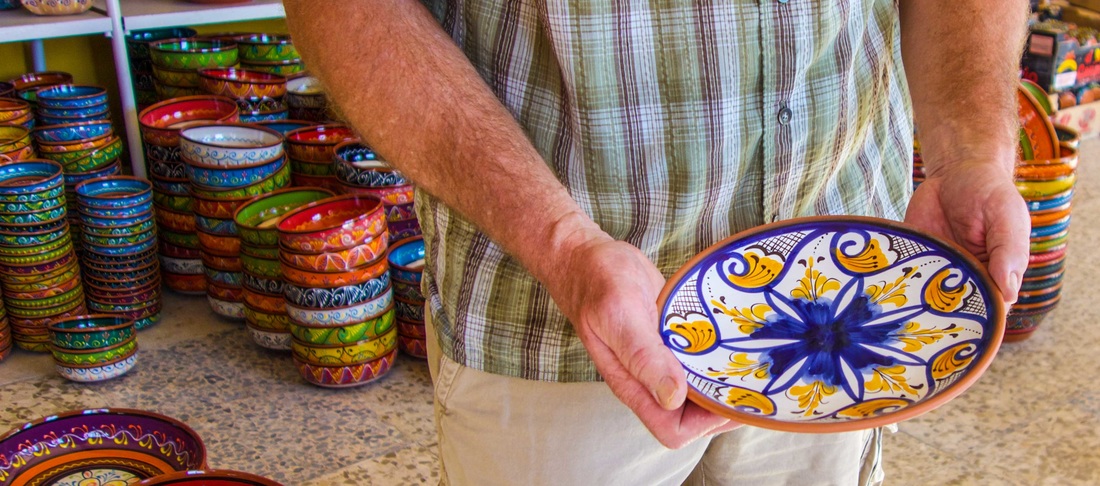
The typical European dinner plate is still no more than 9 inches across, and a tapa plate tends to be between 7 and 8 inches. My friend Steve, who exports
hand-painted Spanish ceramics
from Andalucía to the US, recently told me, “When I first started, my biggest problem was getting the artisans to make cups and plates that were big enough to sell in the States. A 12-ounce mug? Unheard of here. They drink their coffee in tiny espresso portions, not our giant lattes. And dinner plates are only 9 inches, tops.” Steve has successfully convinced his Spanish suppliers to create jumbo crockery, making American consumers happier, if not slimmer.
As for me, I’m sticking with European-sized plates and portions. “Studies show that
people are more satisfied with less food when they are served on 8-inch salad plates
instead of on 12-inch dinner plates,” says nutritionist Dr. Penny Klatell. “For an average size adult who eats a typical dinner of 800 calories, the
smaller portions
that would result from using a smaller plate would lead to a weight loss of around 18 pounds a year.” Now that’s food for thought.
Unlike some of my better-organized and more practical blogger friends, I don’t accept sponsorships of any kind. Any products mentioned in my posts are personal favorites I included because I thought you might enjoy them.
YOU MIGHT ALSO ENJOY
10 WAYS TRAVEL GETS BETTER AFTER 50
EAT MORE OFTEN SO YOU DON’T GET FAT
4 KINDLE TRAVEL BOOKS 4 JUST 4 BUCKS

Leave a Reply