“I remember driving around with half a sheep in the back of the car,” Martin said. “Because in those days, when you went visiting, you always brought your own food.”
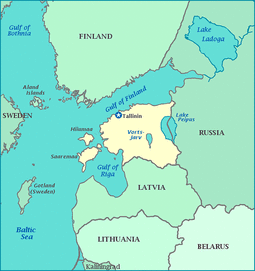
We were in Tallinn, the capital of Estonia, a small country perched precariously between Russia and the Baltic Sea. As you can imagine, Estonia has been invaded by every major seafaring nation around and spent most of the twentieth century under the successive domination of the Russian Empire, Nazi Germany, and the USSR. The Soviet half century was particularly dismal; if you managed to survive the mass deportations to Siberia (Estonia lost 25% of its population by the end of WWII), you had little food or money, and lived with rampant, completely justified paranoia.
“They kept telling us how great everything was,” said Kay-Krister, with the kind of deadpan irony often found in former Soviet citizens, who have a knack for conveying an eye roll and a mental shrug without any perceptible change of tone or expression. “They were schizophrenic times.”
Kay-Krister
was escorting us through the infamous
KGB headquarters
on the Hotel Viru’s twenty-third floor, a penthouse level the Soviets denied even existed. She showed us surveillance devices that seemed like props from a Cold-War era James Bond movie: the microphone hidden in the bread plate, the camera that shot through a peephole, massive reel-to-reel tape recorders. How closely were the KGB listening? “One visitor,” she told us, “said to his wife, ‘Look, they didn’t even give us toilet paper!’ Two minutes later came a knock on the door. They opened it and someone was standing there, holding out a roll of toilet paper.”
So how
did
the Estonians finally win their freedom from the superpower next door?
They called it
the Singing Revolution
. The Soviets had outlawed Estonia’s patriotic songs, but by 1987, with the USSR struggling to hold itself together, people began to sing the forbidden tunes at ever-larger public gatherings. As one Estonian put it, “If twenty thousand people start to sing one song, then you can’t shut them up, it’s just not possible.” In 1988, nearly 300,000 people — more than a quarter of the population — came together at the Song of Estonia festival, waving flags they’d kept hidden for generations. And on that day, Estonia’s political leaders began talking seriously and publicly about the road to freedom.
There was more to it than singing and talking, of course, and tanks were eventually involved. But Estonia prevailed, winning its freedom in 1991.
“We were lucky to have good leaders,” Martin’s wife, Erge, told me.
The new government, she explained, invested wisely in education. Literacy is now 100%. Every Estonian is taught computer
programming in grammar school and has access to a free university education and free Wi-Fi. With the universal Estonian ID card, virtually all banking, voting, taxpaying, and medical record-keeping happens online. Estonia is the first country offering the opportunity to become an e-resident, which lets you set up and administer an Estonian business remotely. Skype got its start here, and today this little country has the highest number of startups in Europe. Government support for startups includes favorable taxes, streamlined paperwork, and good advice.
“Do you …” I had never asked this one before and could hardly get the words out of my mouth, the concept was so foreign to me. “Do you
trust
your political leaders?”
“Yes,” Erge said, as if it was the most natural thing in the world. “I think they’re moving in the right direction. They are honest. We don’t have a lot of corruption.”
This staggering statement piggybacked on another stunner I’d heard earlier that day. We were standing in front of the Parliament building when
our guide, Heli
, asked, “What don’t you see here?” We looked around blankly. “There are no gates, no guards. Sometimes when I am giving this tour we see the prime minister, walking out of the building, alone. He just waves.” She laughed at our expressions. “This is an open society.”
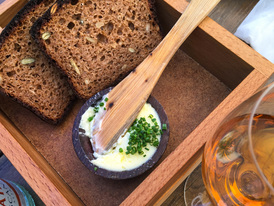
Leib’s signature black bread, beautifully paired with a crisp Italian orange wine
We were in Tallinn’s Old Town, where the cobblestone streets were bustling with locals and visitors strolling past medieval buildings, many housing inviting shops and restaurants. There is plenty to buy, and you no longer need to bring along half a sheep as a hostess gift. But locals have not forgotten their roots. One of the hottest new eateries is
Lieb
, which means black bread, the staple of Estonian cuisine through good times and bad. Kristjan, Leib’s co-owner and sommelier, loves international recipes and imported wines, but makes sure the food is solidly grounded in local ingredients.
“Here in Estonia,” he told me, “we do not have the richest soil. It is not the best climate. Our vegetables have to suffer a bit to grow. And that is how you get the best flavor.”
Estonia is, like its vegetables, no stranger to hardship. But in just 25 years of freedom — the longest stretch of independence since the Danes invaded in 1206 — this little country has earned a place at the table where our technological future is being created. Kind of makes you wonder what other surprises Estonians have in store for us in the years ahead.
We have been on the road a month and have cover
ed 2296 km / 1427 miles.
Highlights have included zany
Amsterdam
, the German city of
Lübeck
on the edge of the Baltic Sea,
the Stockholm disaster
, and the new foodie mecca of
Helsinki
, Finland. We’re now in the Baltic State of Estonia; after a week in the capital, Tallinn, we’ve just headed onward to the university town of Tartu. To follow our adventures as they unfold,
subscribe to this blog
, like
my Facebook page
, and
find our current location on the map
.
Leave a Reply