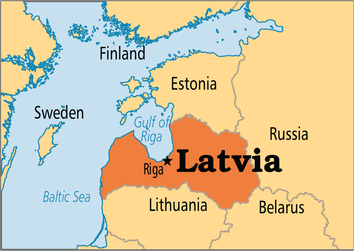
Latvia, as even the Latvians will admit, is not precisely the center of the universe. It’s the middle Baltic State, tucked between Estonia and Lithuania, and until this year, I would have been hard pressed to pinpoint it on a map of the world — or even, to be honest, a map of the Baltics. The capital, Riga, is a hot destination for Russian bachelor parties but hosts few American, British, or Spanish visitors. Yet in just a few days here, we’ve connected with various friends, some from Seville and some we’d recently met in Estonia, all of whom happened to be passing through Riga. Apparently, others do not share my difficulty in locating Latvia on a map.
Riga may be gaining popularity, but there is nothing mainstream about it. Oh sure, there’s a charming Old Town, a UNESCO World Heritage site with splendid Art Nouveau buildings, noteworthy art museums, even a TGI Friday’s. But scratch Riga’s conventional surface, and you’ll find much edgier stuff.
We started with the
Pauls Stradiņš Museum of Medical History
. Displays cover such health care high points as pre-historic skull drilling, nuns nursing victims of the black plague, straightjackets with shackles, medieval surgical implements, and an iron lung. For an extra 43 cents we were allowed into the basement for the special gastroenterology exhibit featuring large, colorful images taken during actual endoscopies and colonoscopies. How fun is that? The exhibit’s title (I am not making this up) was “Where the Sun Never Shines.” But by far the grisliest object we saw was the stuffed remains of
the two-headed dog
, the result of an experiment in which Soviet surgeon Vladamir Demikhov succeeded in joining two animals together. He advanced science considerably, paving the way for human heart transplants and earning acclaim in the international medical community. Dog lovers, however, tend not to be fans of his work.
Feeling the need for a cheerier setting, Rich and I headed to the
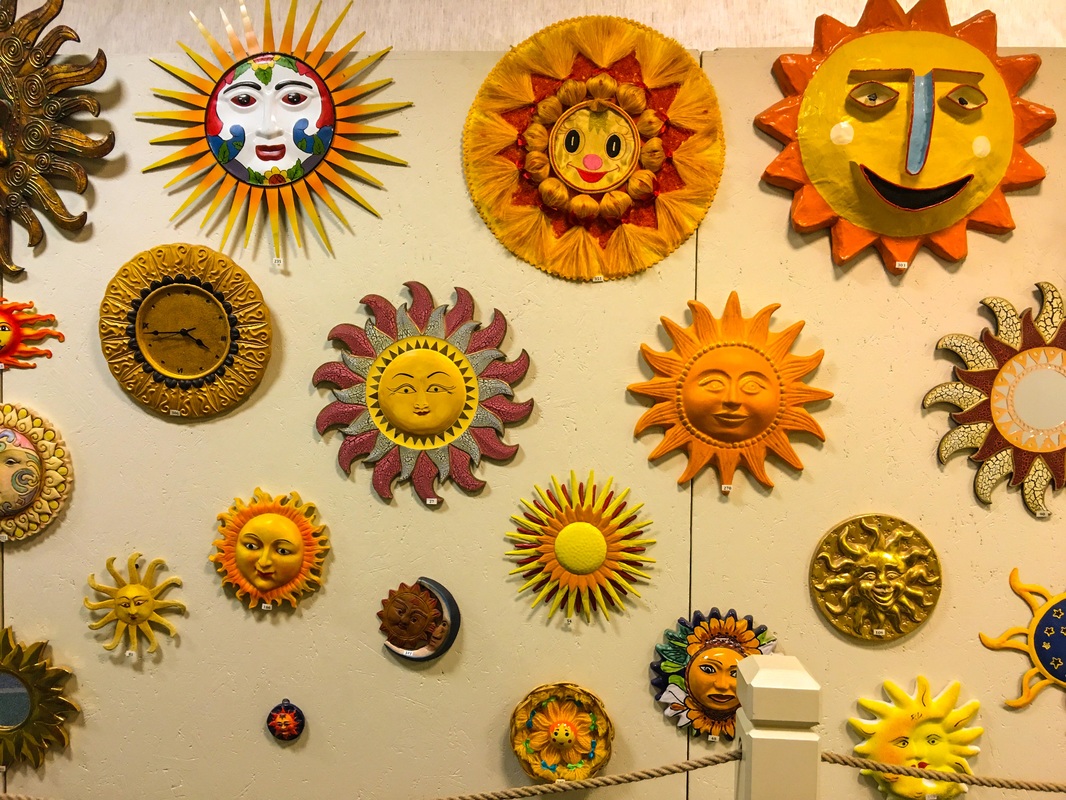
Sun Museum
, which turned out to be a random assortment of solar-themed art owned by a local woman named Iveta Gražule. It was like visiting that eccentric relative who collects umbrella cover sleeves or UFO memorabilia; you admire the perseverance but keep wondering why on earth anyone would do it. We were in and out in ten minutes.
I had higher hopes for
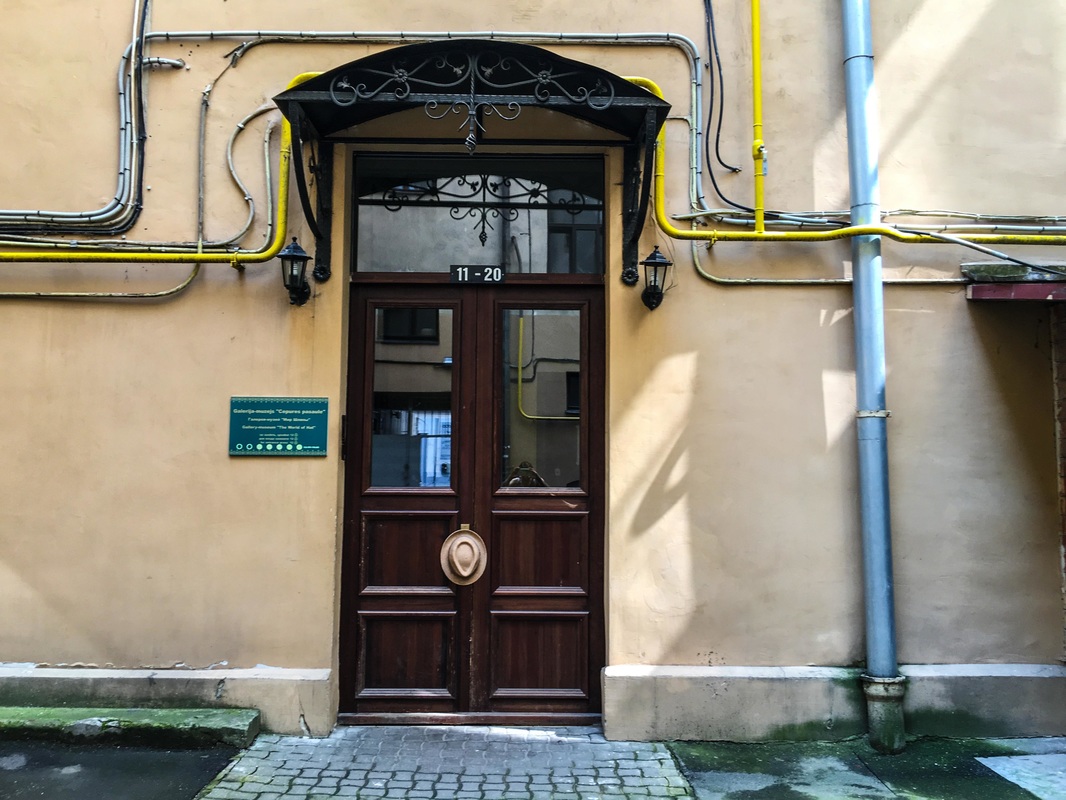
the World of Hat
, another private-collection-turned-museum, and one that we tracked down with great difficulty in an obscure courtyard. It was meant to be visiting hours, but no one answered the bell so we’ll never know what we missed.
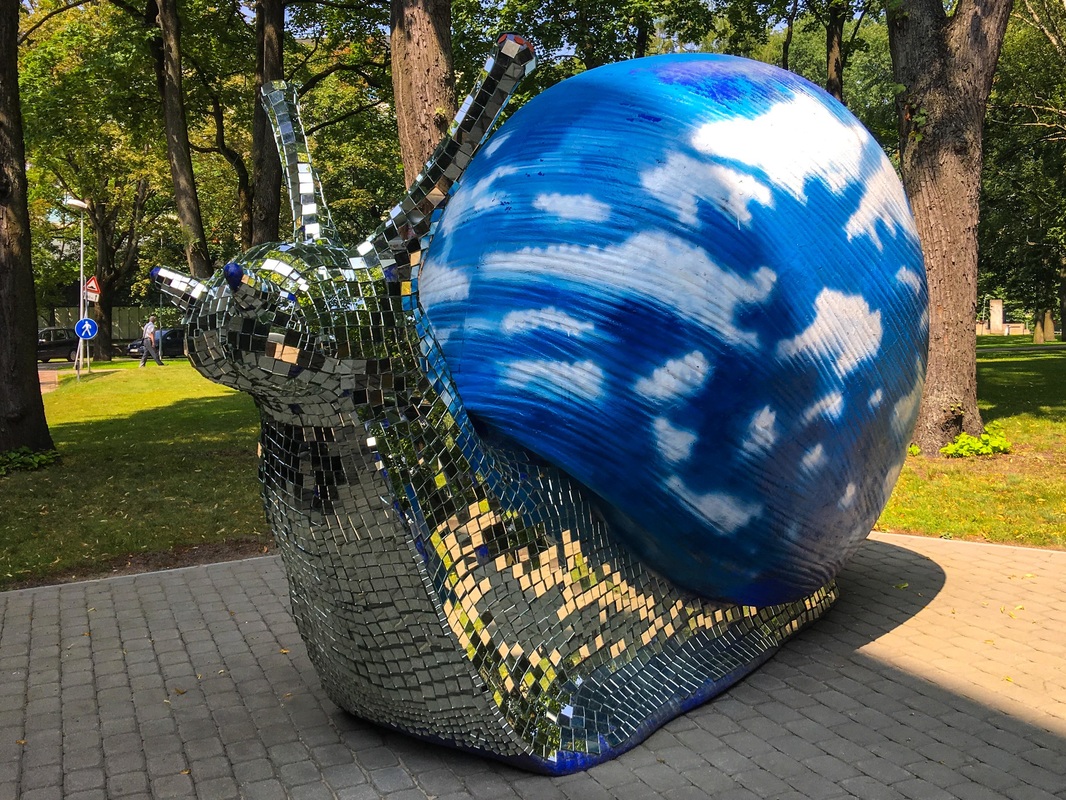
We then spent time admiring Riga’s giant snail, a relic of a 2014 campaign in which large plastic snails were placed on city sidewalks in hopes of stimulating interest in building a contemporary art museum. It failed utterly to achieve that goal, but residents had a marvellous time pushing the snails up and down the sidewalks and taking selfies with them.
Another famously unsuccessful effort was Riga’s
Hospitalis
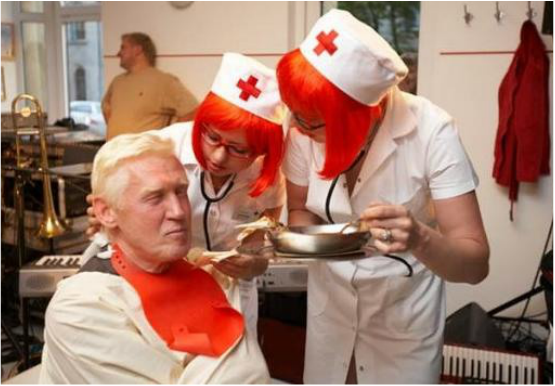
restaurant. Spaces were decorated like hospital suites, waitresses were dressed as nurses, and meals served on metal trays were eaten with surgical implements. If you paid extra and signed the necessary waivers, they would put you in a straightjacket and feed you. I can only assume this concept dining experience was a joint project with the Pauls Stradiņš Museum of Medical Horrors (I’m sorry, I mean History). Incredibly, Hospitalis is no longer in operation.
Far scarier and all too real is
the Corner House,
the infamous basement in which the KGB conducted interrogations, now opened as a museum. As the old joke goes, “The Corner House has the best view in Riga; from there you can see Siberia.”
But why simply observe relics from the past when you can have the full immersion experience in
a Soviet prison hotel
? A few hours from Riga, the former military prison Karosta offers tours that include being thrown in cells, yelled at by guards, and dragged outside to perform exercises. If you pay extra, you get to wear a prison uniform, spend the night on a wooden slab with a thin blanket, and suffer insults, interrogations, and punishments. “Not all of the guards are completely fluent in English,” one website notes. “American visitors are often surprised by the amount of abuse they receive.” The prison is, of course, said to be haunted.
“I take my students there,” a schoolteacher told me.
“How old are they?” I asked, aghast, imagining first graders handcuffed to radiators in an excess of verisimilitude.
“Teenagers. They love it.” She explained that locals born after the Soviet era are eager to discover how they would handle themselves under hardships like those suffered by their parents and grandparents.
Am I ready for immersion in the Soviet experience? “Don’t even think about it,” Rich told me. “I don’t care about the rest of it, but I am not spending the night on a wooden slab.”
“Don’t be silly,” I said. “You’d mouth off to a guard, and they’d have you out in the yard doing pushups till dawn.”
The Karosta prison hotel may not work for us, but if you’re looking for a truly unique place to rendezvous with friends, consider Latvia. Conveniently located between Estonia and Lithuania, this little country offers big opportunities to make memories that will last a lifetime.
THE PLAN: 3 MONTHS ON TRAINS & FERRIES WITH AN OPEN ITINERARY & SMALL SUITCASES. Distance cover
ed so far:
2648 km / 1645 miles.
Highlights have included zany
Amsterdam
, the German city of
Lübeck
on the edge of the Baltic Sea,
the Stockholm disaster
, the new foodie mecca of
Helsinki
, Finland, futuristic
Estonia
, and a surprisingly kookie
Riga
, Latvia. We’re now in
Kuldīga
,
a small town in the Latvian countryside. To follow our adventures as they unfold,
subscribe to this blog
, like
my Facebook page
,
and keep checking
the
map of our journey
.
Leave a Reply