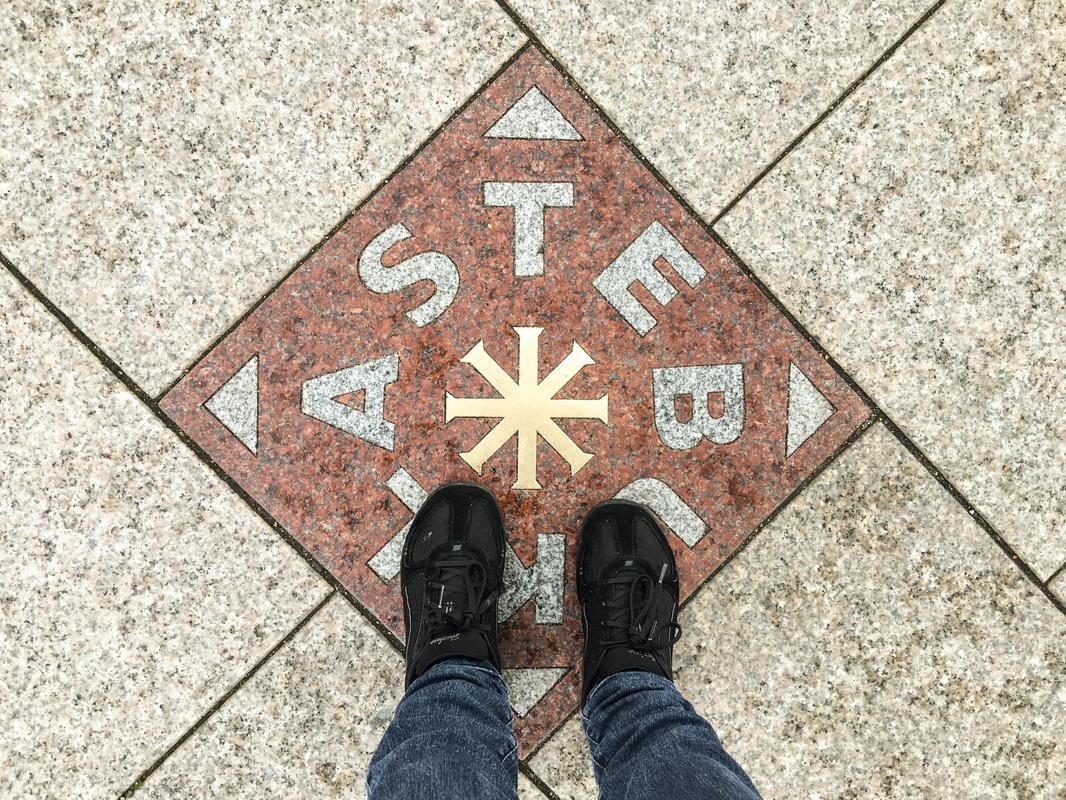
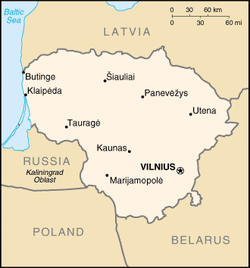
According to local legend, the Miracle Tile of Vilnius, Lithuania has the power to make wishes come true. Some say you have to stand on it, twirl around three times, jump in the air, and clap your hands to get your wish. Others suggest this tradition was started mainly to provide the locals with a little innocent amusement and has nothing to do with getting what you ask for. I’m not going into all the details of my experience but suffice to say that if you’ve been fretting about the long-term viability of the planet’s ecosystem, you can relax; it’s sorted. You’re welcome.
The Miracle Tile also marks one end of the longest human chain ever assembled. On August 23, 1989, two million people in Estonia, Latvia, and Lithuania — one quarter of the population of those three countries — joined hands in a 420-mile line running from
Tallinn, Estonia
through
Riga, Latvia
and ending (or starting, depending on your perspective) right on the Miracle Tile of Vilnius. The men, women, and children in that long line were protesting Soviet occupation, which had recently been revealed as the illegal result of secret protocols in the
Molotov–Ribbentrop Pact
between the Nazis and Stalin, who reached a clandestine agreement allowing Russia to occupy the three Baltic countries. This revelation provided legal justification for dismantling Soviet authority in the region, and on that day in 1989, two million people braved the wrath of a superpower to stand up for their freedom. By 1991 they had it. Was this the Miracle Tile at work? I’ll leave that for you to decide.
For some in the Lithuanian capital, freedom from the Soviets was only the beginning. On April 1, 1997, the residents of
Užupis
, a small, bohemian district tucked inside a loop of the Vilnia River, declared themselves the independent Republic of Užupis. They have their own flag, currency, constitution, president, anthem, and an army of 11 men; if you go there, you can have your passport stamped. The Republic of Užupis isn’t recognized by any official government, and no one (including, I suspect, the ringleaders) is quite sure where on the serious to tongue-in-cheek spectrum the whole enterprise falls.
One of the projects that brought the group together was convincing the city to enliven the landscape with a statue of the outrageous musician
Frank Zappa
. Saulius Paukstys, who spearheaded the movement, faced considerable resistance from authorities. “They said: ‘What has he got to do with Lithuania anyway?’ We said: ‘Nothing really.’ Then someone convinced them that Zappa had Jewish features and seeing as
Jewish history
is very important to Lithuania, they plumped for that.”
The residents of the Republic of Užupis are mostly artists, and playfulness and creativity are some of the tiny republic’s most cherished ideals.
The constitution
, drafted in a local bar, is a treat to read. Here are some of my favorite provisions:
Everyone has the right to make mistakes.
A dog has the right to be a dog.
A cat is not obliged to love its owner, but must help in times of need.
Everyone has the right to die, but this is not an obligation.
Everyone is responsible for their freedom.
As the republic’s first president, Roman Leleikis, explained at the time, “We’re trying to energize a community by asserting our independence. It’s very different from the independence gained in ’91, but we’re trying to foster the same spirit so that people can make things happen for themselves. That’s a trait they lost through 70 years of oppression.”
Today, the people of Vilnius
are
making things happen for themselves, and one way they’re doing it is through the sharing economy, with peer-to-peer transactions that link neighbors to neighbors, visitors to locals. You can rent lodgings from
Airbnb
, get around town with
Uber
or in a
City Bee
car, and now, thanks to the entrepreneurial spirit of a local chef named Ruta, you can share a meal in a private home via
EatWith
.
Rich and I signed up to go to Ruta’s home for a dinner made from homegrown vegetables and herbs, berries picked in the forest in the Baltic tradition, and seasonal ingredients from the market. Ruta’s training began in her grandmother’s kitchen. “For me, cooking became a way of making people happy,” she told us. “When I heard about EatWith, I knew I had to convince them that I should be part of that here in Vilnius.” The screening process was rigorous, but Ruta persevered and became the first — and so far, the only — EatWith host in Lithuania.
The dinner was delightful. Rich and I lingered long at the table with Ruta and her husband, Vidmantas, discussing everything from the state of the world to the ingredients in each mouthwatering morsel on our plates. As I dipped my spoon into the homemade coffee mousse, I thought about all the years of my childhood when I had stood in terror of the USSR and wished with all my heart that the Iron Curtain would come down. I don’t know how much of the credit belongs to the Miracle Tile, but however it happened, I am still astonished and deeply grateful that the Baltic States are enjoying their freedom, and I hope they will hold on to it for a very long time to come.
Soon we’ll be wrapping up our time in the Baltic States and heading south into Poland to start the second half of our trip. To date we’ve
cover
ed 2976 km / 1849 miles
,
mostly by train with a few ferries and the odd bus thrown in.
Highlights have included zany
Amsterdam
, the German city of
Lübeck
on the edge of the Baltic Sea,
the Stockholm disaster
, the new foodie mecca of
Helsinki
, Finland, futuristic
Estonia
, and a surprisingly kookie visit to
Riga
, the capital of Latvia. We spent a few days in the Latvian countryside, in the small town of
Kuldīga
,
then headed south to
Šiauliai, Lithuania
, where there appeared to be nothing to do — until there was too much to squeeze in.
We’re currently in Vilnius, the Lithuanian capital.
To follow our adventures as they unfold,
subscribe to my blog
, like
my Facebook page
,
and keep checking
the
map of our journey
.
Leave a Reply