It’s easy to become dazzled by Seville’s gorgeous architecture, passionate flamenco, great food, and vibrant street life. The city’s abundant charms and reasonable prices have made Seville the current darling of international travel, inspiring
Rick Steves’ new video
,
The Independent’s
“
20 Photos that Show Why Seville Was Voted 2018’s Top Place to Visit
” and, as I mentioned in
my last post,
the announcement that Seville is
Lonely Planet’s
#1 Travel Destination
of 2018. But to get acquainted with
Sevilla profunda
(deep Seville), you’ll need to explore the quirky, oddball places that don’t get mentioned in typical guidebooks. Want to have something special to write home about? Join me on a little visit to Seville’s weirder side.
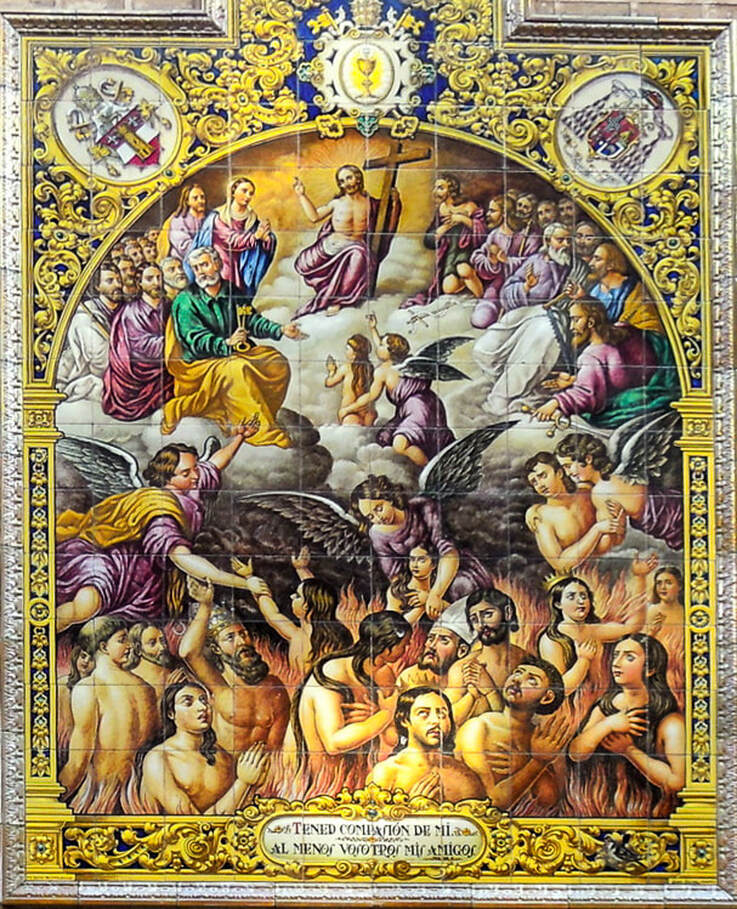
The Purgatory Tiles
I’d passed by the tiles on the outside of
San Pedro
’s church dozens of times before a Spanish friend said, “Can you find the bird in this scene of Purgatory? The artist always used to put one in. If you find it, they say you’ll be married within the year.” This feature wasn’t particularly useful to me, as I’d been married for nearly two decades at the time, but I stopped and took a closer look.
The thing that struck me most forcibly was the expressions on the faces of the naked people, who appeared to be, at most, mildly peeved about suffering the hideous torments of Purgatory, which according to traditional Church doctrine was where you went after death to atone for sins in hopes of gaining heaven.
Found the bird yet? No?
Click here.
Íñigo Lopes
’s Tomb
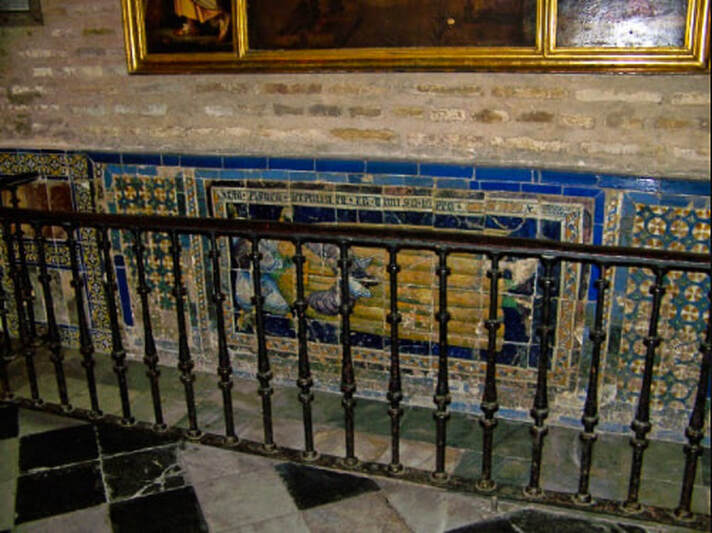
If you didn’t find the bird on your own, not to worry. There’s another church where you can hedge your bets about matrimony: the magnificent old
Santa Ana
across the river in the Triana district. A tomb built into the wall is said to be the final resting place of a
Puerto Rican prince
. For reasons that have been lost in the dim mists of antiquity, it’s believed that if you touch this tomb with the toe of your shoe, you’ll be married within the year. Needless to say the wall has been battered to bits by centuries of hopefuls. Eventually the priests got tired of replacing the tile and put up an iron railing — but positioned it just close enough that if you really stretch, your shoe can connect solidly with the side of the tomb.
Doña Maria Coronel
Three Miraculously Preserved Dead Bodies
Like many ancient Catholic cities, Seville maintains the somewhat ghoulish practice of publicly displaying the mortal remains of well-known religious figures. The most recent addition is
St. Angela of the Cross
in the
Instituto de las Hermanas de la Cruz
(Sisters of the Company of the Cross). In her youth, she was deemed too sickly to be accepted into any established convent, so she started one of her own and ran it until 1932, when she died at the age of 86. There’s lots of speculation about what they did to preserve her body, because she appears plump, rosy, and bursting with health under the altar in her chapel.
Another popular dead body is that of
San Fernando of Castile
, the king who was canonized for retaking Seville from the Moors in 1248. On his feast day, May 30, his corpse in its gold and crystal coffin is lifted out of the wall tomb and set up behind the altar of the Royal Chapel to preside over a mass celebrated in his honor. When the dignitaries depart at the end of the service, everyone else rushes forward for a closer look at his desiccated, blackened remains.
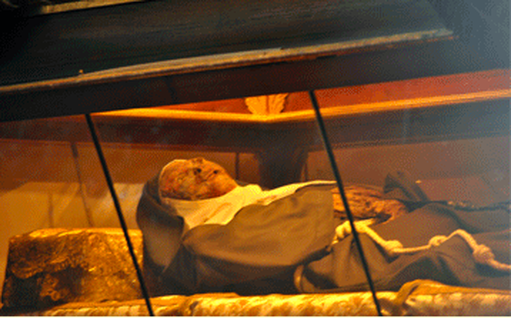
On December 2 you can view the mummified corpse
Doña Maria Coronel
in the chapel of the convent she founded, Santa Inez (St. Agnes). As a girl, she was very beautiful and found herself relentlessly pursued by King Pedro the Cruel, a sort of fourteenth century Harvey Weinstein who wouldn’t take no for an answer. When Pedro finally cornered her in a kitchen (brace yourself, this part’s a ghastly shocker) she dashed a pan of boiling oil in her own face to make herself unattractive to her pursuer. She died in 1411 at the age of 77. Her remains are distinctly creepy.
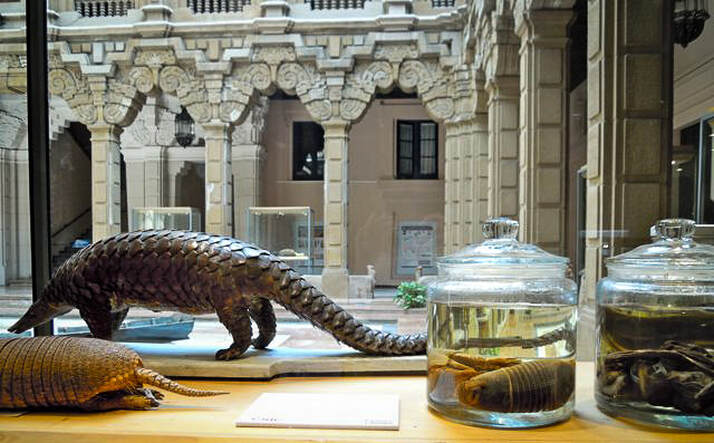
The Little Science Museum of Horrors
Part mad scientist’s laboratory, part animal morgue,
La Casa del Ciencia
(House of Science) displays glass jars of bats and other beasts, a rare Iberian lynx with his eyes sewn shut, and various large birds laid on slabs with old-style mortuary toe tags tied to their feet with string. Housed in the dramatic 1929 Peruvian Pavilion in Parque Maria Louisa, it makes a pleasantly macabre side trip when visiting the Plaza de España.
I’ve been exploring Seville since 2001, and it never ceases to amaze, bewitch, and entertain me. The city has more legends and lunacy than I could possibly have imagined and I’m always discovering new stories. Mainstream tourist guides are a great way to find the major points of interest, but
Sevilla profunda
has plenty of weird to share with those who choose to wander down its back alleyways.
To Continue Your Offbeat Tour of Seville
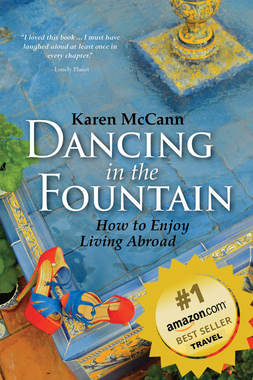
When Rich, our dog, and I moved to Seville from Cleveland more than a dozen years ago, we had no idea what we were getting ourselves into. It’s been quite a ride. For an inside look at the city — its ancient traditions, off-the-wall legends, and ability to embrace life’s mysteries — check out my memoir
Dancing in the Fountain: How to Enjoy Living Abroad.
“I loved this book,” wrote
Lonely Planet.
“
I must have laughed aloud at least once in every chapter
… The advice in the book is terrific.”
“A delightfully well-written true-life adventure story
,” says New York Times bestselling author Chris Brady. “McCann’s writing is
inviting, immediately charming, and constantly entertaining
.”
Look Inside “Daincing in the Fountain”
Subscribe to my travel blog

Leave a Reply