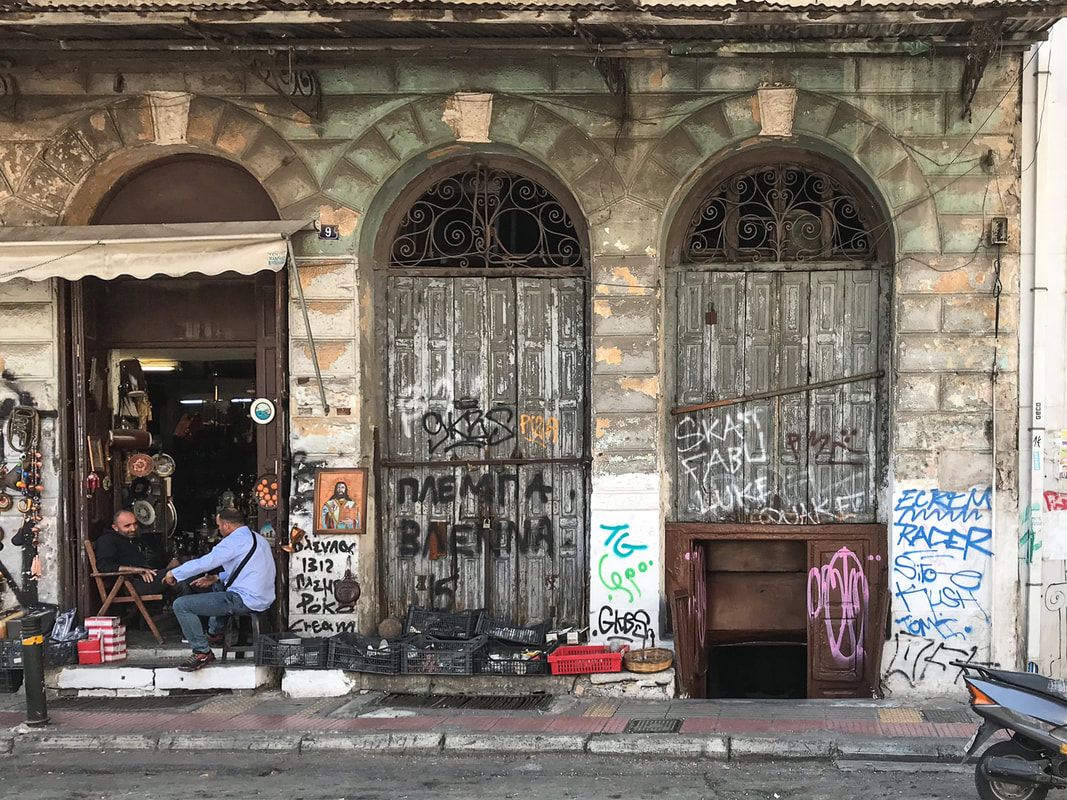

“It has to be right here!” I exclaimed for the tenth time. Yet again, Rich and I walked up and down the sidewalk, around the corner and back, on an obscure street in downtown Athens. The helpful little GPS map on the phone showed a blue dot (us) right next to the red pointer (the alleged taverna). We’d been shown the place just two days earlier. Had it somehow vanished since then?
It wasn’t until someone trotted down the steps, ducking under the lintel, that I realized I was looking directly at one of the two doorways that give the restaurant,
Diporto
, its name. (Still searching? It’s the low brown opening with the pink graffiti.) I felt as if I’d discovered Narnia at the back of the wardrobe.
“Quick, let’s go in before it disappears again,” I urged.
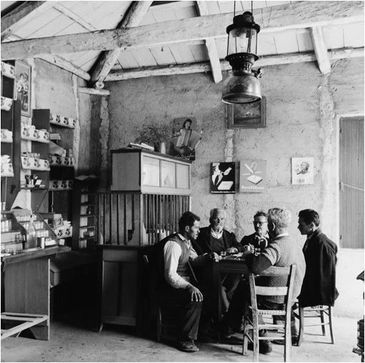
The kind of tavernas I remember from back in the day.
The Diporto is without doubt my favorite eatery in Athens. To be fair, the actual food isn’t exceptional, but here I found the old-school atmosphere I remembered from my visit to Greece as a teenager in 1972. In those days, tavernas were masculine enclaves where the occasional young hippies who passed through were viewed as amusing curiosities and treated with traditional Greek
xenia
, the generosity and courtesy shown to those who are far from home.
From the moment we entered the Diporto, our host
, Kyr. Mitsos,
refused to let little things like no written menu and no English stand in the way of dishing out generous helpings of
xenia
. As we settled at one of the wooden tables, he brought over a chunk of crusty bread and several sheets of paper that would serve as plates and napkins. Then he fetched a pair of glasses and a large tin cup set in a plastic container of ice. I picked up the cup and sniffed.
“Water?” asked Rich.
“Retsina.”
Retsina is a hearty white wine that carries a hint of pine, a flavor popularized 2000 years ago when Greeks were sealing their wine jars with pine resin. It was the perfect complement to the food that began to arrive: crisp sardines, chunky vegetable stew, garbanzo bean soup, and yellow split peas with onions and olives. OK, to be honest, the split peas were a bit underwhelming, but everything else was great — not Michelin-star great, but comfort-food-at-grandma’s great. When we’d eaten our fill,
Kyr. Mitsos
came over to the table, pulled out a chair, and sat down. He frowned in thought, then wrote a number — our bill — on the paper covering the tablecloth.
Xenia
is considered a two-way street, an obligation on both sides to make the guest-host relationship work. During our time in Greece, Rich and I did our best to express our genuine appreciation to our kind hosts at the Diporto,
our Airbnb
,
our EatWith dinner
, the
Taste Athens Food Walk
, and everywhere else we went. While we rely heavily on mutual goodwill to get us past the inevitable faux pas that arise in a foreign social setting, we also do a little advance research in an effort to keep personal embarrassment and international incidents to a minimum.
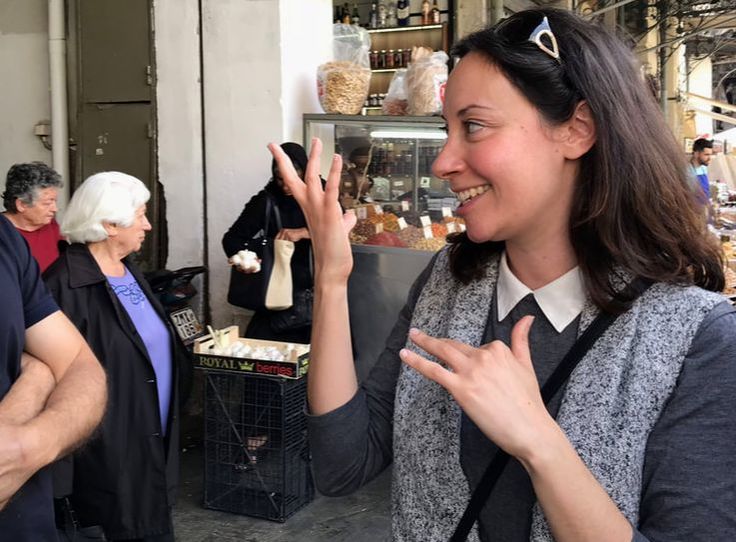
I tend to talk with my hands, so I paid close attention to Rich’s latest find, the
Culture Crossing Guide
, which explains that certain gestures, considered perfectly innocent back home, cause deep offense among Greeks. For instance, while a thumb’s up is OK, a thumb’s down is most definitely not acceptable in polite society. And apparently holding up your hand with the palm facing the other person is a good way to get into a bar fight. Even the simplest non-verbal communication becomes tricky when a single downward nod means “yes” and a single upwards nod means “no.” To add to the confusion, the Greek word for “yes: (ναι) is pronounced née, and the word for “no” (όχι) is pronounced oh-he, sounding much like okay. As you can imagine, the possibilities for misunderstandings are endless.
Seeking further guidance, I recently downloaded the updated Kindle edition of one of my old standbys, the book
Kiss, Bow, or Shake Hands
: The Bestselling Guide to Doing Business in More than 60 Countries.
Even if you’re not in town on business, you’ll find a wealth of useful advice and information, such as: “After giving or receiving a compliment, Greeks sometimes make a puff of breath through the lips to ward off the ‘evil eye.’” I love this idea and fully intend to employ it in any situation in which I feel there’s a risk that the evil eye may fall on me.
Perhaps the richest information can be found in the online
Cultural Atlas
. Here’s one of my favorite bits: “To fully understand the Greek communication style, one must appreciate their love for discussion. ‘
Kefi
’ refers to the contentment, bliss and joy one feels when a moment is so overwhelmingly enjoyable they are transported by it. The Greeks recognize
kefi
arising when an engaging conversation with good company becomes particularly delighting and fulfilling.”
Rich and I enjoyed a lot of
kefi
during
our most unplanned, disorganized trip ever.
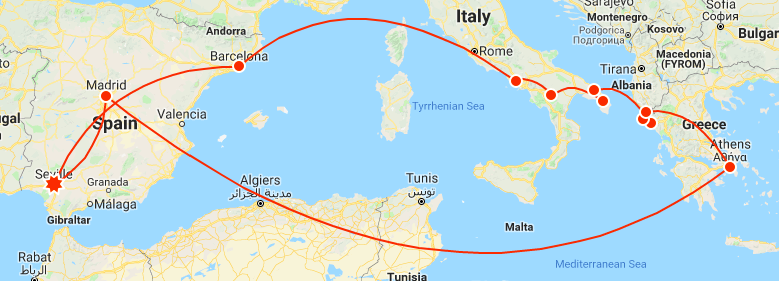
One of the main reasons we travel is to be transported by unexpected delight at the sudden confluence of good company and good conversation — if possible combined with good food and a cool bottle of retsina. Last night we flew back from Athens to Spain, drawing this adventure to a close, but we’ll carry the memories forever:
Anna and the pay-as-you-go elevator
,
Rich’s Albanian haircut
, the disappearing Diporto, and the joys of
xenia
and
kefi
. And I still have stories from the trip to share; watch for my upcoming post: Dive Bars of the Mediterranean.
Thanks for joining us on the journey!
Sign up here for updates!

Leave a Reply