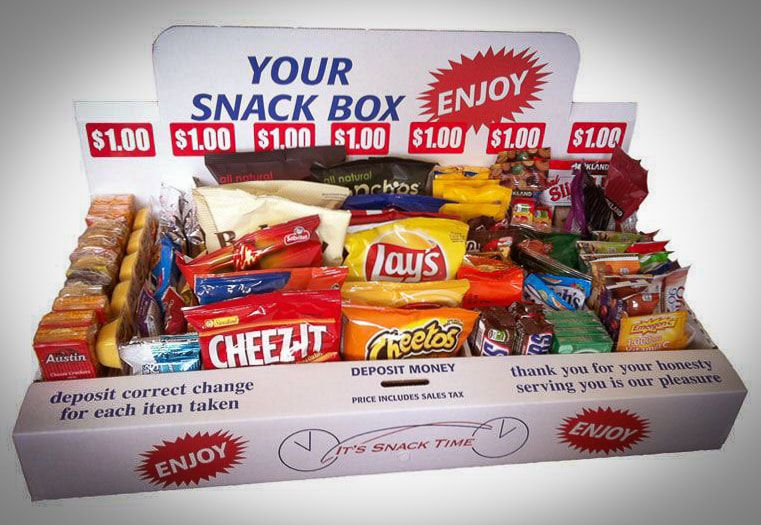



Many years ago in California, a salesman showed up in my office holding a cardboard tray enticingly stuffed with cookies, candy bars, and chips.
“I’m going to leave this in your break room,” he said. “No, I don’t want any money up front. We’re
HonorSnacks
. We trust that when one of you takes something, you’ll deposit the correct change.”
“What if people don’t leave the money?”
“In my experience, people are basically honest.”
I rolled my eyes. Yes, we were reasonably honest folks. But (and I did try to explain this to him) we were also young, overworked graphic artists with deadlines that required very long hours at our drawing boards. The packet of Cheetos grabbed at midnight, and virtuous intentions to settle the tab later, would inevitably be forgotten in the mad rush to get the next project out the door.
“It’ll be fine,” he insisted.
You won’t be surprised to hear that three weeks later the HonorSnacks guy stood glowering in my doorway, brandishing a battered, empty cardboard tray and a small handful of change that was far, far short of what was due.
“You slit your own throats,” he growled.
I was reminded of the HonorSnacks incident as I listened to Rich describing what he’d learned about ethics in
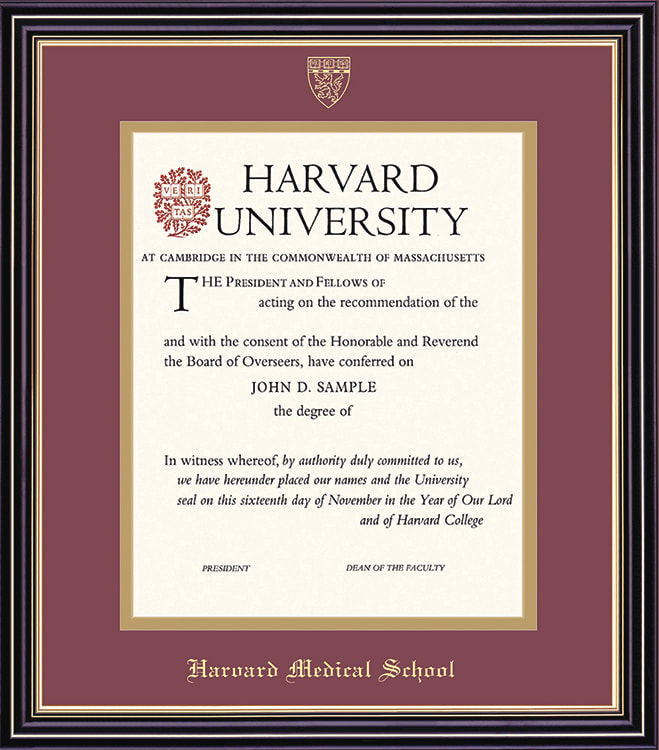
Harvard University’s Justice course
. He’d recently completed this popular 12-week online study program, which is free if you don’t want the Harvard diploma for your wall. I offered to use my graphics skills to create a fake one for him, but instead he’s simply going around telling everyone he graduated from Harvard.
“What’s the take-home message from the course?” I asked.
“We studied political philosophy and ethical theory from Aristotle onwards,” he said. “It may sound like esoteric stuff. But as the teacher pointed out, we’re faced with ethical questions every day of our lives, small ones and big ones.”
We all know ethics can be slippery. My favorite definition comes from former Supreme Court Justice Potter Stewart: “Ethics is the difference between knowing what you have a right to do and what is right to do.”
“The professor,” Rich told me, “emphasized the difference between consequential and categorical morality.”
“Huh?”
“Consequential morality is all about the outcome. The ends justify the means. It’s OK to rob a bank to keep your kids from starving. Categorial morality says that some things are just plain wrong, like murder, and can’t be justified under any circumstances. It’s not OK to murder your great-aunt to get money to feed your kids.”
“So it’s about what you’re prepared to do to achieve something?”
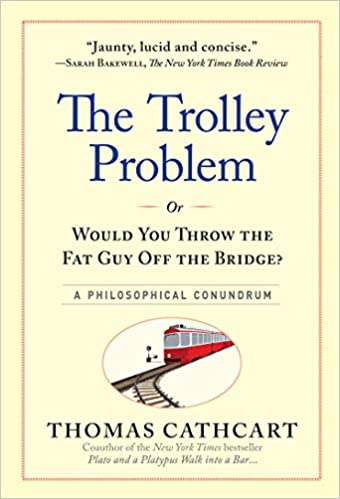
“In part. There’s a classic moral dilemma known as ‘The Trolley Problem.’ Imagine you’re on a bridge over some tracks and see a runaway trolley that’s about to kill five people. A fat man is standing next to you, and you realize if you push him off the bridge, he will fall on the track, and his massive body will derail the trolley car, saving five lives. The question is, would you kill the fat man?”
“Well, for a start, I doubt I’m strong enough to heave a fat man over the railing. And I am positive that I could not properly calculate his trajectory to be sure that he’d fall on the track in a way that would derail the trolley.”
“My point — and I do have one,” said Rich, “is that from the consequential ethics standpoint, the outcome would justify the killing, but categorical thinkers wouldn’t agree.”
My head was beginning to spin with the effort to grasp all this. But in a vague way I saw what he meant. It’s about different ways to calculate what you’re justified in doing in order to achieve your goals. For instance, Rich and I recently resorted to a little trickery to obtain Covid tests. Was that morally wrong?
As you may have heard, Spain has lost its “safest destination in Europe” status and is now swamped with cases — 161,000+ on December 30th alone — although hospitalizations and deaths remain mercifully low. Masks are now mandatory outdoors unless you’re eating, drinking, doing sports, or sunbathing. (Yes, they have their priorities straight. No facial tan lines!)
Some areas have curfews and other restrictions, but Andalucía’s officials believe we should eat, drink, and be merry now — then cope with the fallout after January 6, when Three Kings Day marks the end of the holidays. In Seville, the shopping, dining out, and partying continue unabated, and no one wants to cancel the Three Kings parade or repeat last year’s compromise — the trio passing overhead in a hot air balloon.
Of course, everyone’s aware of the Covid risk and self-testing like mad. Home test kits, which were plentiful in Seville a few weeks ago, grew desperately scarce by December 20th.This put me in a bit of a pickle, as I’d asked my 17 guests to self-test (twice, if possible) before coming to lunch on Christmas. Rich and I had ten kits on hand already, but we began scouring the city for more. We finally found one pharmacy that had some but would only sell us five. We bought those and kept looking, unsuccessfully, until I had my brilliant idea.
“Go back to where we bought those last tests,” I said.
“But they’ll recognize me,” he objected.
“Not if you’re in disguise.”
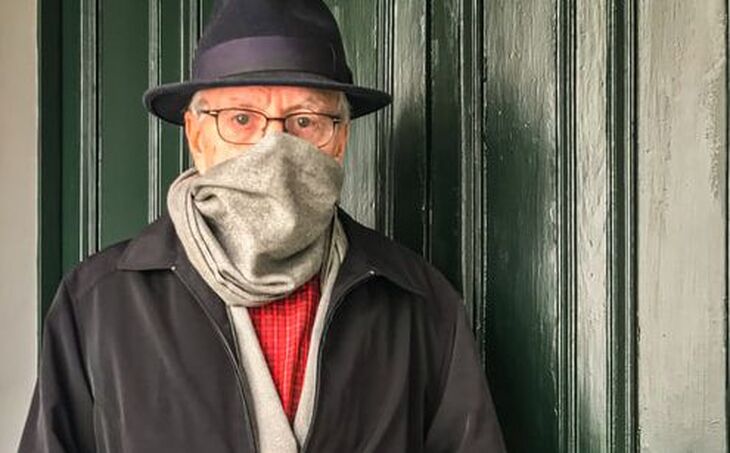
So Rich put on a different jacket, a baseball cap in lieu of his trademark fedora, his other glasses, and my red scarf — and walked out of that pharmacy with five more tests. He is still basking in the glow of carrying off a successful clandestine mission.
From the standpoint of consequential ethics, his pharmacy caper was fully justified. Technically, the categorical thinkers might say we didn’t have a right to those test kits, but Rich and I felt that making sure our guests were safe was a moral imperative. And luckily, additional test kits were soon shipped to pharmacies throughout the city, so nobody went without.
From Aristotle to Potter Stewart to all of us, people have spent thousands of years trying to define what’s right, and it never gets easier. To me, the best starting point is considering the common good. And in this era of FOO (Fear of Omicron), the common good calls for doing our best not to catch or spread Covid. So Rich and I are voluntarily isolating at home for a few weeks. We’re going out for walks, shopping, even having an occasional coffee in an outdoor café, but we’re not sitting barefaced within contagion distance of others. I’m enjoying the time to paint, write, do jigsaw puzzles, make comfort food, and solve TV mysteries.
Naturally, Rich has jumped into a new study project: pigeons. His conversation is studded with such gems as “Did you know pigeons can see in color? And they can recognize human faces in photographs!” Yes, it’s pretty thrilling stuff. Watch for an in-depth post on pigeons soon. In the meantime, stay safe, be kind, and just say “no” if the HonorSnacks guy ever shows up at your door.
If you’re not already on my mailing list,
sign up today and get a
free copy of my book
Seville’s New Normal
in Microsoft Word.
YES! SEND ME THE FREE BOOK & UPDATES
EXPERIMENTS IN CREATING NEW NORMALS
WHAT I LEARNED IN AMERICA’S HAPPIEST CITY
IS TRANSYLVANIA SAFE? IS ANYWHERE?
Leave a Reply