






As Silicon Valley’s wealthiest techies glance at the calendar and wake up to the fact the grim reaper may someday be heading their way, they’ve started pouring serious money into cutting-edge longevity research. The result is a raft of companies such as the Methuselah Foundation, which aims to make “90 the new 50 by 2030.” I’m in! Let me know when you work out the details, guys.
Nobody has drunk the longevity Kool-Aid quite as deeply as software developer Bryan Johnson, who sold his company for $800 million and currently spends $2 million a year on his body. Now 48, Johnson’s goal is to have the brain, heart, lungs, liver, kidneys, tendons, teeth, skin, hair, bladder, penis, and rectum of an 18-year-old. And he’s willing to do absolutely whatever it takes to get there.
Like what? Well, he’s installed a medical suite in his home and assembled a team of more than 30 healthcare professionals for the all-consuming project he calls Blueprint. He gets up at 5:00 every morning and downs two dozen supplements and medicines. After working out for an hour, he breakfasts on a smoothie laced with such yummy ingredients as cocoa flavanols and collagen peptides, the first meal in his all-vegan, precisely 1799-calories-a-day diet.
He monitors every bodily function you can think of, and quite a few you really don’t want to contemplate. His doctors perform a constant stream of medical tests and treatments. To keep his skin supple, he gets weekly acid peels and laser therapy and avoids the sun. He goes to bed at exactly the same time every night, alone, after wearing blue-light blocking glasses for two hours.
Yikes! Johnson may have the liver of an 18-year-old, but he has the lifestyle of someone who’s pushing 100. Will he live longer — or will it just seem like an eternity?
I have promised myself that I will never go down this road, even if I win billions in the El Gordo lottery (which is unlikely to happen, as I haven’t bought a ticket). If I had an extra $2 million a year, monthly colonoscopies would not be high on my splurge list. Johnson, however, is keeping a very close eye on his GI tract. And as wacky as that may seem at first, there are sound medical reasons we should all be giving a little extra love to that part of our anatomy. We now know our network of innards plays such a vital role in our physical and psychological functions that scientists have started referring to it as our “second brain.”
“Although it can’t compose poetry or solve equations,” observes the Harvard Medical School newsletter, “this extensive network uses the same chemicals and cells as the brain to help us digest and to alert the brain when something is amiss.”
We tend to think our emotions start in our minds and hearts then head south to our stomachs, which then respond with nervous collywobbles, cozy warmth, or gut instincts we’d be fools to ignore. In fact, the action often starts in the GI system itself, which then communicates with the brain, nervous system, and our fight-or-flight hormones. The gut’s 500 million neurons hold 50% of our body’s dopamine, a chemical messenger communicating feel-good sensations, and 90% of our body’s serotonin, which plays a key role in such essentials as mood, sleep, memory, perception, and sexual desire.
Wow, no wonder Johnson wants to know what’s going on in there!
via GIPHY
Who knew keeping our tummies happy was so important?
Now that word is out about the second brain in our midsections, experts are rushing to provide advice about how to keep them in tip-top shape. Their suggestions aren’t very startling. Consume more plants — preferably 30 different kinds a day. (Seriously?) Eat fermented foods, such as yogurt, kefir, kimchi, and sauerkraut. (OK, I didn’t expect that one.) Exercise. Sleep. Hydrate. (And before you pour yourself a glass of water, read my post “
Spanish scientists find beer rehydrates better than water
.”) Avoid antibiotics whenever possible. Reduce stress.
As usual, being told I need to reduce stress instantly raised my anxiety level and made me think, “OK, sure, great idea. How?” No life is worry-free. And one glance at the day’s headlines generally leaves my stomach in knots. I already take regular news fasts; what else can I try?
A new study in Finland
and
decades of research in Japan
suggest there’s a powerful amount of stress relief to be found by hanging out with trees.
The Japanese call it “forest bathing” (
shinrin-yoku
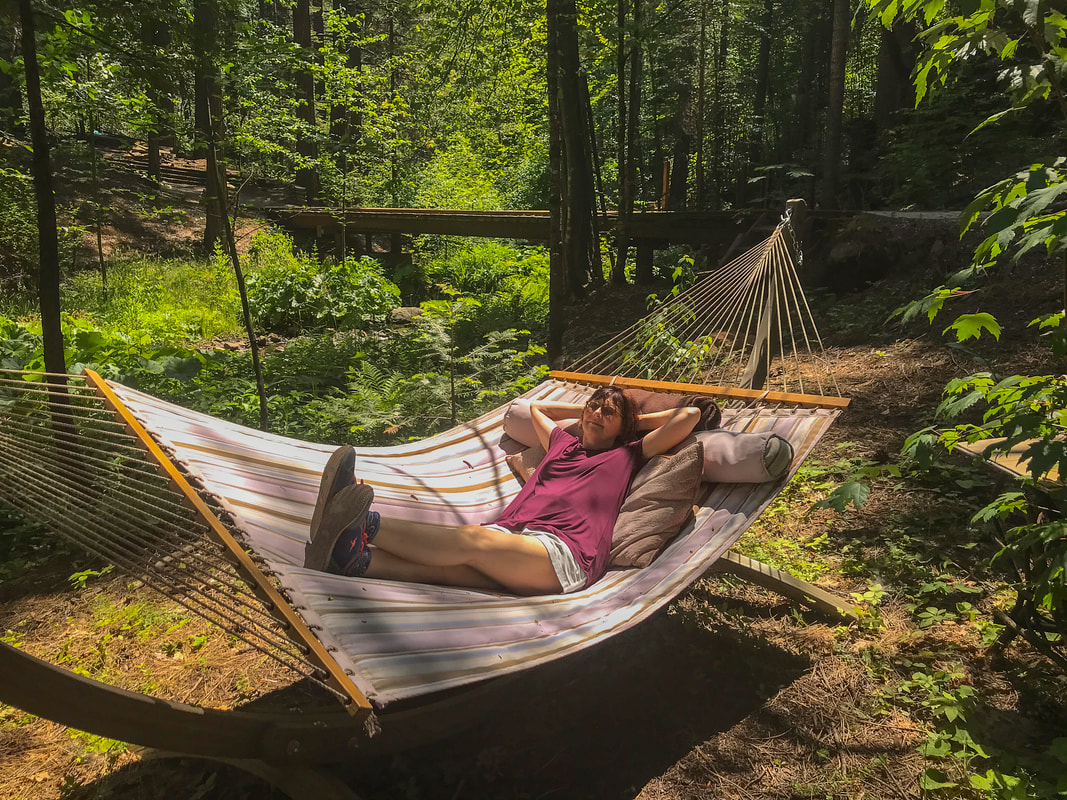
). You spend time in a park, woods, or other greenspace, switching off your phone and quieting your breathing so you can really look around and be present to the moment. “Listen to the wind and taste the air,” advises Tokyo medical professor Qing Li, president of the Japanese Society of Forest Medicine. “The art of forest bathing is the art of connecting with nature through our senses.” (Don’t worry, it doesn’t involve taking off your clothes and jumping in water. It’s metaphorical bathing.)
You may be tempted to dismiss this as a bunch of woo-woo, tree-hugging nonsense, but there’s plenty of hard evidence of the therapeutic benefits. The new Finnish study, for example, demonstrated that people who went to a park or other leafy place three or four times a week were able to significantly reduce their use of medications for conditions closely linked to stress: anxiety, asthma, depression, high blood pressure, and insomnia.
Just living near trees can boost our wellbeing. A
2016 study
of 100,000 women tracked the amount of greenspace surrounding their homes and matched it with health changes over a period of eight years. Women surrounded by the most greenery lived 12% longer — and had better mental wellbeing.
“If forest bathing was a pill, drug makers would be touting it as the next wonder drug,” says psychologist Jason Holland.
This is all wonderful news for travelers, because just about any trip includes free access to leafy plants, whether in an urban park, uncharted wilderness, or the kind of gorgeous woodland trails featured in articles such as
15 Best Spots for Forest Bathing Around the World
. Wherever we go, we can connect with the natural world, recover from the discombobulation of the journey, and soothe both of our frazzled brains.
In today’s crazy-making society, it isn’t easy to find a path to serenity and good physical and mental health. When Bryan Johnson plunged into his extreme makeover, he was overweight, overwhelmed, and deeply depressed. Today, he feels he’s at the top of his game and is excited to be pioneering groundbreaking longevity research. While some of his doctors consider the gains more modest and incremental, Johnson insists, “For every 365 days, I age 277 days.”
I respect Johnson’s dedication but frankly, he lost me at “gets up every morning at 5:00.” And then there are all the pills and procedures he endures every day and the lack of spontaneity his strict regimen requires. None of that works for me. My goal is to age gracefully and realistically, like actress Cherie Lunghi. “I can honestly say I love getting older,” she once remarked. “Then again, I never put my glasses on before looking in the mirror.”
THAT WAS FUN. WANT MORE?
Subscribe to receive notices when I publish my weekly posts.
Just send me an email and I’ll take it from there.
[email protected]
Curious?
Enter any destination or topic in
the search box
below
. If I’ve written about it, you’ll find it.
And be sure to
check out my
best selling travel books
here
.
YOU MIGHT ALSO ENJOY
HOW TRAVEL KEEPS OUR SYNAPSES YOUNG
DON’T WORRY, IT’S DISTRACTION, NOT MEMORY LOSS
SPAIN SAYS: BEER HYDRATES BETTER THAN WATER

Leave a Reply