
“Nothing is permanent in this wicked world — not even our troubles.”
— Charlie Chaplin
“I always feel younger here in Seville,” Rich said at breakfast Friday morning. My husband looked remarkably chipper for a man who had been out till all hours watching live cabaret in an old warehouse on one of the city’s more obscure back streets. And why wouldn’t he? According to recent research,
novel experiences abroad fend off the effects of aging
. If so, I’m all in.
The researcher, Edith Cowan University’s Fangli Hu, says it all comes down to entropy. Digging deep into my hazy memories of high school science classes, I recalled that entropy refers to the tendency of the universe to unravel into chaos then hurtle inevitably towards death. How does that help us exactly?
According to Hu, positive new experiences build physical, emotional, and psychological resilience. More resilience means we’re less jittery. And when we’re calmer, she explains, “Organs and tissues can then remain in a low-entropy state.” Meaning we aren’t plunging quite so rapidly into the whole chaos-hurtling-toward-death scenario.
And if I say so myself, Rich has a gift for throwing himself into novel experiences … and carrying me along with him.
The health benefit of novelty is excellent news for those of us who live abroad. Because every day our brains are stretched like Silly Putty.
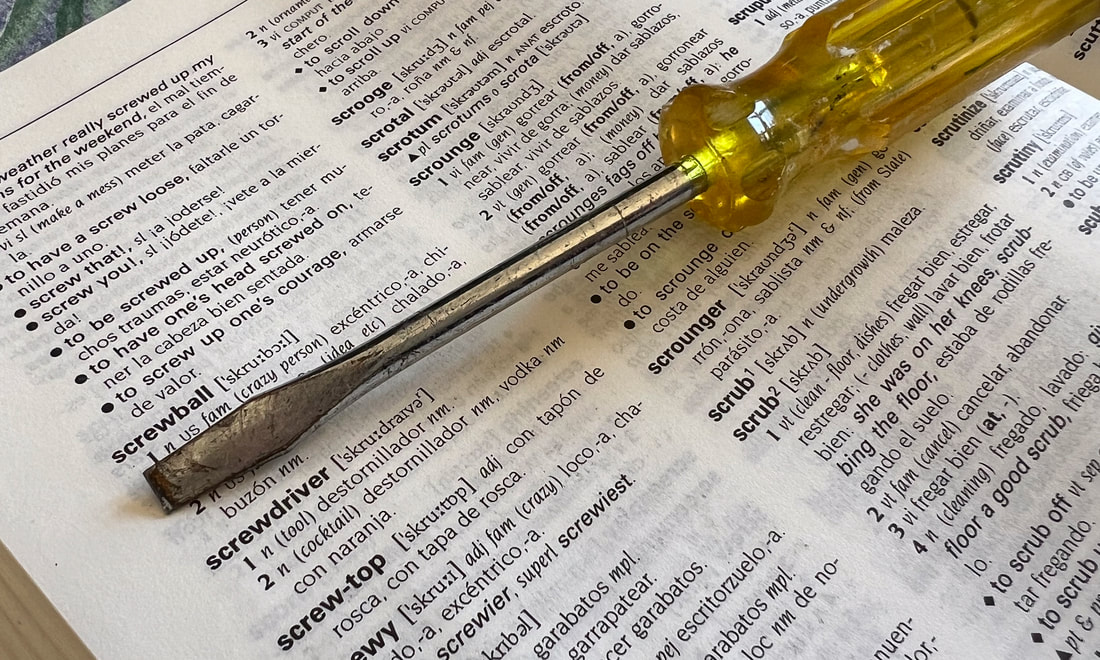
Rich often illustrates this point with the Screwdriver Story. During our very earliest days in Seville, he needed this simple tool for a minor repair and looked up the Spanish word in his dictionary (this was in the dark days before smartphones). He then walked to the hardware store muttering to himself, “
destornillador, destornillador, destornillador,
” ignoring all the odd looks he was getting from fellow pedestrians. Stepping confidently through the door, he strode like a lion to the counter.
And that’s when his mind went completely blank. Groping desperately, he found something that sounded almost right and blurted out, “
Ordenador
!” The Spanish word for computer.
Confusion reigned. His attempts to elucidate and pantomime only made things worse. Eventually he fled, returning home to consult the dictionary before trying a different hardware store. He never showed his face in the first one again.
Now, a pessimist might consider this a high-stress, entropy-boosting situation. To an optimist like my husband, it was exhilarating.
“In these situations,” he explains, “you’re not on automatic pilot. Everything is a challenge. Every day is full of accomplishments.” Eventually, he did manage to return home with a screwdriver. And by now this small purchase had taken on mythic significance: it wasn’t just something to check off on his to-do list, it was a triumph.
Filling your life with such modest but thrilling victories helps you feel more confident, less stressed, and — according to Hu — better able to fend off that old devil entropy a bit longer.
So if stress is bad for our longevity, where in the world can we go to find a relaxing, life-prolonging haven?
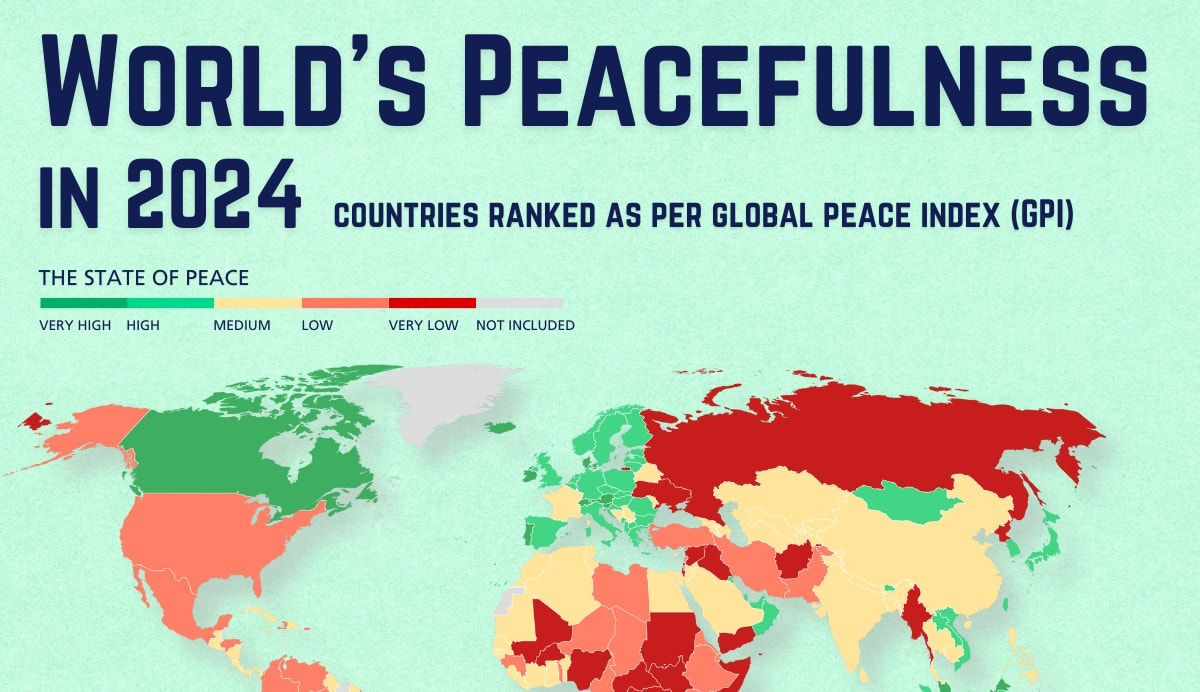
I decided to look up the Global Peace Index for 2024.
(Find the entire list here.)
Even in these troubled times, some nations still manage to achieve stability and tranquility, starting with these standouts.
Iceland
Ireland
Austria
New Zealand
Singapore
Switzerland
Portugal
Denmark
Slovenia
Malaysia
This is Iceland’s 17th year in the top spot, thanks to a small, close-knit population, a robust economy, and so little crime cops don’t carry guns.
Out of 163 countries on the list, Spain came in at a respectable 23rd, while the US showed up at 132nd — just above Iran and Lebanon. I suspect if the poll was taken this week, we might score even lower on the tranquility scale.
Don’t get me wrong — America is doing lots of things right these days. We have the lowest unemployment in half a century, slower inflation, a manufacturing boom, record-breaking gains in the stock market, and crime plummeting to historic lows. “
The American economy has left other rich countries in the dust
,” says Zanny Minton Beddoes, editor-in-chief of
The Economist
. “A relentless dynamism is the essential characteristic of the American economy and the ultimate force propelling it forward.”
But while relentless dynamism is great for our economy, it does nothing to soothe our collective nerves, frayed by constant upheaval at home and abroad. American’s organs and tissues are clearly in a high-entropy state right now.
Is it any wonder that the latest polls show 50 million Americans (15% of the population) are currently planning to move overseas?
Not everyone will follow through, of course. But it’s easy to see the attraction of a less stressful environment. I don’t know how life arranges itself in Iceland, but I can tell you that in Seville, the pace is slower and far more civilized.
Here, very sensibly, the day revolves around the twin pleasures of food and conversation.
First breakfast
is at home with family and typically includes
café con leche
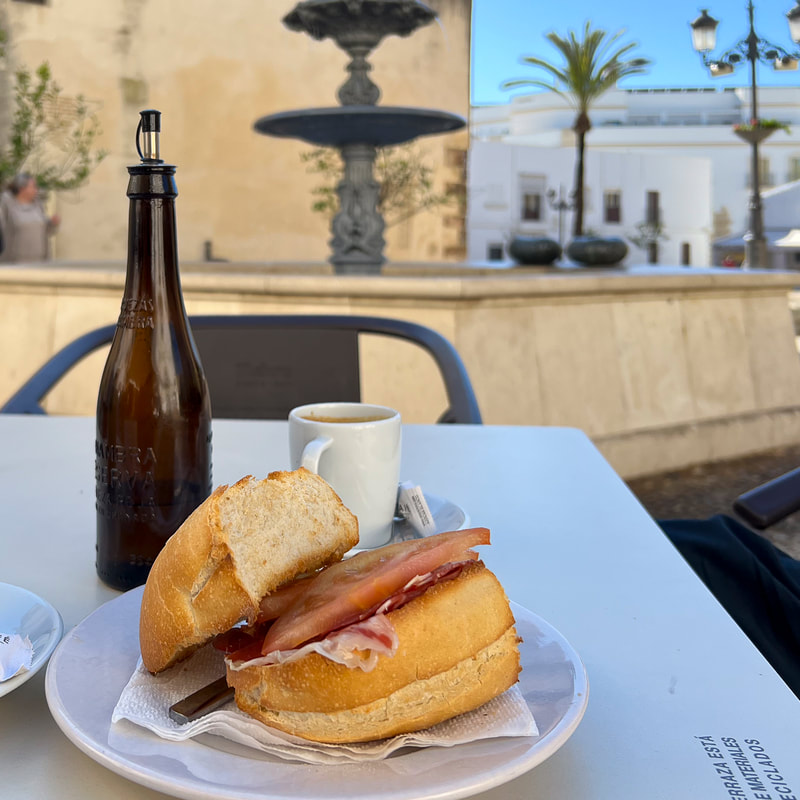
(a small, strong coffee with milk) and toasted baguette with a drizzle of good olive oil and slivers of
jamon
(cured ham; prosciutto’s toothier, more flavorful cousin) and possibly a slice of tomato.
Second breakfast
takes place mid-morning. If you’re working, you put in a solid hour or two at the office then repair to the nearest café for another round of toast and coffee accompanied by lively conversation with colleagues.
Lunch
is a leisurely and substantial repast at 2:00, if possible taken at home with the family and followed by a siesta.
Merienda
(afternoon snack) may be enjoyed with family or friends and often involves coffee and a sweet roll — yes, essentially a third breakfast — around 5:00 pm. After that you head back to the office for another three hours.
Dinner
is served at 9:00 or 10:00 and may be just beer and tapas or a full meal. If you have friends around, it can last until 2:00 am or later.
Spanish healthcare experts insist
five meals a day are essential to keeping your weight down
, as it prevents overeating at meals or — horrors! — snacking. “To lose this traditional schedule,” warned a
MujerHoy
article darkly, “is to throw open the doors to indiscriminate nibbling.” Egads, not that!
In ways too numerous to mention in one post, I find life in Seville encourages me to pause frequently to smell the orange blossom, sip espresso, ponder the meaning of life, and enjoy the companionship of
amigos
from around the world. You may discover that you resonate best with the daily rhythms of Iceland or Portugal or Singapore. Or some less frenetic corner of America, for that matter.
Finding or creating a peaceful sanctuary, with an unhurried pace and congenial company, can sustain us through even the most turbulent times. “We need, above all things,” said philosopher Alan Watts, “to slow down and get ourselves to amble through life instead of to rush through it.” Or as Mae West put it, “Anything worth doing is worth doing slowly.”
THE
AMIGOS
PROJECT
This post is part of my ongoing exploration of how living and traveling abroad can enrich our lives and help us find fellowship, avoiding the isolation that’s become a global epidemic.
DON’T MISS OUT!
If you haven’t already, take a moment to subscribe so I can let you know when I publish my weekly posts.
Just send me an email and I’ll take it from there.
[email protected]
SUBSCRIBED BUT NOT GETTING POSTS?
If you ever miss a post announcement, please
check your spam folder
. Internet security is in a frenzy these days.
WANT MORE?
My best selling travel memoirs & guide books
Best of Cheap & Cheerful San Francisco
Cozy Places to Eat in Seville
GOING SOMEWHERE?
Enter any destination or topic, such as packing light or road food, in
the search box
below
. If I’ve written about it, you’ll find it.
Leave a Reply