
There is something about walking into a prison and hearing the inner gate clang shut behind you that really makes you think about life choices. I had no phone, no money, not even a pen to use as a shiv. I’d been told that if an alarm went off I should freeze. If there was pepper spray, I should move away but never run. If someone was injured I should make no move to help. If I was taken hostage, nobody would try to get me back.
Of course, I’d prepared for this day. For a start, I’d spent considerable time updating my prison slang, figuring that phrases like “cheese-it, the screws” might no longer be in vogue.
I soon learned that as a first timer, I was a “fish.” My two companions were my “road dogs” (close friends). Luckily, I was not there as a “spider monkey” (someone doing hard time); my “EPRO” (earliest possible release option) was less than four hours away. Then again, maybe not. In prison movies, a riot always breaks out, and if that happened, surely I’d be captured and wind up dead or somebody’s bitch.
Any way you look at it, there’s a certain edgy excitement about walking into San Quentin.
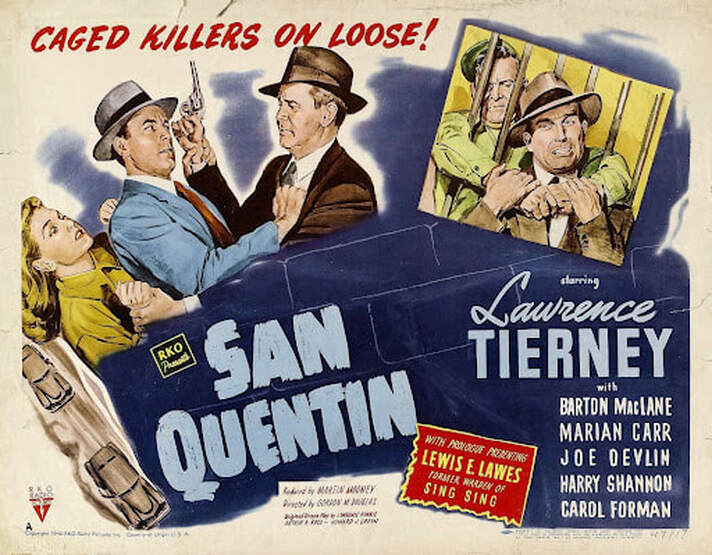
California’s oldest prison was once the home of America’s largest death row and creepiest bad guys, including mass murderer Charles Manson. Today death row is closed, old walls are coming down, and the sign out front reads “Rehabilitation Center” instead of “State Prison.” The $239 million Scandinavian-style makeover has begun.
Twenty-five years ago, Norway’s prisons were as crowded and violent as ours, with 70% of released inmates becoming repeat offenders (in America it’s 76.6%). By shifting their focus from punishment to rehabilitation and reintegration into society, the Norwegians reduced the recidivism rate to 20%, one of the lowest in the world. It turns out that treating people like human beings with a future encourages better behavior (go figure).
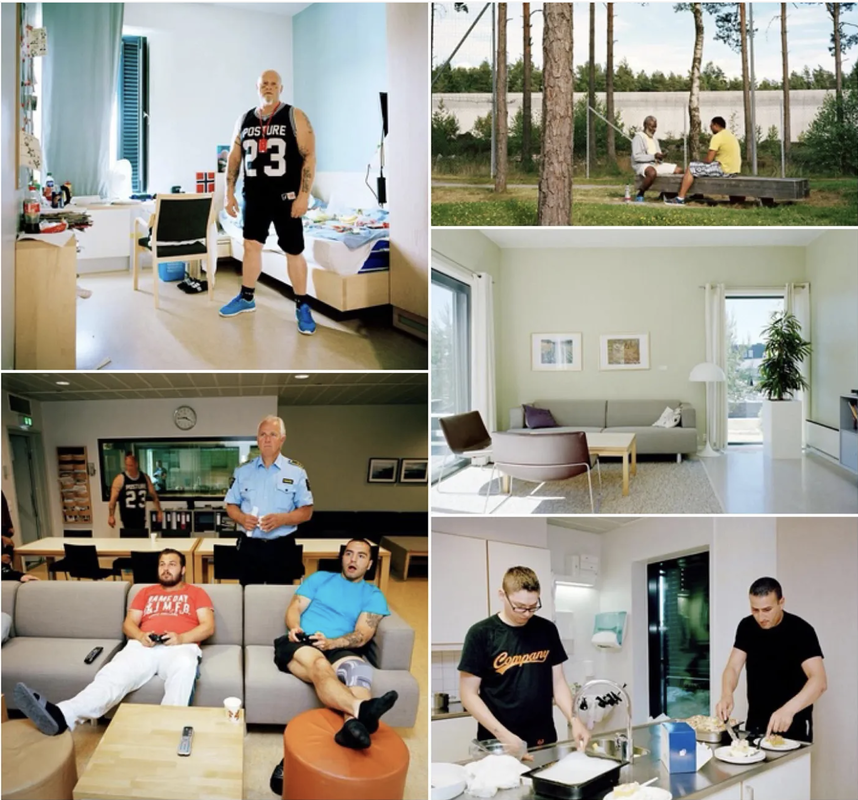
The reforms are not just about helping bad guys turn over a new leaf; it’s about saving us, the American taxpayers, billions. On average, states spend $64,865 a year per inmate. Arkansas keeps that down to a thrifty $23,000, Massachusetts tops the chart with a whopping $307,468, California is midrange at $128,089. If 50% of San Quentin’s 4000 inmates went straight, that would save the state $256,178,000 a year. Cost of the renovation: covered in the first twelve months.
Education and personal development are key to the transformation. And one of the longest-running success stories is Marin Shakespeare Company’s theater program.
I first heard about it from my former yoga teacher Suraya Keating, who told me she went into San Quentin regularly to teach drama workshops and direct plays. I’d tried to get tickets before, but they sell out fast. A month ago, I completed the extensive paperwork, passed the security clearance, and obtained a free ticket to the Bard’s Love’s Labour’s Lost.
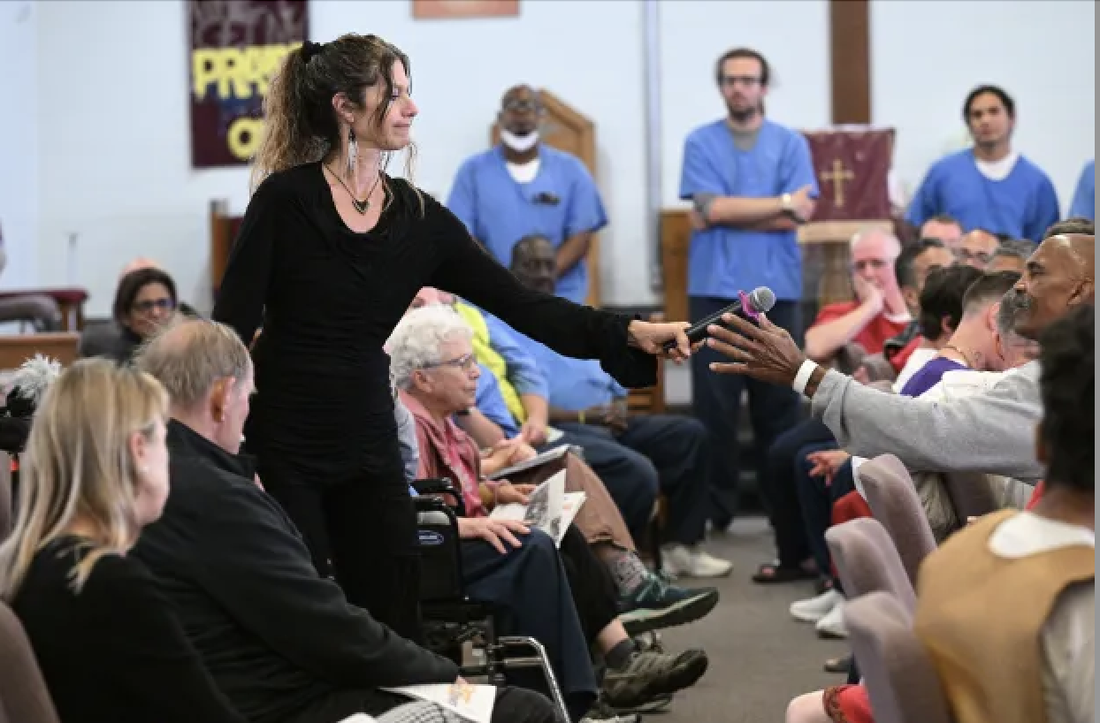
So there I was, listening to the gate clanging shut behind me, wondering what the hell I’d gotten myself into. We passed through several more metal gates, each marked, “Do Not Slam.” Which seemed ironic because — hello, wasn’t this the slammer?
We crossed a courtyard to the chapel repurposed as a theater and found the cast milling about in the vestibule. Many wore swashbuckling costumes, the female characters — played by men, as in Shakespeare’s time — sporting gowns and plumed hats. I found myself chatting with an inmate wearing a bright yellow beret and full face tattoos. He said he was doing Tiptoe Through the Tulips. Exactly where was that in Shakespeare’s play? I decided not to ask.
“And the face tattoos?” I inquired. “Real or part of the costume?”
“Very real,” he said. “And somewhat limiting in life.” I could only imagine.
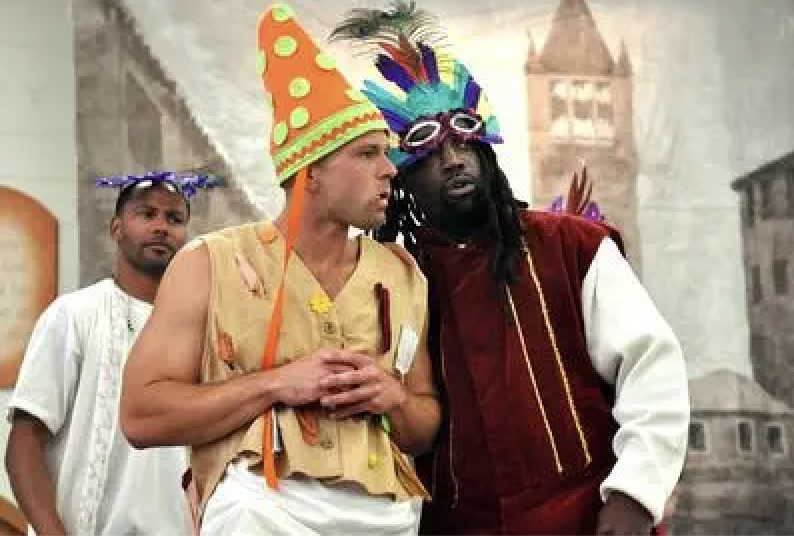
With or without Tiptoe Through the Tulips, I was a bit hazy on the plot of Love’s Labour’s Lost and had to look it up. A young king and his road dogs swear off women until a princess arrives on a diplomatic mission with her road dogs. Clandestine romances ensue, love letters go astray, the guys dress up as Russians, the ladies dress up as each other, confusion reigns. Some were Broadway level talents, many … were not. It didn’t matter. The actors were clearly having a rip-roaring good time.
As Lady Rosaline, the princess’ BFF, Angie Gordon was a standout — smart, funny, saucy, flirtatious, striding around barefoot, emoting like mad. I later learned Angie is a leader in the prison’s transgender community; in April she organized the first ever Transgender Visibility Night Panel Discussion.

“We were there to share a message of resiliency in the face of setback,” she told reporters. “Trump is a punch in the face, for many out there but especially for the trans community. But punches in the face are going to happen. It’s what you do with those moments, right?”
Many of the other actors seemed equally resilient. Despite lives that included extra helpings of questionable choices and tough luck — you don’t go to San Quentin for spitting on the sidewalk — that day the cast members glowed with energy, enthusiasm, joy, and hope.
This struck me as the robust kind of hope Rebecca Solnit meant when she wrote, “Hope is not a lottery ticket you can sit on the sofa and clutch, feeling lucky. It is an axe you break down doors with in an emergency. Hope should shove you out the door, because it will take everything you have to steer the future.”
How do you maintain hope and navigate a future when all seems lost? Long ago I asked a nurse caring for dying children how she got through each day when there was no hope.
“Oh, there’s always hope,” she said. “You just hope for different things. You start out hoping for a cure, then for temporary remission, then an easing of symptoms, and finally a peaceful death. But you always hope for something.” Hard-won wisdom I’ve carried with me into every crisis of my life.
This being Shakespeare, we had a play-within-a-play, a talent show with guys impersonating Michael Jackson, Prince, Elton John, and Elvis; Jailhouse Rock brought down the house. La Bamba had everyone up dancing. And my acquaintance with the facial tattoos did a deconstructed Tiptoe Through the Tulips in the character of a “J-Cat” (madman) so convincing I felt the hair rising on the back of my neck. I gave Love’s Labour’s Lost a standing ovation.

After three years imprisoned by the Nazis, psychotherapist Victor Frankl wrote, “When we are no longer able to change a situation, we are challenged to change ourselves.” He believed the way to overcome suffering is to find a purpose, some way to work for the common good and support those we love.
If I learned anything during my time in prison, it was that joy can flourish in the most unlikely places, that we are here to look out for all our road dogs, and that there is always hope, no matter what.
I couldn’t film the version I saw, but this movie moment captures the spirit of Jailhouse Rock as it was performed at San Quentin that day.

Leave a Reply