I try not to play favorites, so every morning, when I follow Seville tradition and place fresh parsley at the feet of Spain’s beloved household saint, San Pancracio, I make sure the Buddha gets some, too. Because hey, when it comes to petitioning for good luck, belt and suspenders, right?
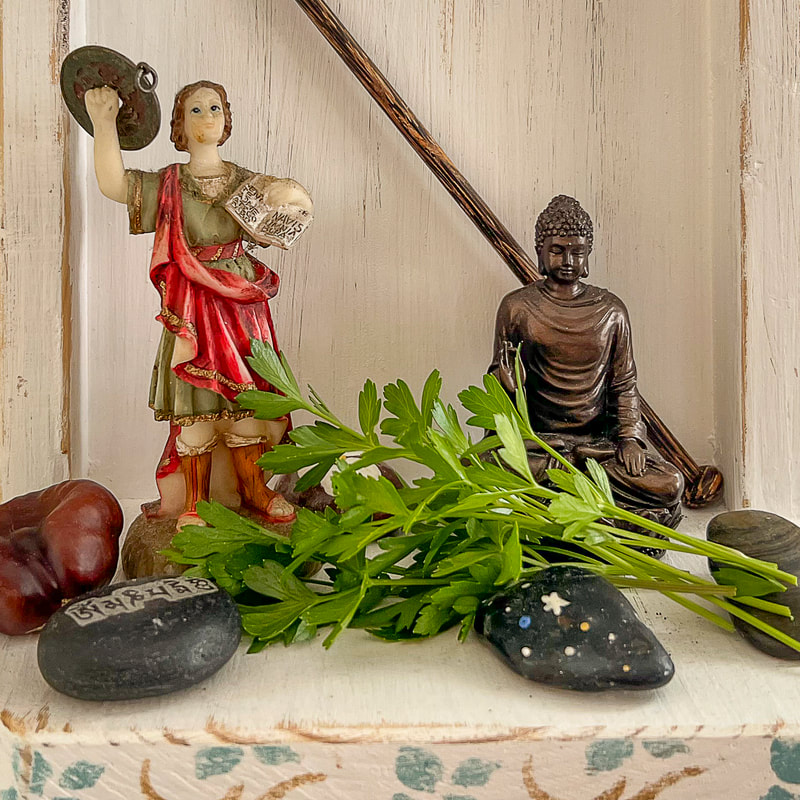
San Pancracio, Seville’s patron saint of health and work, shares altar space and daily parsley with the Buddha.
But I may have to up the amount of parsley or expand the lineup on my little home altar, because to be honest, these guys have not been coming through for me lately. In the month we’ve been back in California, Rich and I have sustained a staggering string of household disasters.
First the garden shed’s electricity shut down. Then the transformer on the garden’s path lights conked out. Next, our modem died. Are you seeing the pattern here?
But wait, there’s more. When our new modem was installed, it didn’t work with our printer, so we had to replace that, too. Meanwhile, our 2008 VW failed inspection thanks to a problem with the thermostat. To get it fixed cost $25 in parts, $675 in labor, because the engine had to be disassembled to get to it.
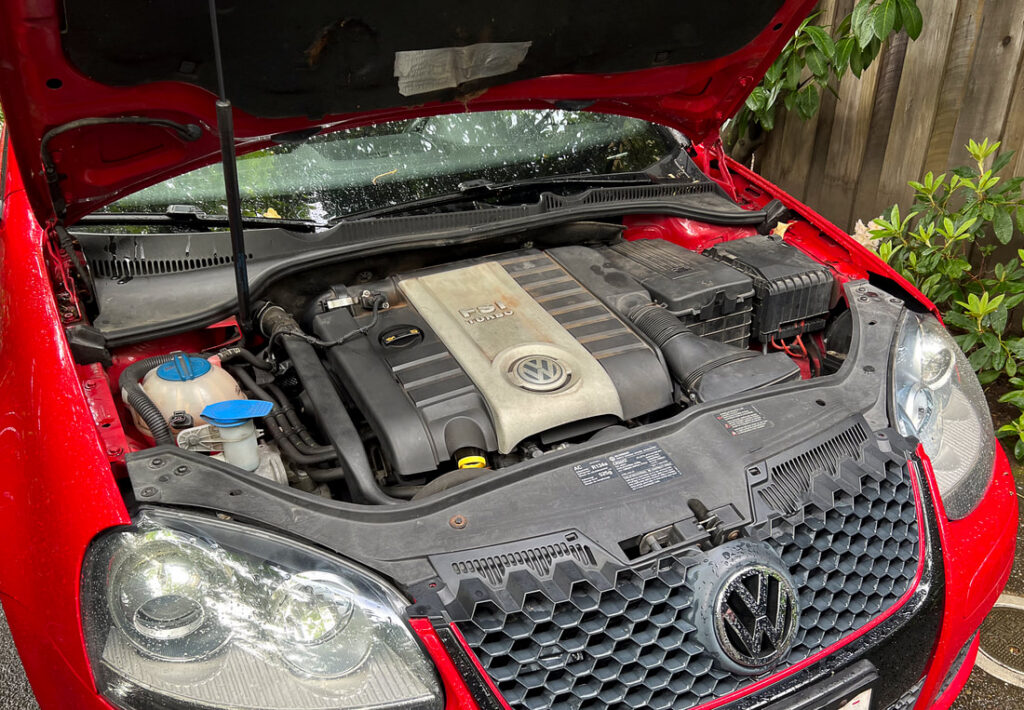
All this had to be removed to replace a $25 thermostat.
Then, apparently in sympathy, our house thermostat gave up the ghost, and it was several long, chilly days before we could get an electrician to install a new one. After that, the garden’s irrigation system trickled to a halt. Adding to the fun, a late night earthquake jolted us awake, but by now we were so used to being rattled that we just rolled over and went back to sleep.
The car failed the inspection again. And yet again. Our mechanic kept finding more frayed, broken, and malfunctioning parts. “I can’t believe the state of your hoses,” he said.
The state of our hoses? What about the state of our nerves?
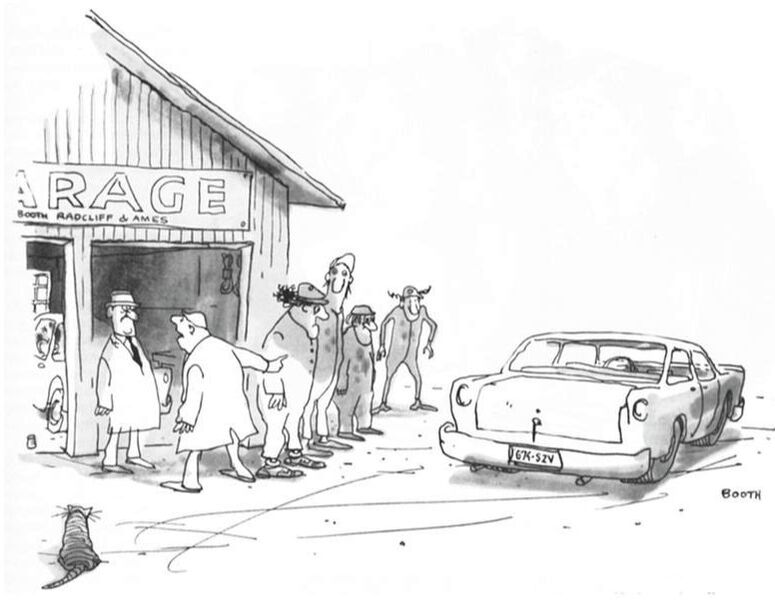
“The men feel there is an evil spirit in your clutch housing. We’ve called a priest.”
But hold on to your sympathy, there’s much, much worse to come. The calamity that may actually make my head explode is the recent announcement that my website can’t stay where it has been since 2011. My web host is abandoning that side of its business, so all the work I’ve ever posted — 612 blog posts and thousands of words of advice about visiting Seville, surviving these turbulent times, and finding cozy dive bars wherever you go — had to find a new home or disappear forever.
To be fair, there were warning signs and I’d ignored them. Years ago, the signup form got so unreliable I finally asked new subscribers simply to email me directly. Lately the search function began sporadically pretending it had never heard of words like Seville or beer. Occasionally (including last week) some people weren’t able to post comments on the blog. A total shutdown shouldn’t have felt like a thunderbolt from the blue. And yet it did.
“Talk to Claude about it,” advised Rich.
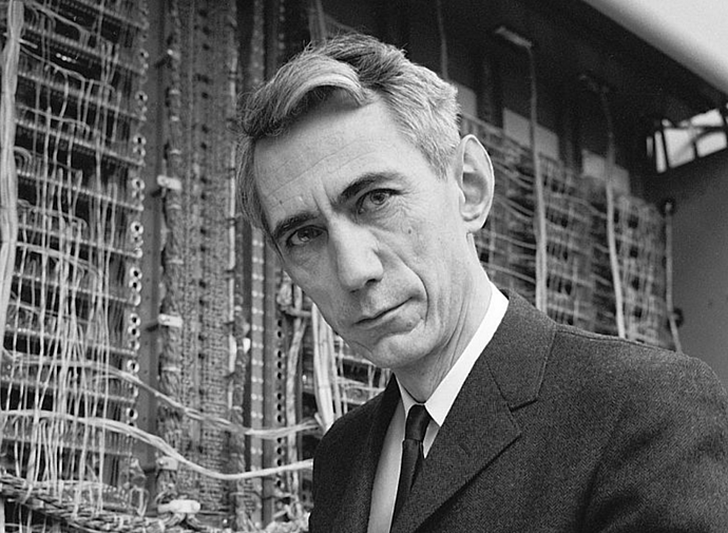
Consulting my chatbot Claude, I always picture the guy it’s named for, Claude Shannon, known as “the Father of Information Theory.” Photo: Alfred Eisenstaedt / Getty
Claude is one of the hot new artificial intelligence chatbots I’ve been testing out. Oh, yeah, I thought. Let’s see what the modern-day oracle thinks.
Consulting my chatbot Claude, I always picture the guy it’s named for, Claude Shannon, known as “the Father of Information Theory.” Photo: Alfred Eisenstaedt / Getty
“The writing is on the wall,” Claude replied. “It’s time to move, and sooner is better than later.” It explained in detail how I would have to download all my material and transfer it to a new host, a long, complicated process potentially costing thousands of dollars: $200 per blog post was mentioned. There was more, but I was hyperventilating too rapidly to take it in properly.
I decided to see if any of my good neighbors could help. My first stop: the former florist shop that now houses our village’s small tech support service for the befuddled. Incredibly, they had a staff member willing and able to duplicate all my content and upload it elsewhere, for a surprisingly modest fee.
The good news: We’ve saved all the text and most photos and are starting to build my new website. I’ll keep this web address (enjoylivingabroad.com) so the shift will be seamless for my readers.
The bad news: everything on the new site requires reformatting. Photos are clustered at the start of each post, the text is peppered with weird random line breaks, and italics, boldface, and links are gone. Fixing each problem is a piece of cake, but it’s a cake with a lot of pieces.
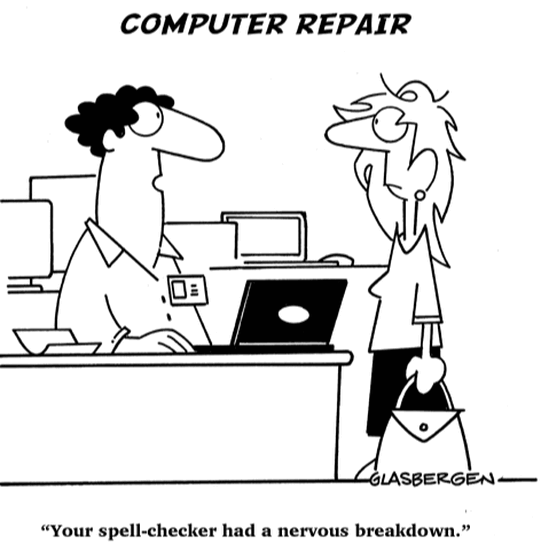
“It always seems impossible until it is done,” said Nelson Mandela. And if these upside-down times have taught us anything, it’s that impossible stuff happens all the time. Just look at the morning headlines.
More specifically, look at the morning headlines about artificial intelligence. Once proclaimed as the savior of our economy and our superpower status, AI is now vilified as the agent of Armageddon.
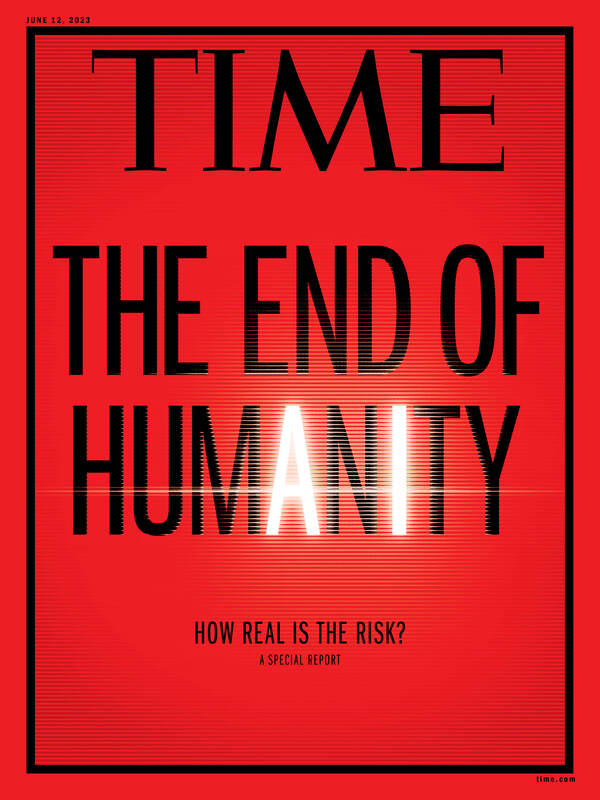
I used to scoff at that kind of paranoia, saying, “That’s impossible,” and “We’ll just pull the plug,” and “Not in my lifetime.” To me, AI seemed a sort of glorified Google, prone to ridiculous 2+2=6-type errors, and luring the unwary into trusting it to guide them through decisions you should only discuss with your mother, your priest, or your parole officer.
All month I’d been diving deep into AI to prep for last Thursday’s launch of the California edition of our Ideas Club. Rich and I planned to re-use all the materials we’d developed for our Seville group’s discussion of the same topic last October. But it turns out AI is taking such giant leaps forward that everything we talked about six months ago is so outdated it seems as quaint as Ken Burns’ Civil War documentary.
Today’s AI is better, faster, stronger, and used by 1.34 billion people — 16.3% of humanity. Here in America, it’s embraced by 80% of doctors and lawyers, 90% of students, and 60% of auto mechanics. It is influencing everyone you rely on to help you navigate your life choices. If any of your young relatives are getting married this summer, it probably wrote their wedding vows, helped them find a venue and register for gifts, and picked the breed of their new puppy.

AI is influencing humanity in ways we can’t even track. (And of course that’s not worrying at all.) But it shouldn’t get too cocky. There are reasons we humans have been apex predators for two million years. We’re considerably smarter and craftier than we look. And we learned eons ago that by joining together we can accomplish extraordinary things.
I take heart from the fact that lots of workers — mostly near neighbors — have pitched in to get my car back on the road, restore my shed’s electricity, install a new thermostat in the house, and give me the tools to build my new website.
Maybe together, we’ll figure out how to navigate a world profoundly reshaped by artificial intelligence. The first step is learning as much as we can about AI and discussing what we’ve learned with our friends, neighbors, and bartenders. All the signs point to a challenging future, and we’re lucky to have a small grace period now to prepare. As author Neil Postman said, “Clarity is courage.”
I’m clear that I am going to need all the help I can get. And while my rational self understands that leaving herbs in front of small religious statues is unlikely to bend the Universe to my will, I am planting a huge pot of parsley on my back deck this week. I figure it can’t hurt.
PS: As the video below shows, robots can do a lot of things but they will never, ever outperform The Rolling Stones. Mick, your job is safe.
Leave a Reply