Every once in a while, our whimsical old Universe surprises me with a gift so lavish it leaves me breathless. This week it was a short film. Quality: horrible. Script: was there one? Acting: amateurish at best. But none of that mattered, because for the first time, I got to see my grandmother, Ramona Langley, in one of the Hollywood movies she starred in back in 1913.
My generation has sporadically searched the Universal Studios archives for her work, but most of those old silent films crumbled to dust ages ago. This week my brother Mike discovered one of her movies on YouTube, posted by the National Film Preservation Foundation.

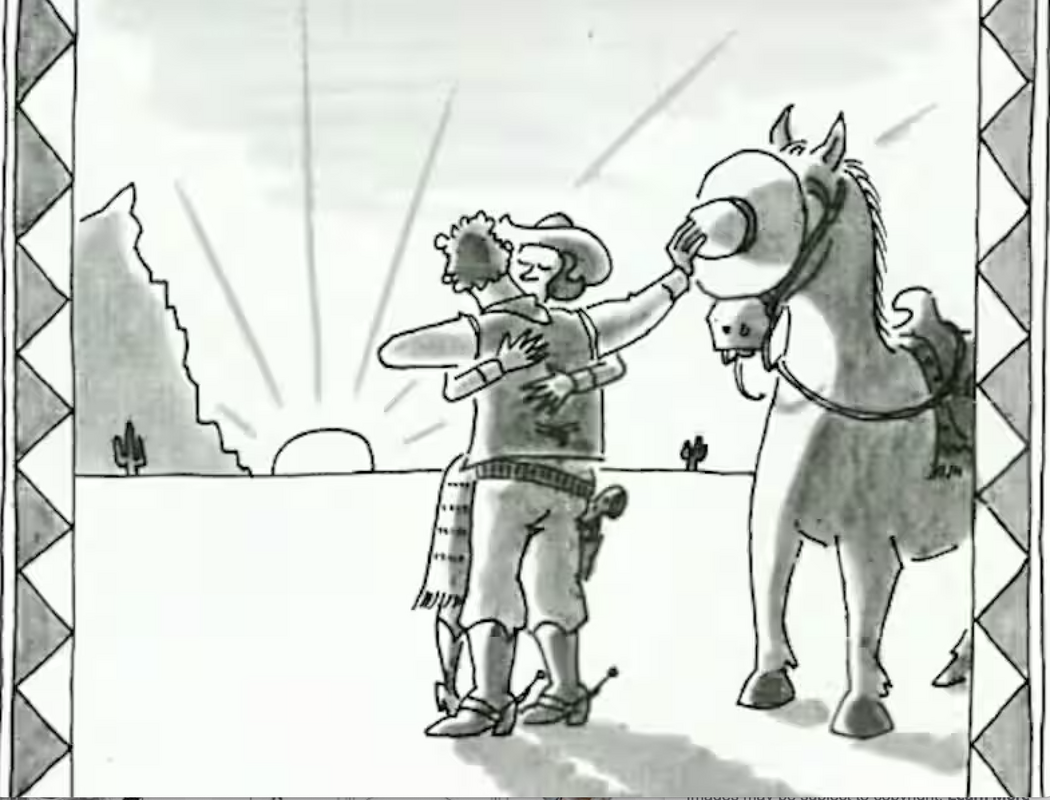
Ramona Langley and Lee Moran starred in The Girl Ranchers, 1913.
“The one-reel gender comedy The Girl Ranchers,” said the NFPF commentary, “is part of a wave of stories, sweeping through American popular culture in the early 1910s, about intrepid girls who prove themselves on the land.… If the film is not, as ads claimed, ‘one continual scream of laughter,’ its amusing stylizations of male and female behavior make for a nicely escalating battle of the sexes.”
My grandmother was nothing if not intrepid and eternally engaged in the battle of the sexes. What a hoot it was to see her at the age of twenty, taking over the Rough Neck Ranch, bossing cowhands, fighting a gun battle with Native American raiders, donning overalls, and quelling the rebellion over “a skirt” being in charge. All that in just 14 minutes! Plus romance!
As a kid, I learned a lot from my grandmother. She gave me dubious romantic advice (“It’s as easy to love a rich man as a poor man. Remember that!”), encouraged me to break the rules (“Let’s go get ice cream cones before dinner. Don’t tell your mother!”), and spoke of her time on the vaudeville stage and Hollywood’s earliest movie sets with such delight it left me with a lifetime love of creative endeavors.
I was thinking about her long-ago career this week as Rich and I gathered with our Ideas Club to talk about the future of work. For those new to my blog, the Ideas Club is like a book club except that we discuss the hot topics of the day. Participants range from mid 30s to mid 80s; most are international friends who chose Seville as their Home 2.0.
This month’s invitation asked, “How will the next generation make money in the new AI-shaped economy? Is Universal Basic Income an answer and/or is deeper societal change required? Are ‘good corporate citizens’ going to protect the public or bow to shareholders’ thirst for profits? (I think we all know the answer to that one.) As the old model of study, work, retirement gives way to constant flux and repeated upskilling, how can people plan for retirement?”

A week in advance, we sent links to articles and videos, and at the event we provided additional questions and fact sheets, including recent layoff statistics that made for chilling reading.
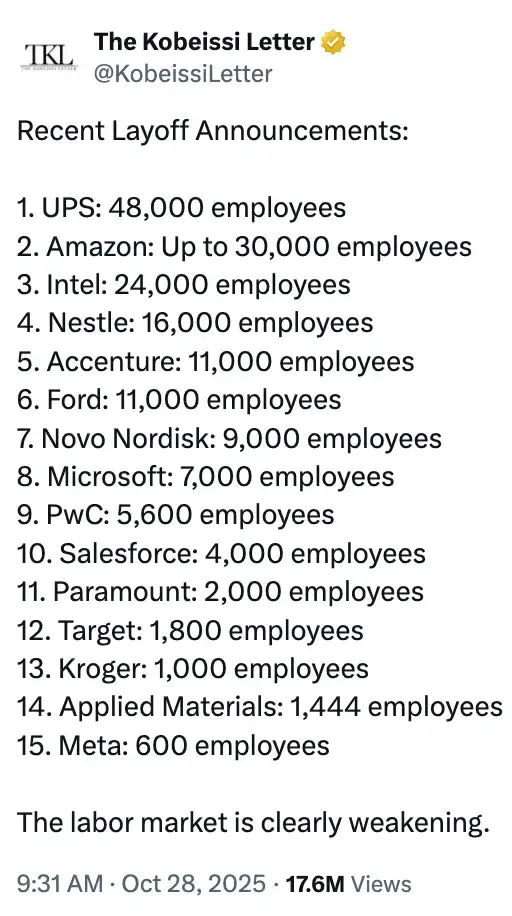
A friend sent me the statistics below, noting that the title’s bad grammar was reassuring in a way, as it suggests AI is still in the bumbling stage, not quite ready for total world domination.
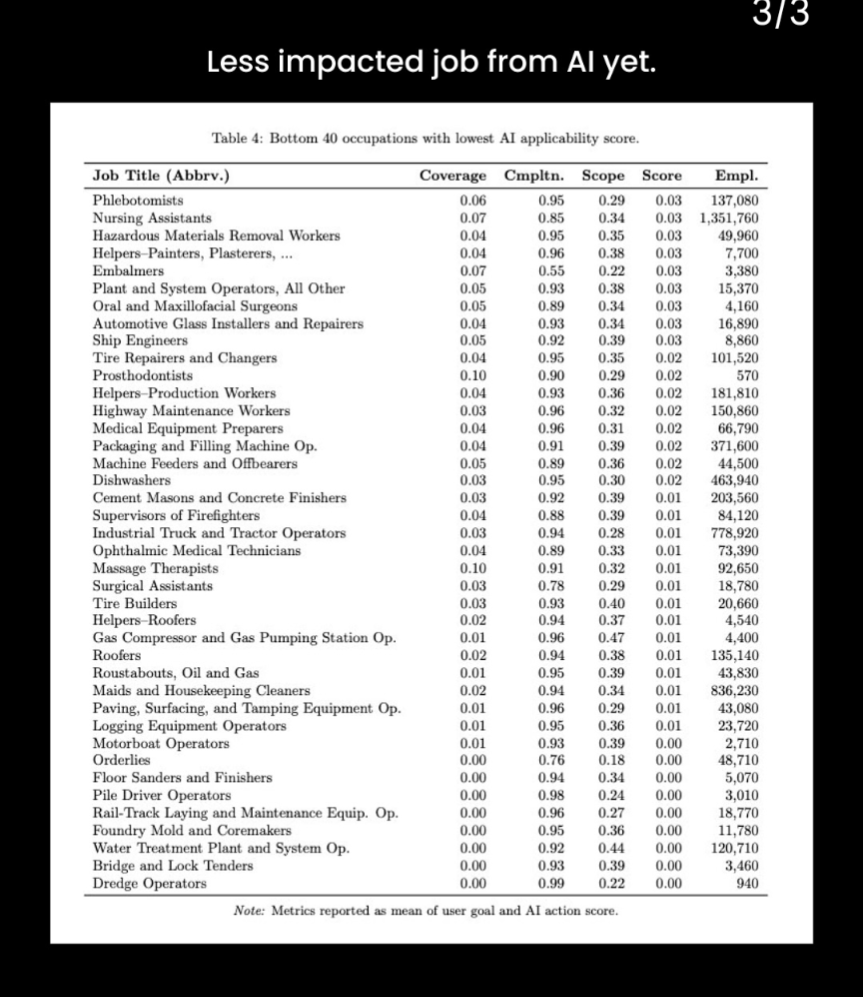
We also included World Economic Forum predictions that appeared on this blog three weeks ago. Clearly the Forum needs a better crystal ball, because shortly after they announced that delivery drivers will remain in hot demand through 2030, some 48,000 employees were laid off at UPS and Amazon. The conflicting statistics prompted a lively discussion of just how little anybody actually knows about what’s happening now, let alone what lies ahead.
The one thing everyone agrees on is that advanced tech is poised to disrupt business on a global scale, just as soon as it irons out a few pesky little bugs.
OK, so our future overlords need a little more time to come up to speed. But while AI isn’t taking our jobs (yet), it is taking our money. America’s jittery corporations are shedding workers like mad to redirect all available funds to AI development and infrastructure. Nobody wants to be left behind during the disruption that forecasters say is coming soon and will be as game-changing as the introduction of the Internet, electricity, or (wait for it) fire.
Silicon Valley speaks of AI as a mega-huge, asteroid-hitting-the-dinosaurs level event. As you may recall from high school science, that asteroid killed 75% of life on earth. So how do you navigate that kind of upheaval? Most are betting their future that a smaller, leaner workforce will make them agile enough to pivot and leap on whatever opportunities AI is going to offer the survivors.
Where does that leave all those pink-slipped workers? Again, nobody knows. Some of AI’s billionaire pioneers are easing their consciences by suggesting somebody (not them, of course, someone else) should provide every American with Universal Basic Income — say, $1000 a month. That would alleviate some layoff pain but cost three billion dollars and still leave ex-employees below the poverty line and scrambling for jobs.

Geoffrey Hinton, the Nobel-Prize winning “godfather of AI,” fears the technology he helped build could wipe out humanity. He suggests programming it with “maternal instincts” so it would nurture us instead. “That’s the only good outcome. If it’s not going to parent me, it’s going to replace me,” he said. So far, everyone is ignoring his advice.
Setting aside the income question for a moment, we considered what laid-off workers would do with bountiful leisure. Half a million years ago, when our first big tech disruption — fire — made it easier to eat well with less effort, we got busy creating language and civilization (obviously still works in progress, but hey, give us time). To provide our lives with interest and meaning, humans need a purpose, even if it’s simply etching patterns into a rock.
The people at my table pointed out leisure is great for creative types like me, and it’s true. Give me a laptop and a few art supplies, and I could happily spend my days writing and painting. Come to think of it, that’s what I do now.
For the non-artistic types, my companions suggested volunteering as a feel-good, endorphin-producing, health-enhancing, purpose-building pastime. “What if America organized itself around a four-day work week plus a fifth day when everyone had to do volunteer work?” someone suggested. Later another participant said, “Yes, but if you’re forced to volunteer, that’s obligatory unpaid work. Isn’t that slavery?”
As you can see, we didn’t exactly solve the world’s problems, figure out how to tame the Wild West currently known as Silicon Valley, or corral our thoughts into cohesive conclusions. But like my grandmother, I’m donning my (metaphorical) overalls and throwing myself into the fray. And while the future we envisioned together at the Ideas Club may not be ‘one continual scream of laughter,’ you can bet your cowboy boots we’ll find it’s an exciting time to be alive.

Leave a Reply