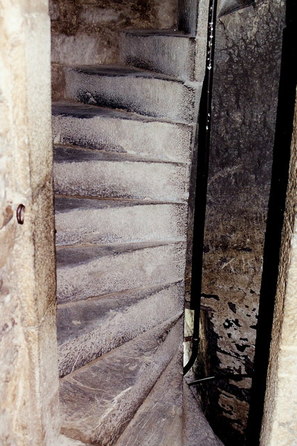




Blarney Castle steps. Photo: Joseph Mischyshyn
I probably don’t need to tell you that I have kissed the legendary
Blarney Stone
, officially the Stone of Eloquence, which is said to confer the gift of gab. To get there, you climb up and down narrow, winding stone staircases deliberately engineered with small distortions to trip up invaders. I don’t know how well that worked on sword-wielding knights back in the day, but just two steps from the bottom of her descent, my friend missed her footing, tumbled forward, and broke her ankle.
Arriving at the local hospital, I felt as if I’d walked into a time warp. This was back in the 1990s, but it looked like the 1940s. Where were the computers? Why wasn’t anything plastic? The metal-frame beds, canvas privacy screens, and glass water carafes appeared so anachronistic that I found myself glancing at the wall to see if there were signs saying, “Loose lips sink ships!”
Any sense of technological superiority I might have felt died a natural death in the next twenty minutes, as it became obvious that my friend was receiving excellent medical care. And I learned a valuable lesson about judging health centers by their gloss. But respecting medical systems, foreign or domestic, doesn’t mean placing blind faith in them. When it’s my life on the line, I tend to take an active interest in the proceedings. And my experiences with hospitals around the globe suggest that you
can
tilt the odds a bit more in your favor.
1.
Bring a care partner along.
If you’re ill or injured, you’re not at the peak of your game, and you’ll need another set of eyes, ears, and brains to help you sort it all out, especially in a foreign language. Ideally, you’ll have a family member or travel companion with you; in a pinch, ask your local embassy, consulate, or a church to recommend someone who can serve as your advocate and translator. Find an online translation resource such as
Reverso
that includes a medical dictionary.
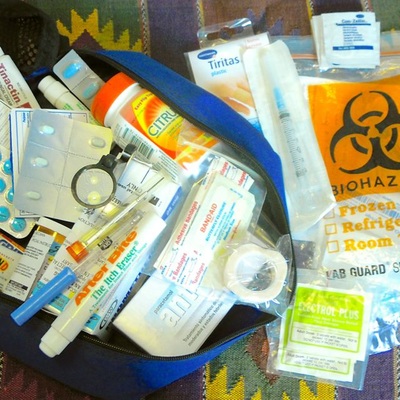
For medicinal purposes only, of course. Photo: Laurie Avocado
2.
Tell the staff about your health history and show them all your medications
, including over-the-counter remedies and street drugs. (You can ask your mom to step out of the room while you discuss your Viagra regimen and marijuana habit with the nurse.)
3.
Buy a notebook, and ask your care partner to write down everything
— the name of doctors and staff, and the diagnosis, treatment options, and medications —in both English and the local language. Insist on meeting the doctor in charge. And get the name of the hospital administrator. In movies they’re always spineless moneygrubbers, but in real life many are competent problem solvers with clout.
4.
Develop a cooperative but firm relationship with the staff.
“I start yelling the minute I get off the elevator,” a patient’s sister once told me. “I want them to know they have
me
to deal with.” Yikes! I strive for a more congenial approach and comply with local customs regarding respectful behavior. But when there’s genuine danger, you can’t afford to take “no” or “wait until morning when the doctor’s here” for an answer. Keep pushing the decision up the line until you get action.
Quaint looks don’t mean the quality of care has to be old fashioned. (Porto, Portugal)
5. Check with your insurance carrier to find out what’s covered.
Many older Americans are aghast to discover that Medicare doesn’t pay for treatment overseas. Those who buy trip and evacuation insurance may be pleasantly surprised. A friend at the Seville consulate asked me to look in on a hospitalized American vacationer, who gleefully reported that her insurance was sending her home on a special plane with a private nurse. It appeared to be the highlight of her trip.
Most of us feel about hospitalization the way Woody Allen feels about dying: We don’t mind the idea, we just don’t want to be there when it happens. But with luck and a proactive attitude, the medical attention we find on the road can save our lives, or like my friend in Ireland, help us get back on our feet again in time to climb the next castle that comes along.
YOU MIGHT ALSO ENJOY
RICH’S WORLD-FAMOUS FIRST AID KIT
YOUR WORST TRAVEL MOMENT?
DANCING IN THE FOUNTAIN

Leave a Reply