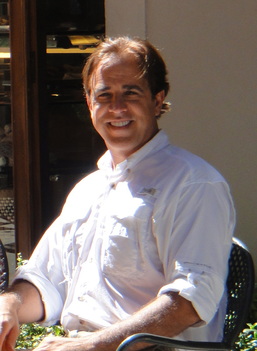
This is a guest post by Chris Brady, the NY Times bestselling author of
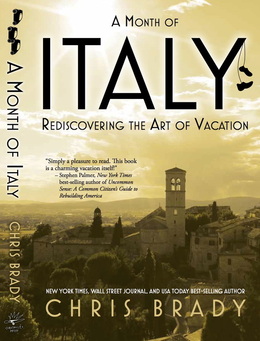
A Month of Italy: Rediscovering the Art of Vacation
and several other titles. You may also remember Chris as the man who penned the lovely words, “McCann’s writing is warm, inviting, immediately charming, and constantly entertaining. Her narrative was so good I found myself wanting to hear more about Cleveland! Now THAT’s good travel writing!” Obviously a man of discerning taste. Chris and I thought it would be fun to exchange blogs, so I invite you to sit back and enjoy his piece here, and then to visit his site and read
my blog, The Joy of Eating
. Happy reading!
“I looked at the people and buildings of Montalcino with eloper’s eyes, knowing what they didn’t: I was about to take flight and leave them behind. A couple of days of hassle and I would be dropped back into my previous life like an apparition. The razor blades providing death to the artist by a thousand cuts of emails, texts, faxes, voice mails, ringing phones, commitments, meetings, and deadlines were about to be given their chance at revenge. They wouldn’t care what we had seen, what we had felt, how our time away had changed us. They wouldn’t feel the metamorphosis that had taken place deep inside. I knew I was entering a transformation as necessary as the digitizing of a document to enable faxing. First I had to withdraw … next came the dread of returning to the violence of the normal. Finally would come the yearning for the familiar and the needed awakening from the dream…”
This excerpt from my book,
A Month of Italy: Rediscovering the Art of Vacation,
attempts to deal with the inevitable emotional transitions we travelers are forced to confront as we translate our bodies from one location to another. Something in us resists the change of scenery and lingers behind, especially if the time spent was particularly moving and meaningful.
Karen McCann deals with this in her fantastic book,
Dancing in the Fountain: How to Enjoy Living Abroad.
“Finally, during my third summer in San Anselmo, it occurred to me that I was fixated on viewing California not as it was, but through the lens of my life in Spain. While the rest of me was arriving in San Anselmo, I’d left my head and heart back in Seville. I was not mentally unpacking my bags. Despite living just a short distance from the communities in which I grew up, went to college, got married, and had family all over the place, I felt more like a foreigner than I did in Spain — or Cleveland, or Boston, or any of the other places I’d lived.”
If you’ve ever spent meaningful and significant amounts of time “elsewhere,” you know exactly what Karen is describing. There is a power of place that gets inside us like the smell of spices in clothing and can’t readily be removed just because we’ve carted ourselves to a different location. As Karen says, we must “mentally unpack our bags.”
I would suggest the following possible steps to take to help you accomplish this “mental unpacking:”
1. Think of people first.
By far, the easiest way to transition to the next place is to put yourself in mind of the people with whom you’ll be able to once again spend time. Perhaps there are old relationships that can be rekindled or new ones to be built.
2. Anticipate adventure.
Next, it is helpful to focus on new milestones and experiences to be sought in the next phase of your existence. These things can only take place if you are “there,” so be glad that you are!
3. Muster courage.
There is something inside each of us that longs for everything to stay exactly the same forever. This cannot be. We must face this reality with courage and push ourselves through to the next phase. It is only on the other side of trepidation that exhilaration exists.
4. Cultivate memories.
Leaving a place behind doesn’t mean losing it. Memorialize your time in each place with photos, journals, and memories so that much of what is gained can be captured, preserved, and repeatedly enjoyed.
5. Promise to return.
It’s a bit of a sleight of hand to leave a place emotionally by promising to return, but I’ve found this to work extremely well. And don’t worry about that old traveler’s fable that says never to return to a beloved place because it will never be as good the second time. This is patently false.
All of this, perhaps, can be summed up in one phrase:
be where you are
. In other words, wherever you go, make sure you are there. In the Preface to her book, Karen handles this nicely.
“But as it happened, I loved Cleveland (yes, I did!). I had moved around a lot over the years, propelled by fluctuations in the family fortunes and later my own, and I had learned that I could make a good life for myself practically anywhere. One thing I know to be true: the secret is mentally unpacking your bags. Or, as the Buddhists like to put it,
being here now
.”
May you travel widely, experience deeply, and manage to be where you are wherever you go.
Chris Brady is the NY Times bestselling author of
A Month of Italy: Rediscovering the Art of Vacation
and several other titles. Listed as the world’s #11
Leadership Guru
, he was voted one of the Top 100 Authors to Follow on Twitter. Chris also writes an eclectic
blog
on the general theme of “living a life that matters.”
Incidentally, Chris is also an avid motorized adventurer, world traveler, humorist, community builder, business owner, soccer fan, and dad. He has one of the world’s most unique resumes, including experience with a live bug in his ear, walking through a paned-glass window, chickening out from the high dive in elementary school, destroying the class ant farm in third grade, losing a spelling bee on the word “use,” jack-hammering his foot, and, more recently, sinking his snowmobile in a lake. Chris and his wife Terri have four children and live in North Carolina.
Leave a Reply