I love bookstores. I also love 1962 VW Bugs, my vinyl copy of the Beatle’s White Album, and coffee that costs less than a dollar a cup. But despite what John Lennon wrote, love
isn’t
all you need, at least not when you’re running a commercial enterprise.
And one fact that’s rarely mentioned in all the recent articles raising the alarm about bookstores as an endangered species is that
a bookstore is a commercial enterprise
. It survives by selling you books. And when another seller does that better, it’s going to succeed. It
deserves
to. Yes, I’m talking about the 800-pound gorilla, Amazon. They figured out how to improve your buying experience with ratings, reviews, and the opportunity to read a solid sample of the book before you plunk down your money. And they offer 11,000,000+ titles, compared to a chain bookstore’s 30,000.
Another fact that’s often overlooked is that
reading is a solitary activity, not a social one
. Journalists wax nostalgic about the neighborhood bookstore as a cozy sanctuary in which people gather on comfy furniture for a leisurely read. Really? When was the last time you did long, leisurely reading in a bookstore? In my case, never. And I’m a
voracious
reader. People browse, skim, and explore in a store, but most serious reading happens at home.
Then there’s the cost. With the average hardcover book priced at $26 (19€),
bookstores are becoming a rich person’s luxury.
I recently asked fellow members of an authors-and-readers Facebook group how they felt about bookstores, libraries, and e-books. And the overwhelming response was that
everyone loves the feel of a “real” book – but most use an e-reader
. As one put it, “e-books are a much cheaper alternative than a new paperback, and as for hardback books – well, [you’d] need to take out a loan!”
The sad-demise articles also bemoan the loss of bookstores as
community centers where authors lecture, kindly old ladies read books to small children, and book clubs meet
to discuss great literature.
Public libraries deliver all that and much more – for free
. Nowadays, free public libraries offer
everyone
the joy of an endless supply of books, and, in the American system at least, e-books, audio books, movies, music, technology courses, assistance with college applications, video games, online language courses, voter information, and so much more. They remind us that words matter, that life is bigger than we could possibly have imagined, and that, as writer
William Nicholson
put it,
“We read to know that we are not alone.”
While working on this post, I was corresponding with
Alicia Bay Laurel
, author of the New York Times bestseller
Living on the Earth,
published in 1971 and updated in 2003. When I was in college in Berkeley,
everyone
had her book on their shelf, right next to
Ram Dass’s Be Here Now
and
Our Bodies, Ourselves
. I had long since lost my copy (which come to think of it, belonged to my roommate) and wanted the new edition. Since it’s all about living organically, in harmony with the universe, it’s naturally not available electronically. Our public library system had both print versions, but I wanted to own this one. So I thought, “Great, it’s been ages since I shopped in that cozy, little independent bookstore in my neighborhood.”
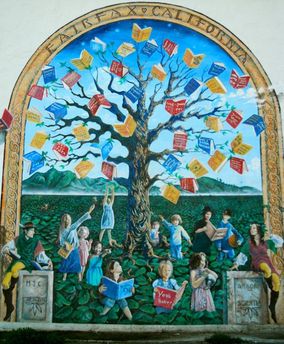
Mural on the now-defunct Book Beat in Fairfax, CA
The clerk had never heard of the book, and after searching online, he declared it impossible to get. So I went to a larger independent bookstore, and they directed me to “the guy with the white hair at the back desk.” He and I shared a delightful fifteen minutes reminiscing about the hippie movement, campus unrest in Berkeley, Ram Dass, and Alicia’s book. And then he also checked his computer and declared her book out of print and unavailable.
So I went on Amazon, which offered the original in paperback, and the updated edition in hardbound and paperback, in new, used, and collectable editions. I bought a used copy (which seemed more in the spirit of the book) for $11.25 and it arrived on my doorstep in two days with free shipping.
And people wonder why bookstores aren’t making it.
Leave a Reply