

I was startled to learn, when I first arrived in Seville years ago, that I was expected to kiss just about everybody on both cheeks. My landlady kissed me each time she collected the rent, my banker kissed me after we opened our account, and the flamenco singers in the dubious bar across the street kissed me whenever I dropped in to listen to the music.
After a few awkward fumbles, I learned it was always your right cheek to their right cheek, then you do the left cheeks, and that’s it. You never kiss once (American-style) or three times (as in Egypt, Russia, Switzerland, Belgium, and parts of France), or do four or more, because honestly, who has the time? It’s tough enough to greet everybody you know with
dos besos
(two kisses) when you meet up at a chaotic bar or crowded party. If you miss anybody, it’s viewed as a hurtful slight that requires a lengthy and sincere apology, if not outright groveling. In ordinary times, you’re wise to kiss first and take names later.
Nowadays, of course, Spain’s
dos besos
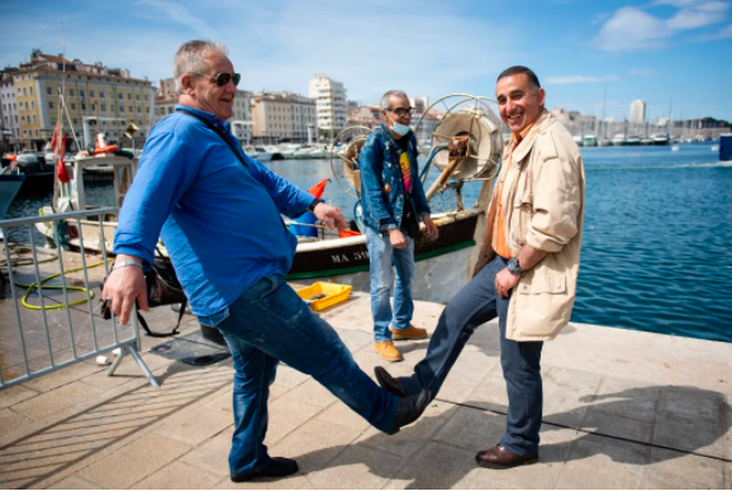
tradition has been suspended for the duration. Most of my friends, both local and international, bump elbows and make jokes to get through the slight awkwardness we all feel at the change in ritual. Some die-hard Spanish pals simply dive in for the two kisses anyway; being fully vaxxed in a region with one of the world’s highest vaccination rates, I’m not too worried about this. But in general, I feel it’s sensible that people are (mostly) holding off on closer physical contact for now.
Don’t worry, even without constant rounds of
besos,
our lips are keeping plenty busy. “I’ve never sold so much wine,” confided my friend Carlos, who runs the cozy bodega
Botellas y Latas
. “When people stay home, my orders go up and up.”
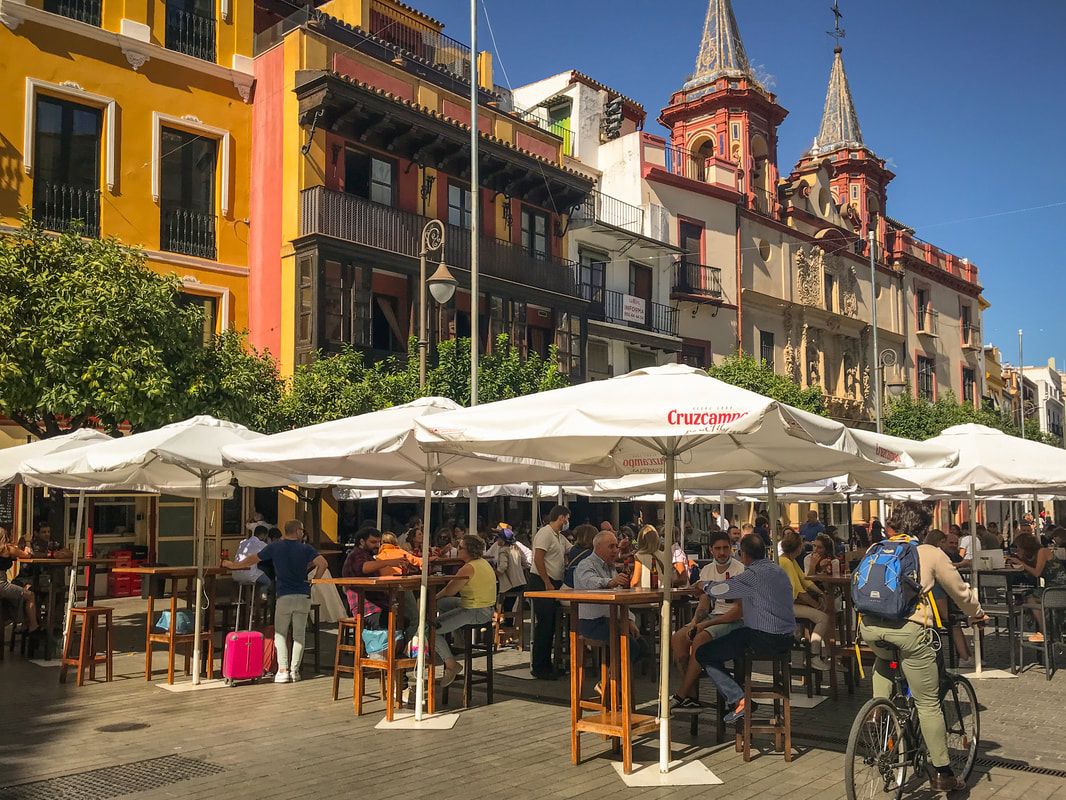
After a summer of providing comfort to those under Covid curfews, Seville’s wine merchants began shifting into high gear to slake the thirst of a population celebrating the freedom from fear that comes with mass inoculation and herd immunity. Everyone wants to gather in the bars, restaurants, and streets to raise a glass together.
Having recently returned from California, where wine drinking is taken very seriously indeed, I needed some time to readjust to Seville’s casual attitude toward
vino
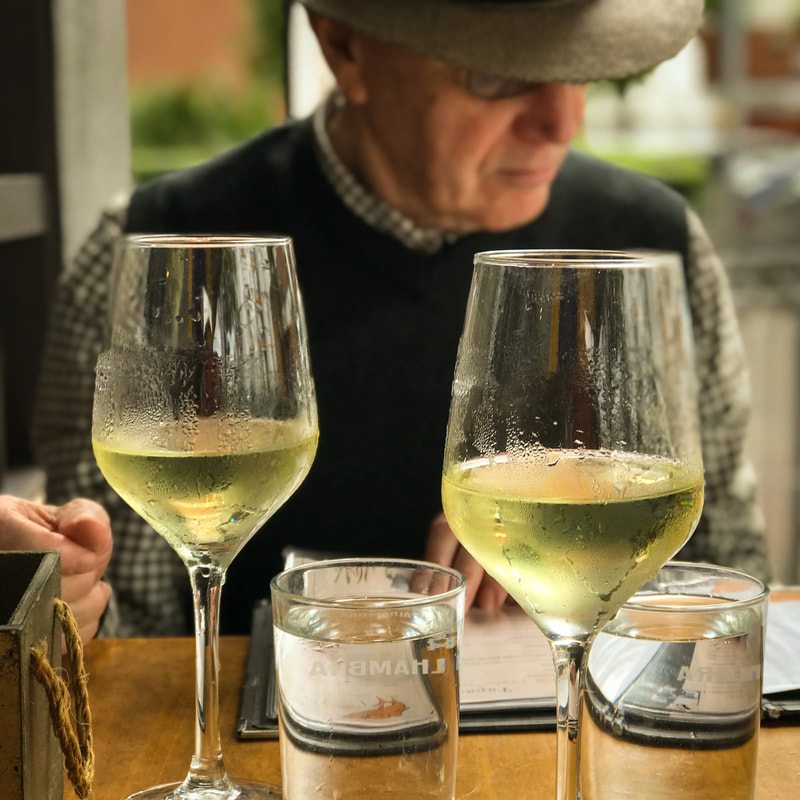
. Bartenders will ask if you want white
(
blanco
)
or red
(tinto)
. Don’t worry if you get flustered and ask for
rojo
(red) as they’ll still get your drift, but
tinto
is the correct term. They’ll then ask if you want
seco
(dry) or
dulce
(sweet) or sometimes
afrutado
(fruity). And this is where I run into trouble. What I actually like is a full-bodied, buttery white with a complex flavor and a long finish. I have embarrassed myself and numerous waiters attempting to obtain something — anything — along these lines in Seville. They always listen politely until I run out of words, and then they say, making a massive effort to appease the mad foreigner,
“Así que
… semi-seco?”
(So … somewhat dry?)
I have learned through diligent trial and error to specify Rueda verdejo (Roo-AY-dah vare-DAY-ho). Verdejo is a full-bodied grape that originated in North Africa and arrived in Spain’s Rueda region in the 11th century, where it was developed into a dense, sherry-like wine. Then in the 1970s some brilliant, public-spirited winemakers from Rueda and France teamed up to create the fresher verdejo we know today. Whew! I can now order a drinkable
blanco
wherever I go.
The amount I don’t know about Spanish wines remains considerable. So the other day, when Rich and I happened upon
DNS Gourmet
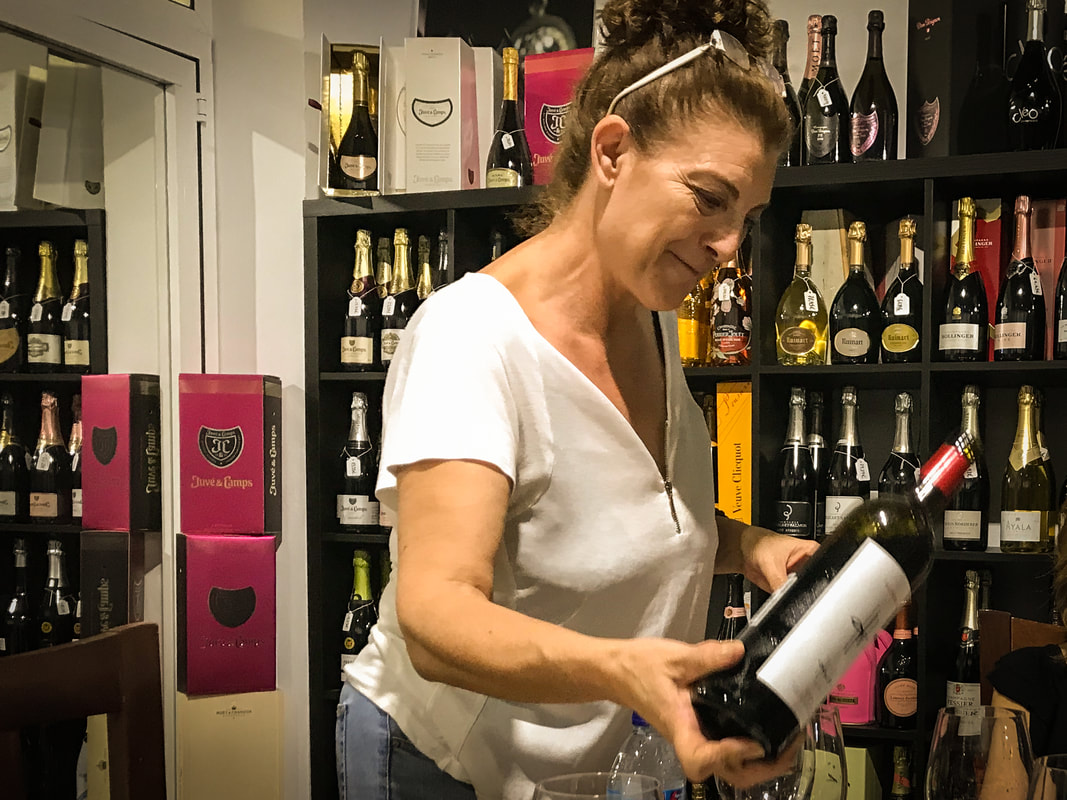
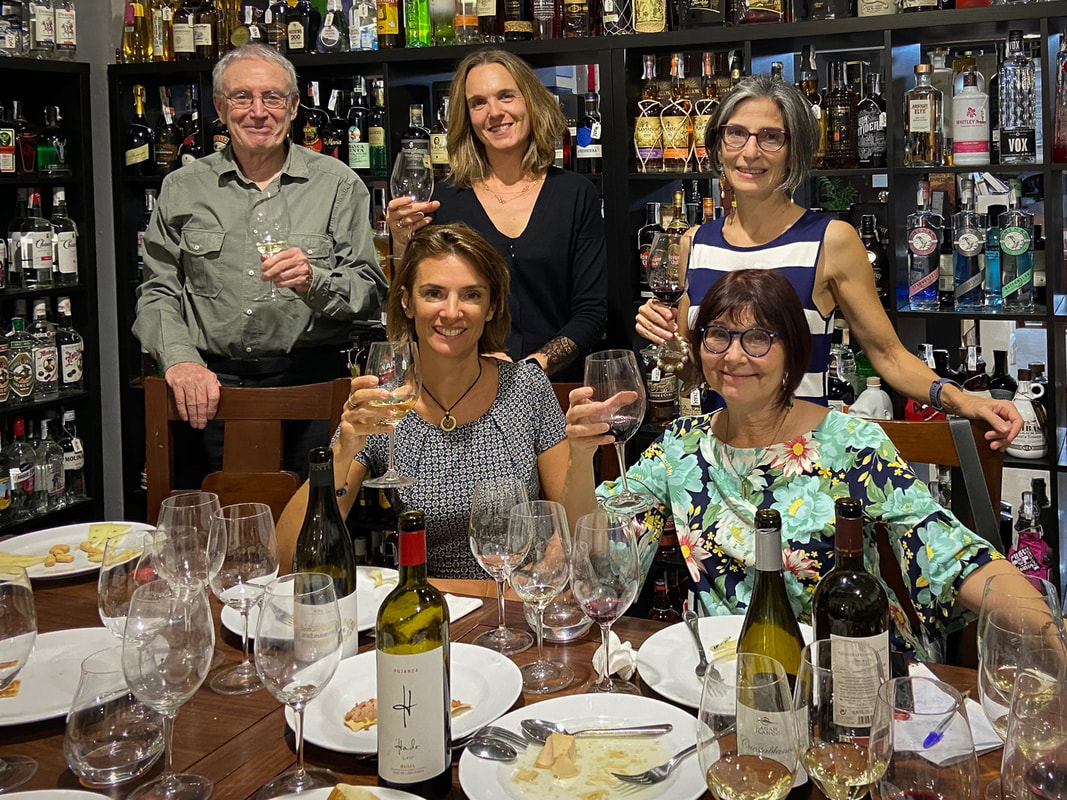
, a wineshop with a tasting table, it occurred to us that maybe we should gather a few friends and learn more. María agreed to organize a private tasting with four wines accompanied by cheese and other nibbles she sold in the shop. We confirmed some friends were available and set a date for last Wednesday.
The evening was tremendous fun, although to be honest, I can’t recall much of what I learned about Spanish wines. I’d forgotten that the subject has two levels: the simplistic Q&A you get from waiters, and the deluge of information you receive from real experts. And
María
was an expert; she’d actually crushed grapes with her bare feet, as people have done for 10,000 years, and showed us a video of herself churning great vats of fermenting grapes with what appeared to be a giant wooden spoon. She’d spent years studying the science of viticulture and art of winemaking. She absolutely knew her stuff.
María
explained that during fermentation, yeast converts the grape’s natural sugar into alcohol; the more sugar the higher the alcoholic content. She then served us a young white called Cuestablanca, made from the Pedro Ximénez grape, usually found in dense, sweet sherries, yet somehow resulting in this dry wine. The second white, a Rueda verdejo called José Pariente, was more to my liking. She said it was good with chocolate, but then, isn’t everything?
Glass by glass, my notes got increasingly sketchy.
After Hado, a lovely red from the Rioja region, she brought out one final
tinto
and the real show-stopper: Pago de los Capellanes from Ribera del Duero. One of my friends, new to Seville and only now discovering the wines, took one sip and got that rapturous look on her face that always makes me think of Romeo’s famous line, “Did my heart love till now?” This is one of the few reds I know well, and it always earns that reaction.
By this point in the evening, my notes were worthless, illegible scrawls. But I can pass on some valuable wisdom: Spain has 138 wine regions but if you stick to the three Rs — Rueda, Rioja, and Ribera del Duero — it’s hard to go too far wrong.
In the Before Times, we’d have kissed María before departing, but now we just thanked her warmly and took off, carrying the leftover wine with us for future study. It’s in situations like these that I really miss the
dos besos
and their way of transforming a business relationship into something close to kinship.
Kissing, like wine, is designed to smooth the sharper edges of life. It lets us relax and feel connected. Of course, you can’t run around doing it just anywhere. Long before Covid, I found that my fellow Californians tend to look at me very oddly indeed if I kiss them the first time we meet. And that goes double in the UK.
Which is why I love the story of Winston Churchill preparing for an especially tricky meeting with French President Charles de Gaulle in 1942.
A diplomatic advisor urged the Prime Minister to treat de Gaulle with kid gloves, adding, “He will probably expect to kiss you on both cheeks.”
To which Churchill replied, “All right, all right. I’ll be good. I’ll be sweet. I‘ll kiss him on both cheeks — or all four if you’d prefer it.”
Luckily for all of us, the idea of kissing on all four cheeks has never really caught on. The
dos besos
tradition, however, is firmly entrenched in the Spanish psyche and will, I hope, become commonplace again soon. I can hardly wait.
This post was written in response to a reader who said she’s heading back to Spain soon and was worried about the kissing custom in these Covid times. I explained to her that most people avoid the customary dos besos. If anyone doesn’t, she can always throw an elbow in their direction.
I’ve been back in Seville a month now, and every day I learn more about how the pandemic has reshaped the landscape and re-defined life in this sociable, foodie city.
CLICK HERE TO RECEIVE FREE UPDATES
on Seville, travel to Europe, and where to find good eats and survival comforts.
YOU MIGHT ALSO ENJOY
DIVE BAR SURVIVAL GUIDE
DO YOU WANT AUTHENTIC TRAVEL? ARE YOU SURE?
THE ONE WHERE I MEET SOME LIVE MERMAIDS

Leave a Reply