

I never learn. Really, I ought to have my head examined.
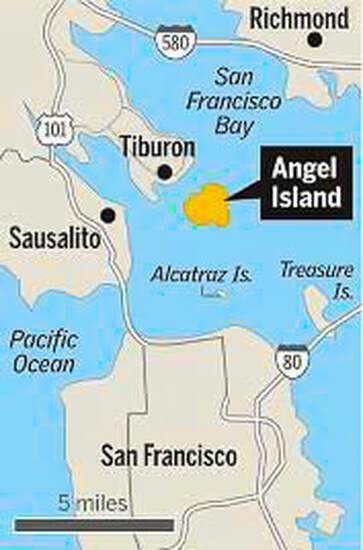
“We should go out to Angel Island,” Rich has been saying all summer. “Take a picnic.”
I was tempted. I’d never been there before, and Rich had fond memories of a visit 50 years earlier; cue the montage of soaring trees and spectacular views of the San Francisco Bay. On the other hand, the island is prone to cold and fog in summer, and every time we considered going, the weather report was so hideous we abandoned the plan for fear of hypothermia. Until this week.
“It’s going to be sunny all day Thursday,” Rich reported excitedly. And before I knew it, he’d booked the ferry tickets.
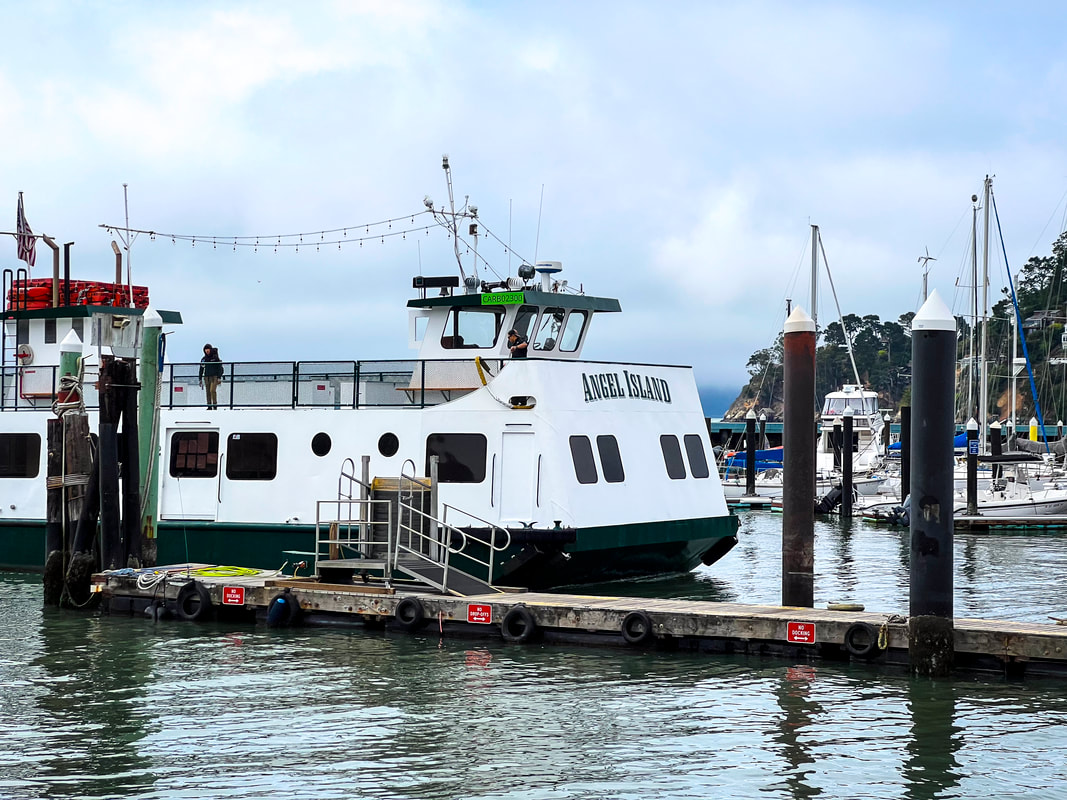
But Thursday had its own ideas about the weather and chose to dawn gray and chilly, with gusty winds that didn’t dispel the fog, just sent it slithering down collars and up shirtsleeves. I huddled in my light jacket, glad it was such a short ferry ride across Raccoon Strait, named for the British 26-gun warship, HMS
Raccoon
, which was damaged at sea and limped into San Francisco Bay for repairs in 1814. No doubt His Majesty’s sailors felt right at home in our pea-soupers.
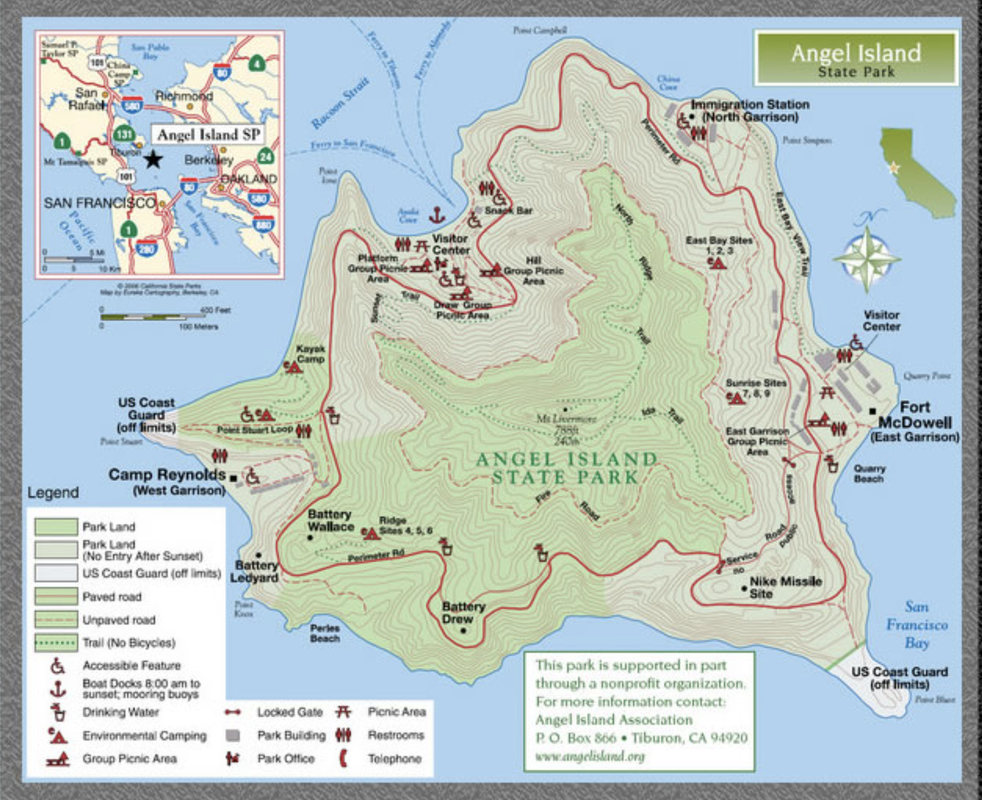
The man at the information desk sold us a map for a dollar and told us the island’s major historic site — the US Immigration Station — was a mile up the coast. “Don’t worry, there’s a shortcut.” He waved vaguely toward the northeast. “Just follow the signs.”
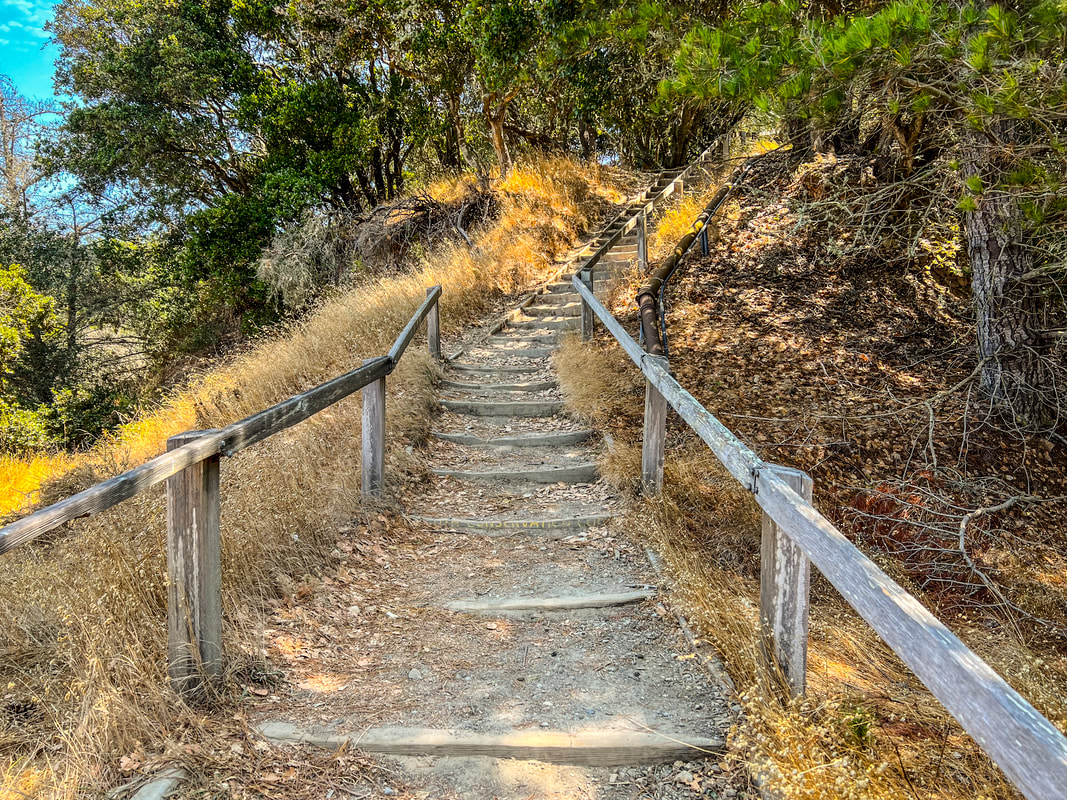
We found the trailhead and started up. And up. And up.
Haphazardly placed wooden risers, eroded dirt steps, erratic or missing handrails — these were conditions I often encounter in other countries, inspiring me to remark, “You’d never get away with anything this unsafe in the US!” And yet, here we were in a State Park on our way to a National Historic Landmark. How standards have fallen.
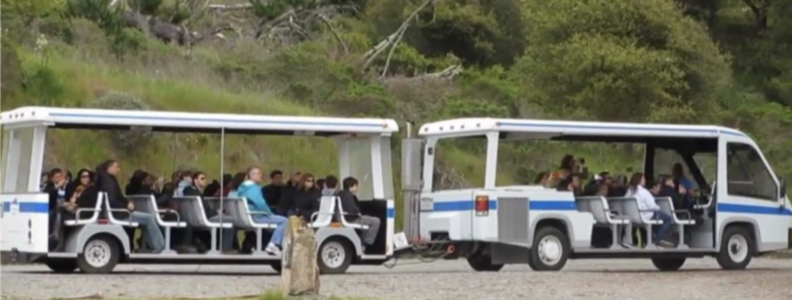
I froze during the first part of the endless upwards slog; then the sun came out, and I sweltered. Emerging at last onto the paved Perimeter Road, I stood gasping for breath. And then I was gasping in astonishment as a shuttle drove by, filled with holiday makers taking their ease, waving cheerily as they breezed past. “There’s a shuttle? Why didn’t anyone tell me about a shuttle?”
Slogging upward, we met a young couple trudging downward. “Did you see that shuttle?” I asked. The woman rolled her eyes. “Yeah. They refused to let us on. Apparently you have to sign up for a tour. In advance.” We heaved “had-I-but-known” sighs and soldiered on past one another.
Eventually Rich and I spotted our destination and began the steep decent to the Immigration Station.
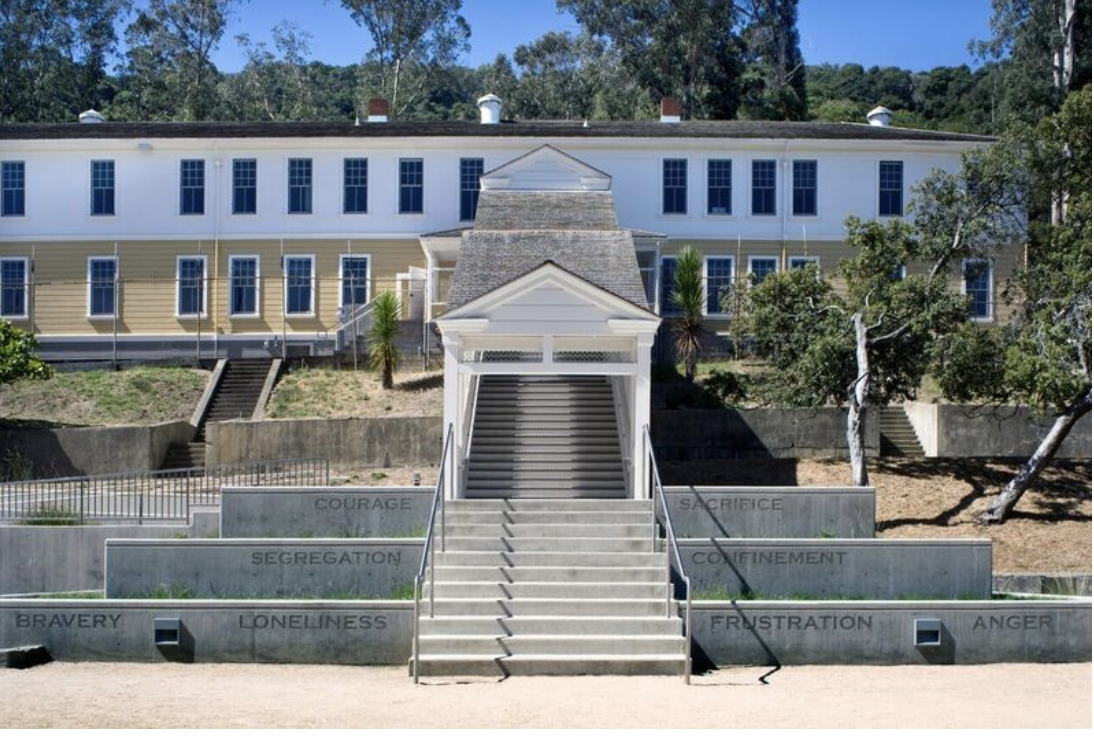
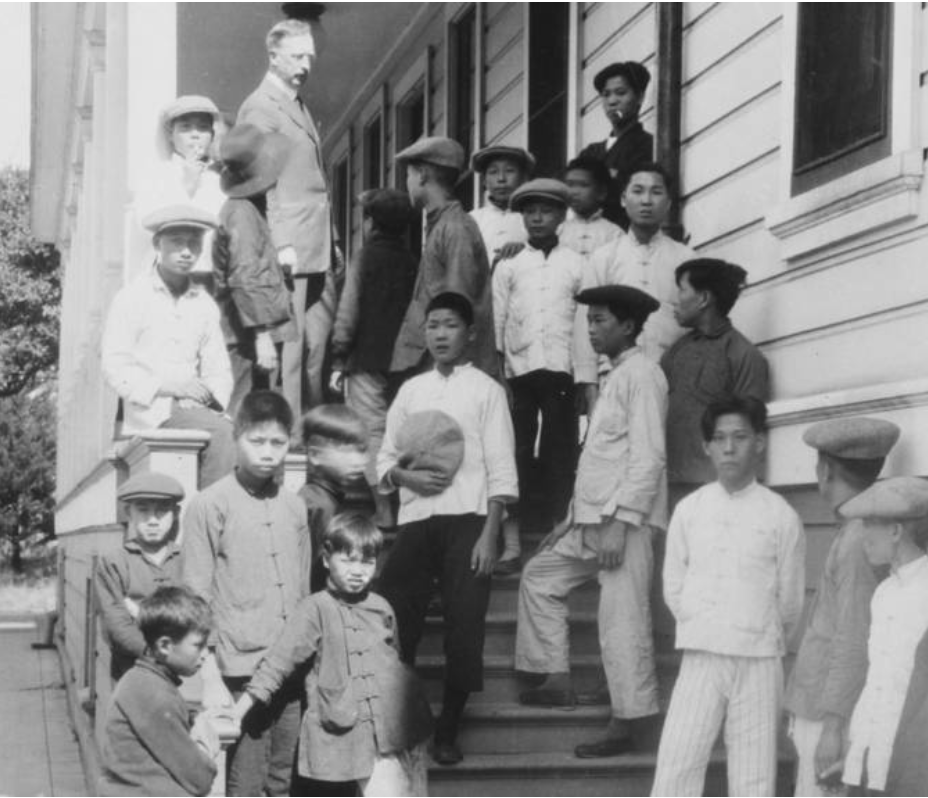
From 1910 to 1940, nearly a million people passed through its doors, each one hoping to build a new life here. And if you’re thinking “Oh, just like Ellis Island,” think again. Although many stories of hardship emerged from Ellis Island, apparently that immigration portal was “Welcome to Disneyland” compared to Angel Island.
The difference? Here they processed mostly Chinese arrivals. The late 19th century was rough there, thanks to droughts, floods, and two opium wars fought against the British, who objected to the loss of revenues when the Chinese government cracked down on the drug trade. Thousands of Chinese farmers and laborers were destitute, and having heard about California from relatives and friends who came over to work in the Gold Rush and build the Transcontinental Railway, they decided to join them.
Unfortunately, America’s post-Civil War economy was in a downturn. Looking for someone to blame, public opinion and laws began to demonize Chinese-Americans for “taking jobs” and “draining public resources.” Everyone blithely ignored the fact that in those days, most Chinese immigrants were healthy adult males who provided cheap labor that enabled American businesses to prosper, and who required little or nothing from government schools, hospitals, or other public services.
It didn’t matter. By 1883, a series of laws led to the Chinese Exclusion Act designed to screen out “undesirable” workers; only wealthy professionals were allowed in. Officials would go out to arriving ships and fast track the first and second class passengers, including most Europeans and a few prosperous Asians. Everyone else was herded into crowded barracks for weeks or months of interrogation and delays at Angel Island’s Immigration Center.
Standing in those barracks, I tried to imagine what it must have been like: families separated, new mothers caring for babies in cramped quarters, men never permitted outside except in a tiny exercise yard. Hope was always in short supply. Heartache was carved into the wooden walls in the form of poetry.
Of course, there were many health and safety complaints — all ignored, until the Administration Building burned to the ground in 1940. Then the whole shebang was moved to San Francisco. And just three years later, to please China, our new ally in the Pacific, we finally repealed the Chinese Exclusion Act.
I’d like to report that attitudes towards immigrants have become much more enlightened since then. Sadly, many Americans still demonize new arrivals — ignoring all evidence that immigrants actually help this country.
You don’t have to become rich or famous to help the US economy.
“How immigrant workers in US have helped boost job growth and stave off a recession,”
reads a recent
AP
headline. “More workers filling more jobs and spending more money has helped drive economic growth and create still-more job openings… Though U.S. inflation remains elevated, it has plummeted from its levels of two years ago.”
And you’ll be happy to hear
“There is no migrant crime surge,”
says
The New York Times
. “In reality, immigrants are less likely to commit crimes than people born in the U.S. Immigrants have had lower incarceration rates — a measure for crime — than native-born Americans for at least 150 years, a recent study concluded.”
The influx of immigrants in New York, Chicago, and Denver coincides with lower murder rates. Texas borderlands have less violent crime than the rest of the state or the nation. The statistics went on and on, but frankly, my eyes soon glazed over.
After wandering around the Immigration Station a while, Rich and I suddenly realized we’d have to hotfoot it down to the port if we were going to have time to eat our picnic lunch before the ferry home.
“I think we’ll be on time, so long as we take the shortcut,” Rich said. I groaned.
As I stumbled down the raggedy steps, I thought about my own ancestors, who had the good fortune to slip into this country before the government established official immigration procedures in 1891. Who knows if my folks could have passed the stringent tests given today’s new arrivals?
And I remembered Rich’s grandmother, who braved a terrible ocean voyage in steerage from Ireland to Ellis Island, vowing she’d never to set foot on a ship again (and she never did).
Let’s face it, 97.1% of US residents are immigrants or descendants of immigrants. Nobody has exclusive rights here.
As President Franklin D. Roosevelt said, “Remember, remember always, that all of us, and you and I especially, are descended from immigrants and revolutionists.”
Angel Island can be reached by ferries from Tiburon and San Francisco. They don’t run often, so be sure to check the return times carefully. And remember: book in advance if you want to ride in the shuttle!
SUBSCRIBERS
If you miss a post announcement, please check your spam folder. Internet security is in a frenzy these days.
This post is part of my ongoing series
OUT TO LUNCH IN
CHEAP & CHEERFUL SAN FRANCISCO
My goal is to discover some of San Francisco’s most colorful neighborhoods so I can check out what’s really going on in this zany town. Are we in a doom loop? Already on the rebound? Still fabulous? And where should we eat afterwards? These and other questions will be explored in upcoming posts.
BROWSE PREVIOUS POSTS HERE
DON’T MISS OUT!
If you haven’t already, take a moment to subscribe so I can let you know when I publish my weekly posts.
Just send me an email and I’ll take it from there.
[email protected]
And check out my
best selling travel memoirs & guide books
here
.
PLANNING A TRIP
?
Enter any destination or topic, such as packing light or road food, in
the search box
below
. If I’ve written about it, you’ll find it.

Leave a Reply