“Why not write about how you handle money?” a reader suggests. “Credit cards? Rail pass? Cash and what kind of cash?”
“Uh, oh,” I said to Rich. “I think you’d better take this one.”
After 29 years of marriage, we’ve worked out a division of labor. I’m the wordsmith who acquires travel phrases in every language, learns foreign alphabets such as Cyrillic and Georgian (кирилица and ქართული), and fills in the gaps with pantomime skills honed by decades of playing charades at family reunions. Rich is the numbers guy who estimates costs and tabulates trip expenses which, astonishingly, usually match the budgeted amount almost to the penny. I, who have a hard time figuring the tip on my bar tab, find Rich’s math abilities impressive and deeply mystifying.
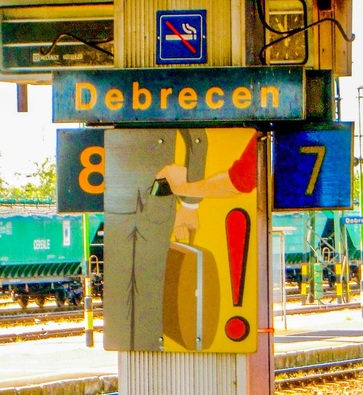
Warning posted in Debrecen, Hungary
“The first thing people need to know is that there are ATMs just about everywhere,” he said. “Carrying large amounts of cash isn’t necessary.” There are
more than 2.2 million ATMs (automated teller machines) worldwide
, one for every 3000 people on the planet. While you won’t find them in very small, remote villages, they are common in towns and cities around the world. There’s even one in Antarctica, although it’s only serviced once every two years, so you may not want to rely on it for frequent withdrawals.
“
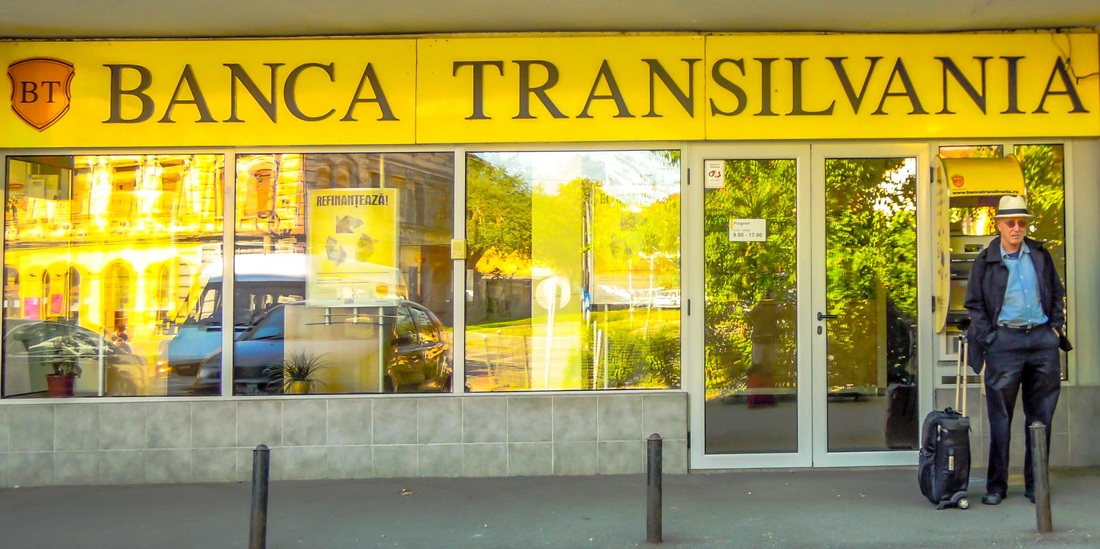
To get the best exchange rate, go to an ATM at a bank
,” Rich said. “Cash machines and money exchanges in airports and train stations don’t usually give you favorable rates, so get minimal amounts there — just enough to cover a coffee and transportation to your lodgings. Then find a bank with an ATM.
Never, ever exchange money with a stranger who approaches you on the street
, no matter what rate is offered; you will come out the loser every time.”
Rich then went into a long, complicated explanation about how currency exchanges are calculated, why we mere mortals never get quite the full, quoted rate (apparently that’s reserved for financial institutions moving large sums around the globe), and what commissions are charged for currency conversion and cash withdrawals. Every step shaves a sliver off the amount you’ll receive, but
the bottom line, Rich says, is this:
y
ou’ll probably want to extract cash using your credit card
. For a start, this lets you use the exchange rate offered by your card issuer, not some random bank you stumble upon. Some credit cards designed for travelers don’t charge for conversion, which helps as well. Most importantly,
if your credit card is stolen or your data hacked, your credit card company is required to reimburse you for your losses.
“I carry two credit cards and a debit card,” Rich explained. “If one’s stolen or hacked, I have backup. I only use my debit card if the current exchange rate is particularly favorable.”
How much do we take out? “I usually carry the equivalent of $100 to $200 in local currency,” Rich said. “And then in my money belt, I keep a hundred each in US dollars and euros for emergencies.”
You’ll have fewer emergencies if you
use ATMs that are inside a bank with security cameras and guards
. When that’s not an option, use outside cash machines with caution. Savvy thieves can discreetly install a skimmer on the ATM to read your data and extract your funds. Be on the alert for anything peculiar about the machine, such as different plastic over the card slot or a keypad that doesn’t fit perfectly.
“Have we covered everything?” I asked. “Cash, credit cards, debit cards…Oh yes,
rail passes
.” As Rich drew a breath to launch into his favorite subject — he can go on about this topic for hours; just ask any of our friends — I added hastily, “Come to think of it, I talked about that in my post
On a Slow Train Through Transylvania
.
”
Rich looked deflated for a moment, then brightened. “There’s
the digital wallet
,” he said. Lately he’s been researching this all-in-one method of using our smartphones for everything: purchases, reservations, boarding passes, insurance, ID. “Apple CEO Tim Cook says that in a few years, money will be obsolete. In another generation, kids won’t even know what cash looks like.”
That prediction may come true in cutting-edge cities like San Francisco, London, and Barcelona. But in the world’s remoter rural regions, I suspect it will take more than a few years for local farmers to start swiping iPhones to buy a scythe or sell a pig. So the bottom line answer to my reader’s question is this: for most destinations, a mix of cash, plastic, and smartphone technology is probably best for now — and for the foreseeable future.
Do you have travel questions? Let me know!
YOU MIGHT ALSO ENJOY
ON A SLOW TRAIN THROUGH TRANSYLVANIA
10 BEST WAYS TO KEEP YOUR VALUABLES SAVE ON THE ROAD
MY BESTSELLING TRAVEL BOOKS – NOW JUST .99 ON KINDLE

Leave a Reply