
Some readers (and you know who you are) have expressed skepticism about our visit to Albania. “Why?” and “Are you nuts?” are among the milder comments I’ve received. “There’s nothing to see there,” a Spanish friend insisted.
I beg to differ.
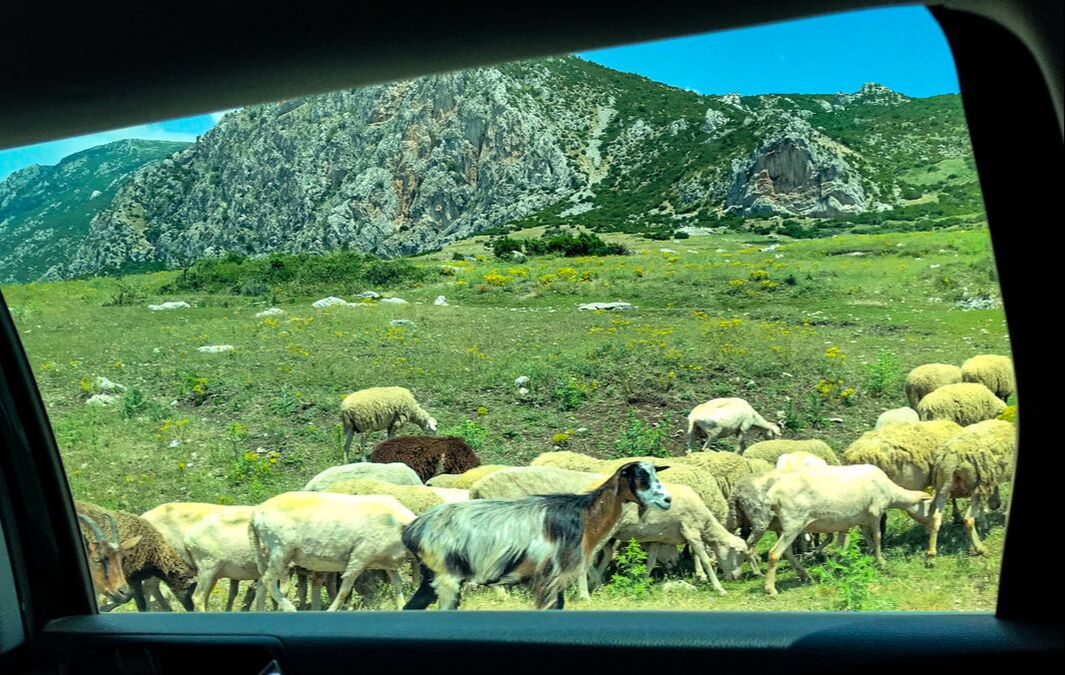
Last Friday we entered Albania over wooded mountains, descending into a broad green valley filled with working farms. Horses pulled ploughs and carts. Flocks of sheep and goats ambled beside the road. Men and women stood waist-deep in fields of purple flowers, harvesting blossoms and spreading them out to dry. Haystacks stood beside cottages that looked like illustrations from medieval fairy tales.
“Did we just go back in time?” said Rich.
Time seems to operate differently in the Balkans, and our destination, the lively, cosmopolitan city of
Korçë
, was no exception. Its checkered past included centuries of Ottoman rule, occupation by various European powers, and a grim isolationist period under communism. Having managed to remain separate from the USSR, Albania was fortunate enough to escape the ghastly Soviet brutalist architecture, so the visible reminders of Korçë’s history showed its Ottoman and European heritage. When freedom was declared in 1990, the city set to work sprucing itself up — painting buildings, expanding parks, adding daring new architecture, and opening shops, bars, and coffee houses galore.
All this plus low prices has made Korçë a popular regional vacation destination. But American visitors remain so rare that people would stop us on the street to exclaim, with surprise and pleasure, “Hey, did I hear you speaking English?” Normally, I’d expect this to be followed by solicitations for money, inappropriate sex, or worse, but in Korçë, people simply wanted to chat with us for the sheer novelty value.
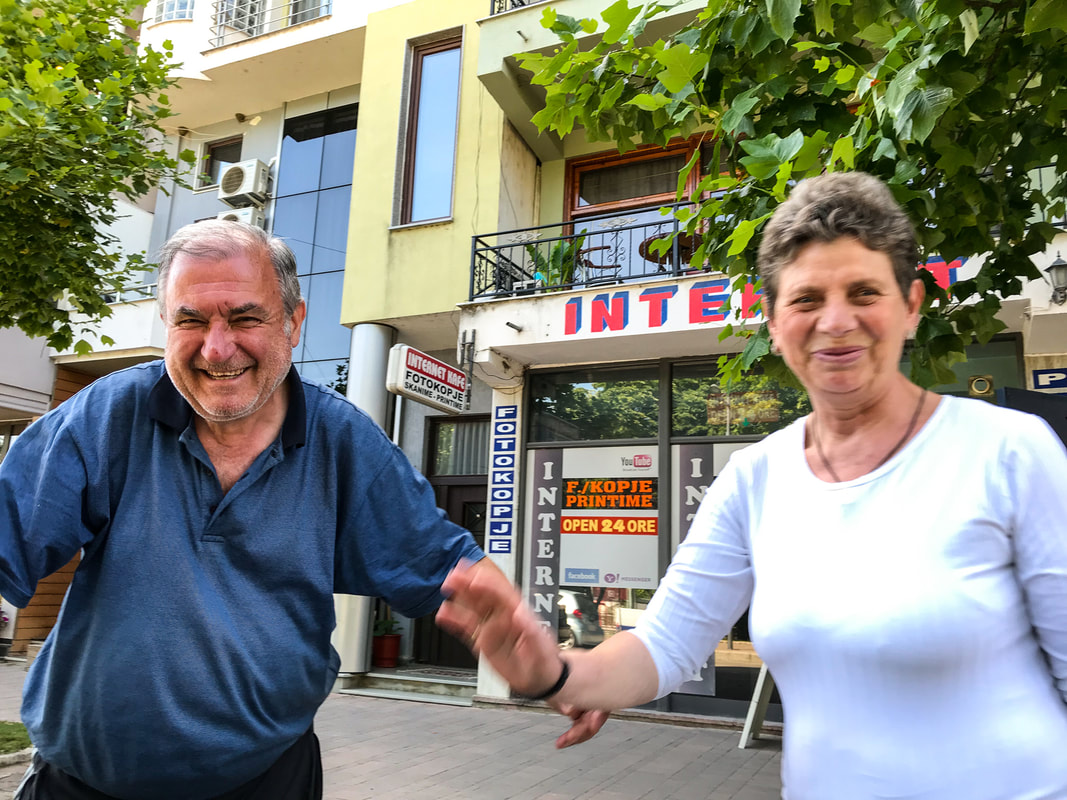
Of course, having practically no English-speaking visitors meant practically no English-speaking locals in service jobs, such as running our hotel. Fortunately, my family is big on charades, so upon meeting our hosts, Elena and George, I easily pantomimed my pleasure at finding that our room was spacious, sunny, and blessed with a balcony overlooking a tree-lined boulevard.
Rich produced a credit card, and here we hit a snag: the hotel only took cash and we had no local currency.
“Bank?” said Rich.
George and Elena nodded their understanding but were stumped as to where we might find such a thing. They took us outside and flagged down passing strangers, who looked equally dumbfounded by the question. A guy in a nearby shop added his two cents worth, and in no time there were eleven (I counted) people working on the problem. Eventually a group of women led us to an ATM five blocks away.
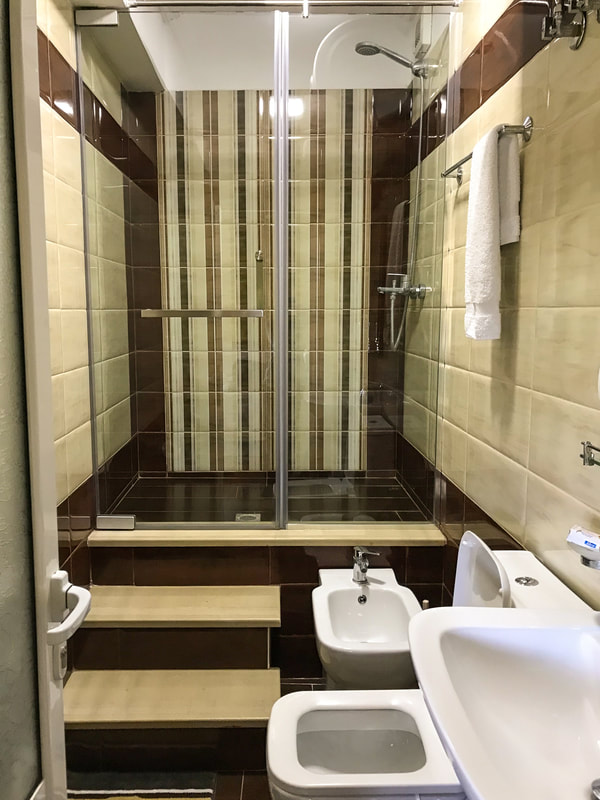
From the ATM Rich and I went on to lunch, so it was only later that I had a chance to check out our accommodations more thoroughly and discover the full, hideous reality of our shower. It was sparkling new and perched at the top of a flight of polished marble stairs, with no handrail. Instantly I pictured myself descending those slick steps with damp, slightly soapy feet and toppling to my doom. Stark naked, soaking wet, and crashing onto a bidet was not the way I wanted to go out.
“If you’re really concerned, we can always move to another hotel,” Rich said soothingly. “I know of one near here; we’ll go check it out.”
And that’s how we came to pay our first visit to
Bujtina Sidheri
, a marvelously atmospheric old hotel and restaurant with rough stone walls, beamed ceilings, and small, old-fashioned bedrooms. I could tell Rich wasn’t keen to move there because he instantly came up with a plan for emailing our current hotel, which prior correspondence showed had someone online capable of communicating in English. We could request another room with a more conventional shower, he suggested, citing my not-entirely-fictitious issue with mild vertigo. “But we should come back here to eat,” he said. “Online reviews say the food is great.”
The next morning Elena and George delivered a homemade breakfast to our room and conveyed via hand gestures that we were free to use the floor-level shower in the room across the hall. That’s when it dawned on us that we were the only guests in the hotel, which was deserted and eerily silent at all times.
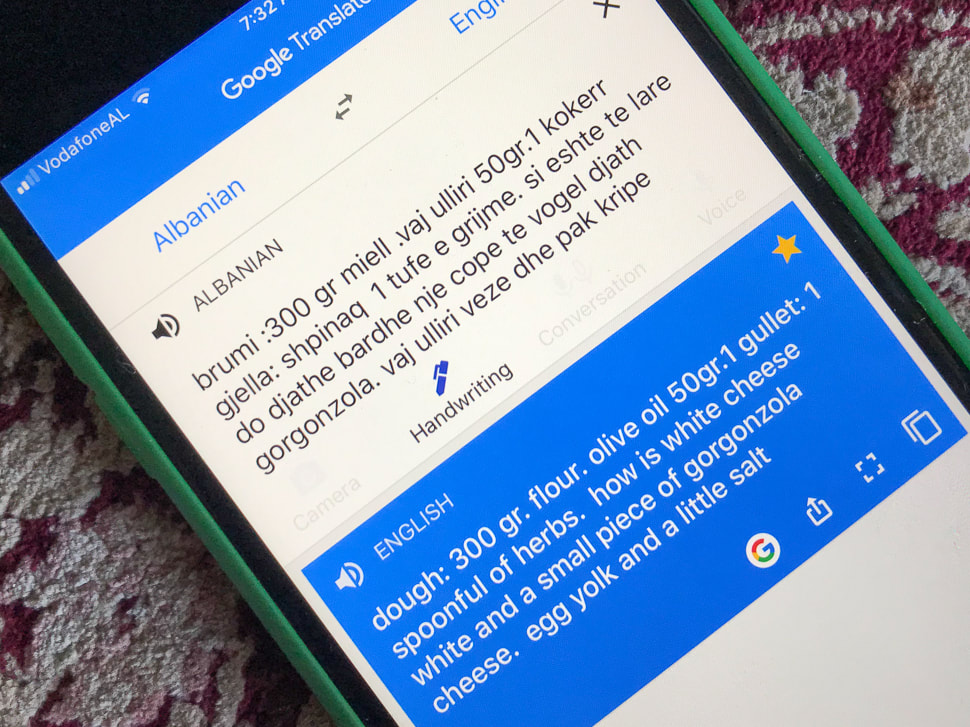
As was Bujtina Sidheri when we returned to it that night. Eventually we tracked down Griselda, the young woman who had shown us around the day before. Hastily concealing her surprise at seeing actual dinner guests, she escorted us to a table. There followed an elaborate interchange via pantomime, Google Translate, and smartphone photos, then Griselda disappeared in the direction of the kitchen.
“What did we just order?” I asked.
“Who knows? I’m sure it will be wonderful,” Rich said.
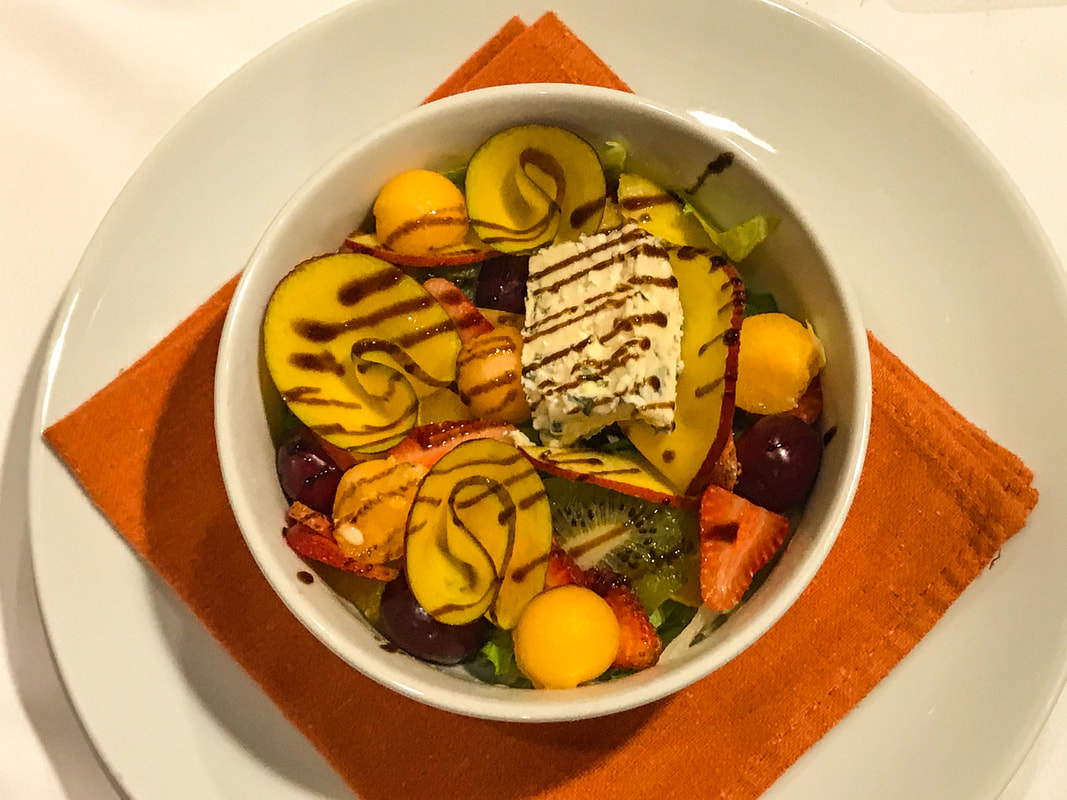
It was. Our salad had elegant slivers of apple, cantaloupe, strawberry, kiwi, and orange, some cherries, and a chunk of magnificent Gorgonzola, all drizzled with a balsamic vinaigrette. Rich’s pork came topped with avocado, pomegranate, and fresh dill. My chicken rollups were tender and perfectly sauced with a creamy chicken broth, a scattering of pomegranate seeds, a dusting of poppy seeds, and a pansy.
We’d just begun tucking into the salads when two musicians arrived with guitars. After a bit of banter with Griselda and cheerful nods to us, they sat down and began to play. The lighthearted folk music danced through the rooms, as perfect an accompaniment to the meal as the crisp white wine.
[Want to hear the tunes? Check out my video below.]
After spice cake with brandied pear, I used Google Translate to tell Griselda I was a travel writer and ask if I could return the next day to film the magic happening in the kitchen. She nodded enthusiastically. We set a time. And then the conversation floundered over the question of what would be prepared. The only word I clearly recognized in Google’s English translation was “cheeks.” I nodded and the matter was settled.
“You think she meant pork cheeks?” I asked Rich afterwards.
“You mean like the
carrillada
we eat in Seville? Who knows?”
Upon our return, we discovered Griselda was making spinach pie. Rich was aghast. “But we just filmed
spinach pie in Bitola
. Are you OK to do a repeat?”
I shrugged. “Let’s roll with it and hope for the best.”
We soon learned that the two pies do share a common tradition but vary wildly in execution. Griselda worked with two other cooks, Julia and Vida, their tasks as perfectly choreographed as a ballet. Together they created a streamlined version of spinach pie in just half an hour. It was twice-baked and emerged from the oven puffed up to enormous proportions, hissing steam like an outraged dragon.
Afterwards, as Rich and I sighed blissfully over the warm, flaky pastry and lush filling, I reflected that Albania was rather like this twice-baked spinach pie. It wasn’t at all what I’d originally expected, but it turned out to be absolutely wonderful — deeply traditional yet wholly original, surprising yet comforting. Our entire visit to Korçë had proved to be safe, fun, friendly, blessed with good food, and filled with quirky moments. And that’s just the way I like it.
[Recipe: Griselda’s Twice-Baked Spinach Pie]
UPDATE ON
OUR MEDITERRANEAN COMFORT FOOD TOUR
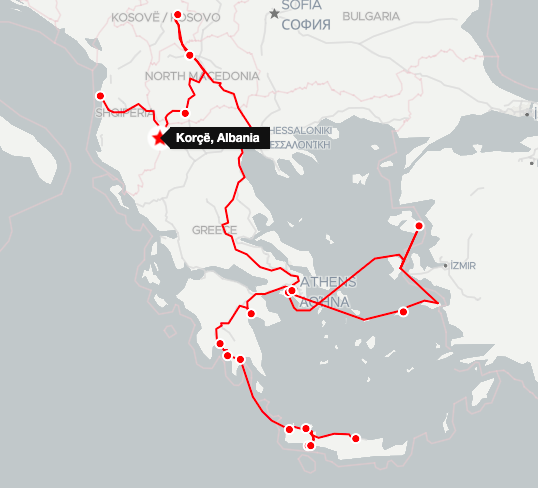
Days on the road: 75
Hotels & Airbnbs: 21
Buses: 13
Ferries: 6
Trains: 3
Trains canceled out from under us: 2
Memorable meals: too many to count
We’ve now left Korçë and moved west to
Durrës, Albainia’s main port and a popular beach resort for Italians and residents of the Balkans. Internet access is shaky, but I’ll post what I can here and on
.
If you haven’t already subscribed, sign up here so you don’t miss a single loony adventure or the next mouthwatering recipe.
YES! SEND ME UPDATES!
Thanks for joining us on the journey.
Leave a Reply