







“When you come to a fork in the road, take it.”
Yogi Berra
My sister-in-law’s new rescue dog — whose previous life was pretty grim — arrived with an ingrained habit of eating so fast it made her ill. Now Sophie gets her kibble in a slow feeder bowl designed with special ridges and pockets that require hunting for every bite in a sort of maze. These days her meals are considerably more leisurely and easier to digest.
No, I’m not suggesting you buy a slow feeder for your kids or grandkids. Sadly, the human tongue just isn’t up to the task. But it’s apparent that when left to our own devices, we humans have a Sophie-like tendency to wolf down our food. One of the major tasks of civilization has been to slow down our meals so we can savor them properly.
Until the mid-sixteenth century, most Western Europeans were perfectly happy with what the French call
service en confusion,
platters of foods tossed helter-skelter on a table while everyone grabs what they wanted and eats with their fingers. Like modern pizza nights, only with messier food and no napkins. When forks burst on the scene, this newfangled contraption was viewed as the devil’s implement. I mean, just look at the shape — straight out of Hades, right?
Early efforts to introduce forks went down in flames. In the year 1004, Greek Princess Maria Argyropoulina shocked the civilized world and her bridegroom, the son of the Venice Doge, by using a fork at her wedding. She had her eunuchs cut up her food and then she daintily lifted each bite to her mouth with this strange pronged instrument. The wedding guests gasped, scandalized.
“God in his wisdom has provided man with natural forks—his fingers,” said one irate clergyman. “Therefore it is an insult to him to substitute artificial metal forks for them when eating.”
When the princess died of plague two years later, Saint Peter Damien told everyone who would listen it was the Creator’s response to the fork incident. “This woman’s vanity was hateful to Almighty God; and so, unmistakably, did He take his revenge. For He raised over her the sword of His divine justice, so that her whole body did putrefy and all her limbs began to wither.”
Yikes! As you can imagine, that put a damper on fork usage, and for nearly 500 years people continued eating with their fingers and wiping them on their clothes in god-fearing righteousness. It was the Italians who first broke ranks, embracing the fork’s ability to gather up pasta more efficiently.
The French continued to turn up their collective noses at these unholy utensils.
According to popular legend, all that changed in 1533 when the fourteen-year-old Florentine princess Catherine de Medici married the future King Henry II of France. She supposedly brought along several Italian chefs and immediately had everyone cooking with garlic and truffles, and picking up forks to eat manicotti and lasagna.
That’s so not how it happened. For years Catherine was largely ignored by everyone who mattered because her husband was so besotted with his mistress, Diane de Poitiers, that his teenage queen was pushed into the background. Catherine didn’t bring any Italian chefs with her and was probably too busy trying to survive and, if possible, get pregnant with a royal heir to worry overmuch about what was happening in her kitchen.
The Italians in Catherine’s entourage, nostalgic for home cooking, found a surprising number of kindred spirits at the French court. In those days, the French were often in Italy engaging in minor warfare with various city-states. In between all the fighting, laying siege, pillaging, looting, and occasionally running for their lives, the French sampled the local food. They liked what they found and brought back fresh ideas, such as serving meals in courses, baking with butter — once ignored as “poor people’s fat” — and eating mushrooms.
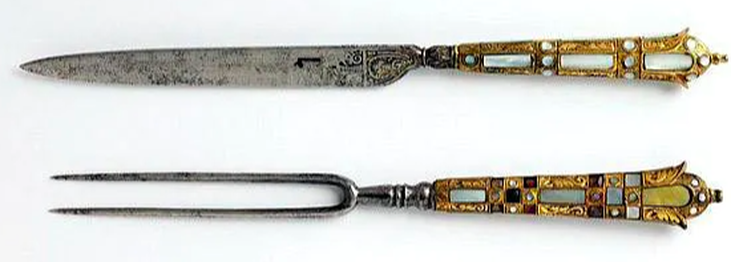
Catherine’s dowery included several dozen dinner forks crafted by the great Italian silversmith Benvenuto Cellini, and these gradually appeared on the dinner table. The French courtiers teased each other mercilessly over the amount of food they spilled learning to use the goofy new implements, but they eventually got the hang of things. Soon fashionable guests were showing up at dinner parties carrying a
cadena
, a specially made box (like those of dueling pistols) containing their personal fork and spoon.
The British held firm, continuing to despise forks as unmanly, proudly eating with their fingers for another 100 years. Then in 1633 Charles I declared, “It is decent to use a fork.” History buffs will remember Charles as the controversial king who ran afoul of everybody and was beheaded for treason, ending the monarchy and making England a republic. He is generally viewed as among worst kings ever inflicted on the realm. But a sound man on forks.
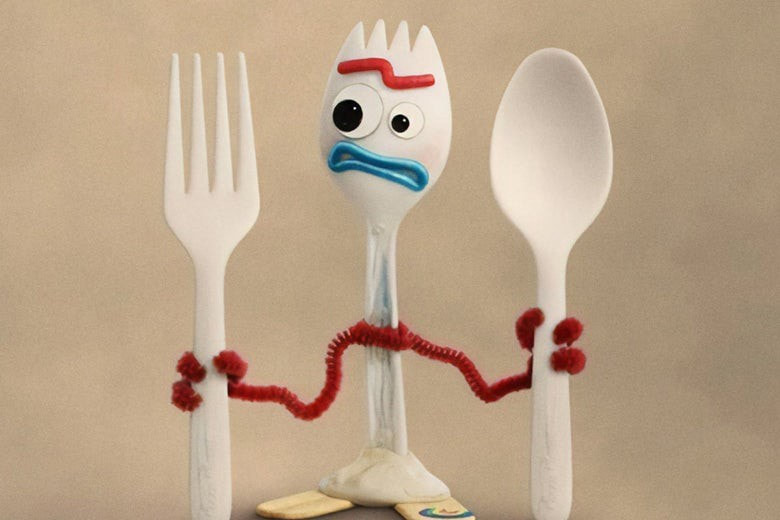
Since then forks have been showing up everywhere and taking on all sorts of shapes and functions. The Victorians went overboard creating special versions for spearing lettuce, fish, mangos, olives, pickles, and bread in a basket, to name but a few. The late nineteenth century sprang the spork (half spoon, half fork) on an unsuspecting public. Sporks became popular in the 1960s, and everyone attempted to figure out how to manage this awkward hybrid, which could stab your tongue if you tried to sip soup, yet had such stubby tines eating spaghetti was a hopeless struggle. Nowadays sporks are most often found in prisons, school cafeterias, and budget airlines.
How are forks likely to fare in the future? Some suggest they may be on the verge of extinction.
“The rise of casual dining, convenience foods and drive-throughs means that for the first time since the 1500s we regularly eat complete meals with our hands,” observes food writer Chad Ward. “Forks and knives may again become the source of confusion and social unease.”
Say it ain’t so! Because if the fork has given us anything (besides fewer stains on our clothing and tablecloths) it’s a sense of eating as an occasion worthy of thoughtful preparation and leisurely consumption. We don’t need a slow feeder bowl, or a staff of eunuchs peeling our grapes, to dine in civilized manner. All we have to do is follow the lead of Princess Maria Argyropoulina, Catherine de Medici, and other pioneers who had the courage to buck prevailing trends and pick up a fork at the dinner table.
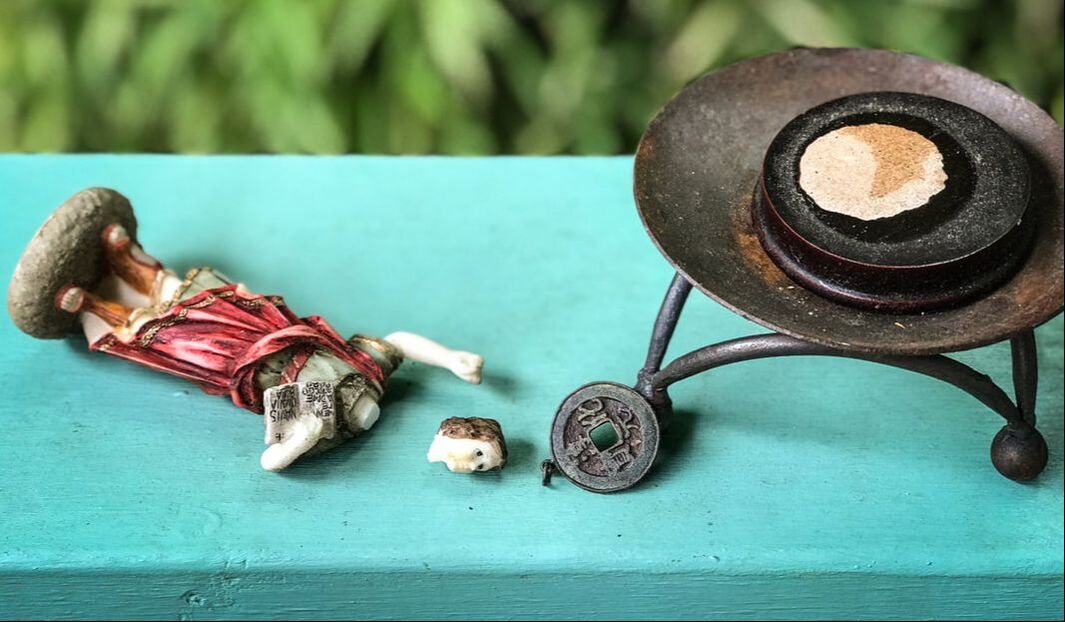
Oh no! Our statue of San Pancracio, Seville’s patron saint of health, suffered an accident this week, possibly knocked over by the neighbor’s cat. At the same time, Rich had a rebound, testing positive again for Covid. Coincidence? That’s for future historians to decide. San Pancracio has now been glued back together and Rich is testing negative again. Whew!
Well, that was fun! Want more?
Sign up to receive notices when I publish new stuff.
GET MORE FREE UPDATES HERE
I do my best with technology, but occasionally readers report snags when signing up for the blog or stop getting notices each week, usually due to spam filters. If that happens, send me an email and I’ll fix it.
[email protected]

Leave a Reply