
“Have you bought your miners’ headlamps yet?” a friend asked me.
“You mean, those lights you strap on your head? Do we need them?”
“They’re really great if you have to pick through rubble looking for survivors,” she said matter-of-factly.
Yikes!
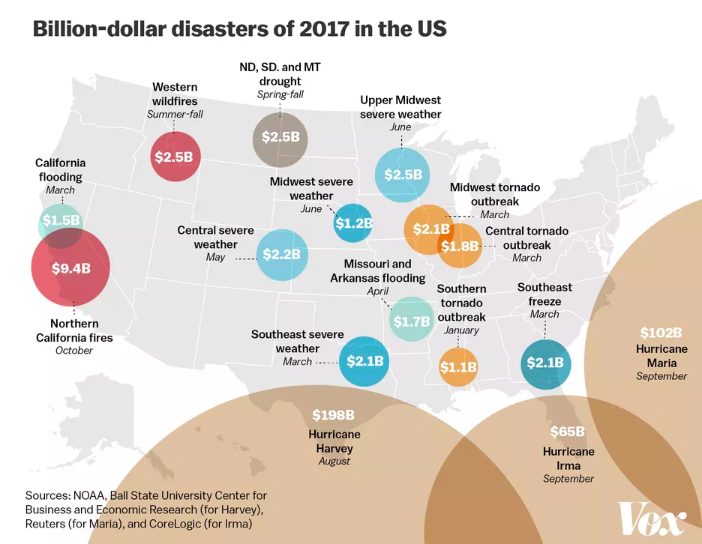
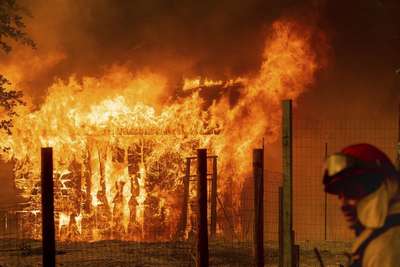
Perhaps the scariest part of that conversation was the way swapping tips for coping with mass catastrophes has become commonplace in the US. If you haven’t been caught up in a large-scale disaster yet, you know someone who has, and it’s clear you could be next. We’re all glued to our screens gasping at scenes of post-Florence flooding in the southeast, wildfires rampaging across California, and the rising death toll around the planet from heat waves and floods.
This is
“the face of climate change … playing out in real time,”
says top climate scientist Michael Mann. The
Bulletin of Atomic Scientists
, which measures planetary extinction-level events using the
Doomsday clock
, calculates we’re now just two minutes shy of midnight (aka Armageddon).
Is the world taking all this bad news with quiet dignity and grace? What do you think?
As any ostrich will tell you, the first line of defense is denial. Naysayers are shifting from “It’s not happening” to “It won’t affect me.” While five out of six Americans agree that climate change exists, more than half our citizens are convinced it will never directly impact them. You might want to ask the residents of North and South Carolina about that. Others, especially those a bit further inland who did not lose family members, homes, pets, businesses, cars, or their region’s power grid, are holding firm. They’re like teenage smokers who say, “I know you think smoking causes cancer but hey, I’m up to a pack a day, and all I have is this nagging little cough.”
Others believe the sky is falling and it’s all God’s fault. The Internet is awash with articles and videos titled “Are We Living in the End Times?” Everyone from Biblical scholars to Al Jazeera to survivalist cults are weighing in, with varying degrees of helpfulness and hysteria. The article “
Here’s Why You Really Need To Prepare Like A Survivalist Right Now
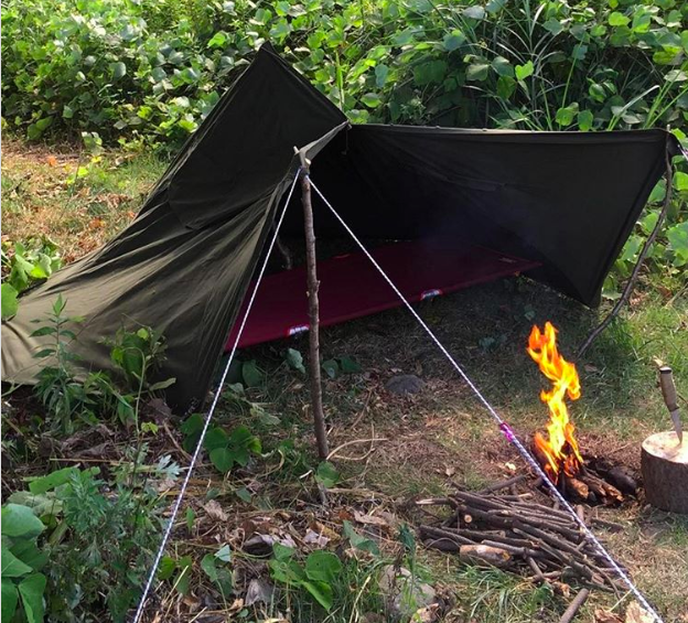
” urged us all to “get into a survivor mindset” and then showed this photo.
Really? I’m supposed to plan on sleeping rough and eating animals I kill and skin with that knife on the tree stump? Are you kidding me?
My home state of California has some of the world’s most unstable geography, but I am staking my life on the belief that the disasters I’m most likely to face will call for a very different set of survival skills. After a summer spent talking with fire survivors and reading the advice of experts, here’s the best wisdom I’ve learned.
Tip #1. Assess the dangers in your area.
In my home state of California, there is a 99.7% chance of a major earthquake by 2037. The wildfires that devoured 1.5 million acres this summer came within five miles of my cottage. Our town of San Anselmo has cycles of serious flooding and we’re due again by 2025. Obviously we’re living on borrowed time. But enough about me; what’s likely to hit your town? Blizzards? Tornados? Mudslides? “
Nowhere in this country can you say, ‘I have nothing to worry about
,’” points out meteorologist Steve Bowen. “You can move to escape a specific peril, but not peril in general.”
Tip #2. Prepare and practice your emergency plan.
As Rich and I discovered when we were evacuated during San Anselmo’s not-quite-as-serious-as-feared
flood of 2017
, the natural impulse is to leap in your car and careen wildly to higher ground. In our case, that left us stuck in a tangle of dead-end hillside roads, and eventually we had to drive back downhill and cross the rising floodwaters to reach someplace warm, dry, and equipped with sufficient chardonnay to sooth our nerves. For the next evacuation, we have selected a destination and practiced walking the 4.5 mile route, in case we have to flee on foot. The phone number and directions are in our address book under Emergency Hotel, as I fully expect to be too overwrought to recall my own name, let alone that of the rendezvous point.
Tip #3. Pack an emergency supply kit.
Rich and I spent all summer accumulating stuff we thought might come in handy: food, water, medical supplies, chocolate bars, vitamin G (aka gin), and a host of gadgets and gismos, all packed in a rolling cart for better fleeing mobility.
(See the full emergency packing list here.)
Tip #4. Vote for people who take climate change seriously.
“The record-breaking extreme weather events causing chaos across the globe should be a wake-up call,” said
Christiana Figueres
, architect of the UN Paris Climate Agreement, when I saw her this summer. “We will move to a low-carbon world because nature will force us, or because policy will guide us. If we wait until nature forces us, the cost will be astronomical.”
With large-scale catastrophes becoming America’s new normal, we’re all struggling to cope. As one journal noted with magnificent understatement, “Whether natural or man-made,
disasters cause many of us to feel increased levels of stress and anxiety
.” While most of us channel our nervousness into stocking up on canned food, jittery young people, fearing they’ll come of age in a post-apocalyptic landscape, are signing up for
courses like this
:
“Rich, do you think we need to learn to make our own glue and rope?” I asked dubiously.
“No. If it comes down to that kind of stuff, we’re toast. Do you think we need to pack more vitamin G?”
“Absolutely. And more chocolate.”
Clearly our work isn’t done yet. A few days ago, I spoke with my friend to reassure her we were now the proud owners of miners’ headlamps.
“Terrific. Do you guys have walkie-talkies? You know the phones may be out.”
And so the shopping continues.
Stay safe out there, my friends, and send me any good emergency prep tips you know! And by the way, I’m on the road next week, so I won’t be posting. Just didn’t want you to worry I’d disappeared into America’s disaster vortex.
EMERGENCY! HEAD FOR HIGHER GROUND — NOW!
PACKING FOR CALIFORNIA’S DANGER ZONE
SURVIVING AIR DISASTERS, ZOMBIE ATTACKS & MORE
Leave a Reply