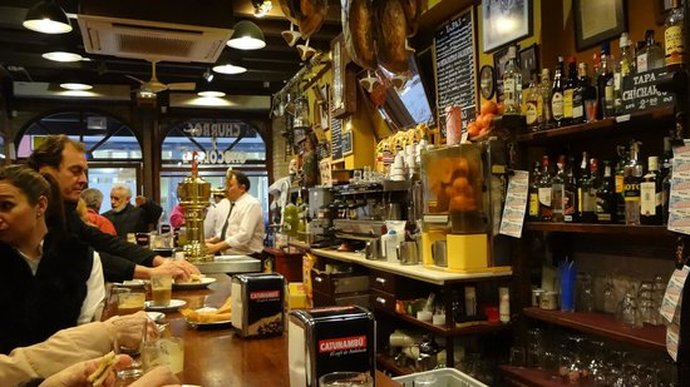

Wednesday morning, I had a truly astonishing experience. I sat in a coffee house surrounded by more than a dozen people of various ages and nationalities, and — get this! —
not one of them was using an electronic device
. I didn’t see a single laptop or iPad, and while one woman did pull out her smartphone to give it a casual glance, she soon put it away. Everyone was
talking
to one another.
“And that’s why we live in Seville,” I said to Rich, as he returned from the counter with
café con leche
.
We’d been back in Seville less than a week, and as so often happens during reentry, I was struck by the tremendous pleasure everyone here seems to find in the simple act of going out to breakfast. That particular morning was icy cold, the temperature just above freezing, and everyone came in at a rush, exclaiming about the weather and exchanging a bit of banter with the barmen as orders were placed and hot coffee dispensed. At the old marble-topped tables, people shed coats and settled in, enjoying the steamy warmth of the café, waiting for the barman’s shout, barely audible over the hubbub of talk and laughter, that would alert them when their food was ready.
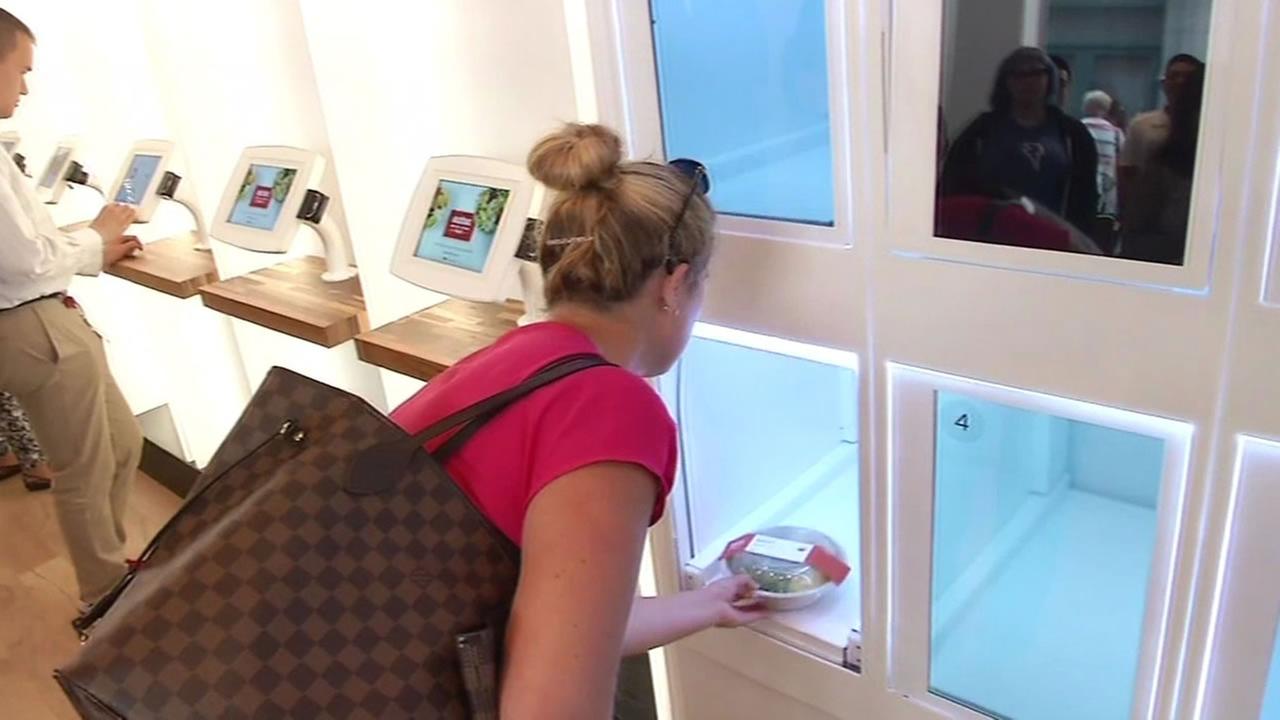
“So I’ve been reading about this new chain of fully automated fast-food restaurants in San Francisco and New York,” I told Rich, as he tucked into hot toast topped with slivers of ham and a generous drizzle of olive oil. “You order and pay via iPad, then collect your order from a glass cubby, all without ever interacting with — in fact, without ever
seeing
— another human being. People are calling it the future of dining.”
He shuddered. “God, I hope not.”
The chain,
Eatsa
, is actually a pretty good idea. The menu is simple, bowls of
quinoa
covered with various toppings, offering an inexpensive ($6.95), fresh, vegetarian meal in cities where even a cheese sandwich and a Coke can, with tip, cost you $25. But it’s hard not to view fully automated dining as one more way machines are taking over human functions, eliminating not only jobs but the small interactions that make us feel connected with our community. Let’s face it, you can’t exchange banter about the weather with an iPad.
Don’t get me wrong; I’m a huge fan of technology. I love the snappy give-and-take of social media and the ease of online research when I’m writing. I can’t wait until driverless cars become affordable. And it’s hard to argue against factories using machines for the most difficult, dangerous, repetitive tasks. But where is all this automation heading?
“47% of All Jobs Will Be Automated by 2034 and ‘No Government Is Prepared,’ Says Economist,”
proclaimed a headline in HuffPost Tech UK.
The Economist
, drawing heavily on a 2013
Oxford Martin School study
, predicts that automation will make nearly half of all human jobs obsolete in the very near future, and that this will unleash a “tsunami of social change.” Yikes! What might
that
look like?
But let’s not get carried away here. Before we start massing for an attack on Skynet, let’s take a look back at other predictions made by people who were absolutely, positively certain they knew about the shape of things to come.
“The telephone has too many flaws to be seriously considered as a means of communication.”
Western Union President William Orton, 1876
“The cinema is little more than a fad.”
Charlie Chaplin, 1916
“Atomic energy might be as good as our present-day explosives, but it is very unlikely to produce anything more dangerous.”
Winston Churchill, 1939
“Television won’t last; it’s a flash in the pan.”
Radio pioneer Mary Somerville, 1948
“Rock and roll will be gone by June.”
Variety Magazine, 1955
“Online shopping is feasible but will flop.”
Time Magazine, 1968
“There is no chance that the iPhone is going to get any significant market share. No chance.”
Microsoft CEO Steve Ballmer, 2007
Nobody can ever be sure where the world is headed; these days, the most anyone can say with certainty is that we live in
very
interesting times. For now, I am sustaining myself by clinging to the small pleasures. Like a warm café on a brisk winter morning, where a smiling Spaniard is waiting at the espresso machine, ready to remark that it’s so cold out, the politicians have their hands in their
own
pockets. Whatever happens, I hope and pray that some jobs will always be done by humans, and that we can continue to count on our local baristas for fresh coffee, old jokes, and worldly wisdom to start the day off right.
YOU MIGHT ALSO ENJOY
7 THINGS TO AVOID WEARING ABROAD
8 TRICKS FOR SURVIVING DISASTERS
WHEN BANANAS GO BAD
Sign up for my blog here
Buy my books on Amazon
Leave a Reply