


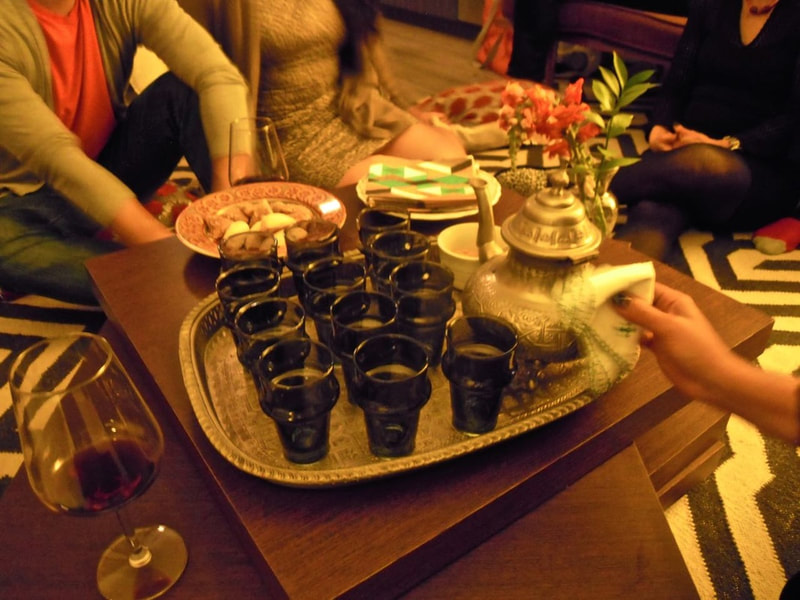
“If you really want to make a friend, go to someone’s house and eat with him,” said civil rights activist Cesar Chavez. “The people who give you their food give you their heart.” In the past, it was a bit tricky to convince strangers to allow you into their home at all, never mind asking them to provide you with a sumptuous meal, hours of sparkling conversation, and possibly a piece of their heart. But nowadays, thanks to
EatWith
and
other meal-sharing apps
, you can connect with people all over the world who love to cook and entertain.
[Here’s how it works.]
For me, a lot of the appeal is the adventure of never knowing quite what to expect.
Take last Friday, for example. Rich and I rolled into Athens late in the morning, utterly relaxed and contented after our time on the islands of
Lesbos
and
Ikaria
. That feeling lasted just about as long as it took us to pull our bags out of the taxi’s trunk and drag them to the sidewalk. Every one of the city’s 3.5 million residents seemed to be rushing furiously past us, shouting into their phones against a backdrop of graffiti so virulent that I could almost hear it howling. We had arrived a few minutes early for an EatWith luncheon and hovered on the sidewalk, feeling invisible and adrift in the crowd.
“Karen?” said a voice.
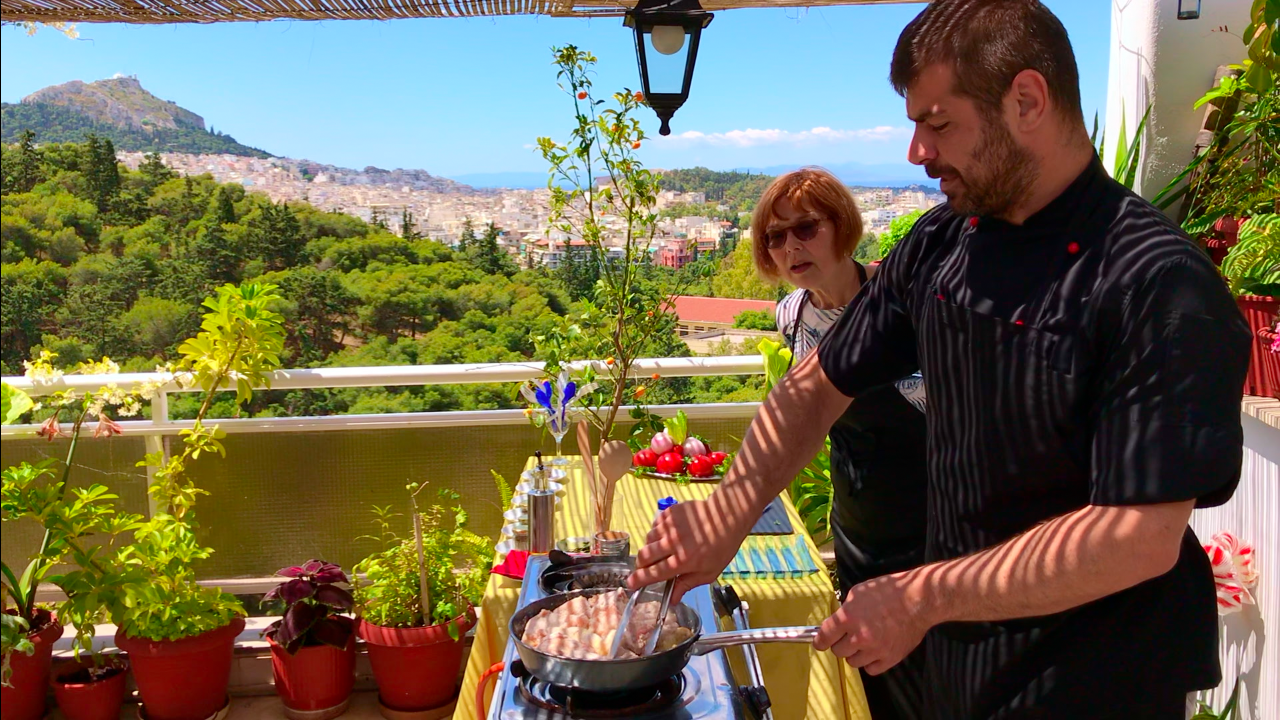
I turned to find our co-host, Nikos, smiling in welcome. In minutes we were on the balcony where his partner, chef Michail, stood in a flower-decked open-air kitchen, shaded with a wooden lattice and overlooking Athens and the Acropolis. Against this breathtaking backdrop, he proceeded to teach us how to cook one of his signature dishes:
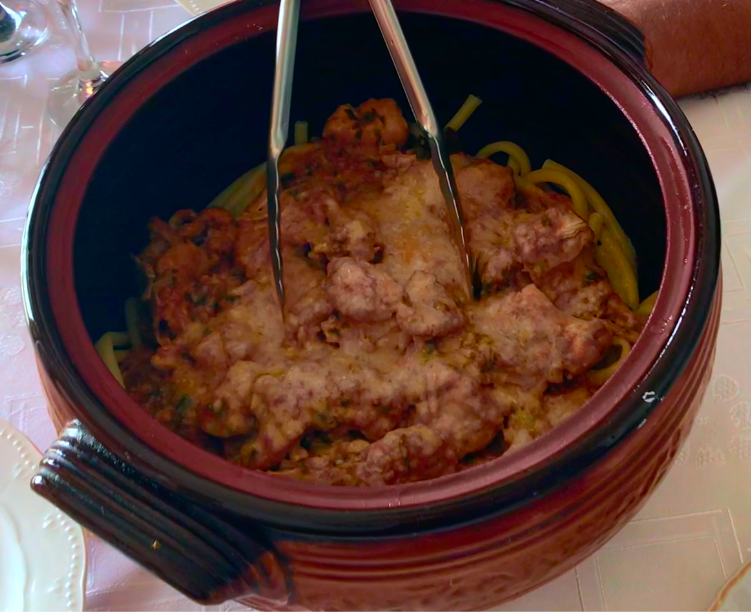
Corfu Pastitsada with Free-Range Rooster and Pasta
.
Now, I know what you’re thinking: isn’t rooster a tough old bird? Ordinarily, yes. Years of servicing hens, fighting off other roosters, breaking up fights about the pecking order, and defending the flock from the occasional hawk or racoon leaves the mature country rooster lean, mean, and leathery. That’s why Michail’s recipe calls for a younger bird, about eight months old.
I’d never cooked a rooster and was delighted when our hosts agreed to let me film the whole process. Then we learned Nikos had trained as a camera man, and Rich was only too happy to share the role of videographer with someone who actually knew what he was doing.
[See the full rooster recipe here.]
Late that afternoon, as we bid a fond farewell to Nikos and Michail and the remains of the rooster, I reflected that the act of eating in community is — at its best — nourishing for both body and soul. This proved true all over again a few days later in a very different setting, when Rich and I volunteered at a soup kitchen run by the
Caritas Athens Refugee Program
.
Rich and I had heard about the soup kitchen two weeks before over breakfast at our hotel on Lesbos Island. I had fallen into conversation with Ann and Linda, two American sisters (siblings, not nuns) who were on the island visiting the refugee camps. As you may recall, in 2015 tens of thousands of asylum seekers — many fleeing wars in Syria, Iraq, and Afghanistan — crossed the 3.4 mile gap between Turkey and Lesvos Island on whatever boats they could find in order to seek sanctuary in the European Union. People met them on the beach with water, blankets, and tarps, but the island was quickly overwhelmed. “Refugees were sleeping everywhere, even on the sidewalks,” a local man told us.
In the ensuing chaos, temporary camps were set up as a stepping stone to more permanent relocation. But years later, refugees are still arriving, and fewer are getting moved on, thanks to tougher EU policies closing down options. In the largest camp, Moria, “the
overcrowding is so extreme
that asylum seekers spend as much as 12 hours a day waiting in line for food that is sometimes moldy. Last week, there were about 80 people for each shower, and around 70 per toilet,” reported the NY Times. The filth, squalor, and violence have led to widespread disease and an epidemic of suicide attempts. And these two nice women had gone there?
“We mostly spent time at
Pikpa Camp
, which is really well run,” one told me. “It’s where they send the most vulnerable refugees, who simply can’t survive at Moria.” She gave me the contact information, and with some trepidation, I emailed the camp and they kindly agreed to let us visit.
Contrary to all my expectations, the visit was inspiring. Staff members Derek and María showed us around the tidy cabins, the communal garden, the kitchen, the “store” where donated clothing and supplies are given out, the tiny medical clinic. They told us about refugees learning to sew so they could transform the life jackets they’d worn on the crossing into
Safe Passage Bags
, which are now sold in a local shop and online. This was a refugee camp done right, a bright contrast to Moria which, when we stopped by, was just as grim as you’d expect. And no, I can’t bring myself to post any photos of that visit.
When families and individuals are lucky enough to get processed out of the Lesbos camps they often wind up in Athens, where living conditions may be better but
negotiating the inscruitable processing system
can take long, frustrating, sometimes desperate years. Every day, hundreds get their main (often only) meal at the soup kitchen run by Caritas Athens Refugee Program. Having volunteered for years at a Cleveland soup kitchen, I thought I knew what to expect. Boy was I wrong. I haven’t worked so hard in decades! I spent half an hour peeling cloves of garlic, then three hours cleaning trays as fast as I could — as more and more kept piling up. If you’ve seen the Sorcerer’s Apprentice you’ll have a pretty good idea of the relentless pace.
The staff and volunteers — Greek, British, German, Australian, American, and others — were astonishingly organized, efficient, and cheerful. The clients were mostly refugees from Afghanistan, Iran, Iraq, and the drought-ridden Horn of Africa, plus some Greek families who had fallen on hard times, and a handful of other Europeans. The staff made sure everyone felt welcome and respected, and while many clients seemed too shell-shocked to talk much, lots of them — especially the kids — clearly knew each other and chatted like old friends.
In the brief interludes when I wasn’t frantically swabbing trays, I enjoyed the sound of the talk and laughter. To me, that’s one of the most comforting sounds in the world: people enjoying their meal and the pleasure of each other’s company. Whenever we break bread together, we establish, however briefly, a circle of community and belonging. That’s a welcome solace for anyone and doubly precious when you’re among strangers, far from the place you once called home.
We’ve been on this journey 41 days. What a ride so far!
LEARN MORE ABOUT OUR MEDITERRANEAN COMFORT FOOD TOUR.
SIGN UP TO RECEIVE UPDATES AS WE GO.
YOU MIGHT ALSO ENJOY
HOW EATWITH WORKS
THE ROOSTER RECIPE
THE KINDNESS OF STRANGERS
Leave a Reply