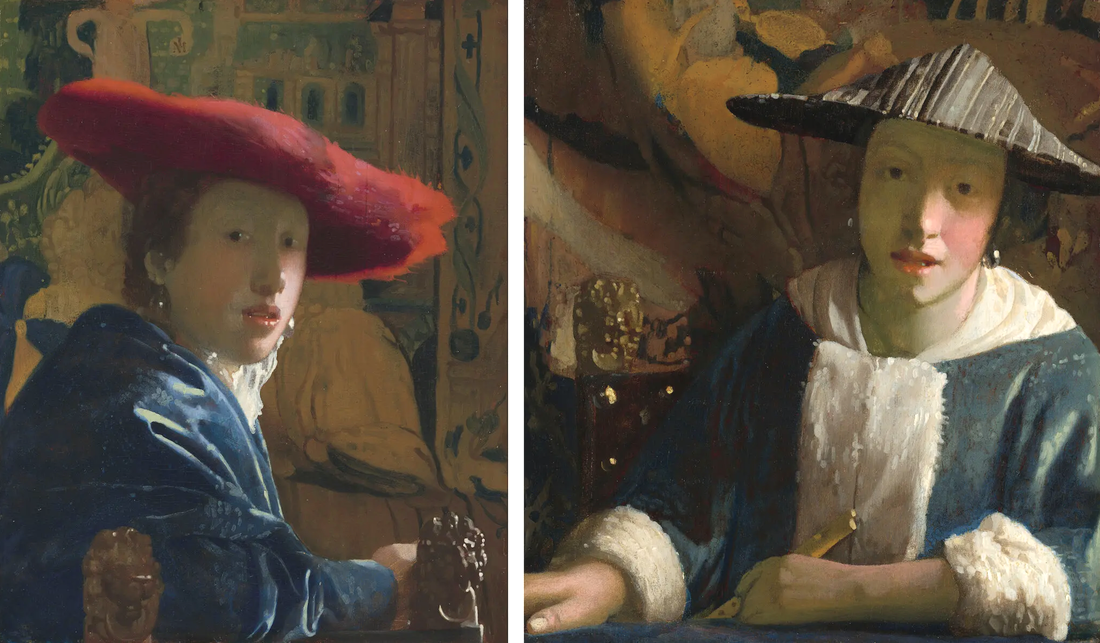


Can you spot the real Vermeer?
If not, don’t worry, because neither could the National Gallery of Art in Washington — from the time it was donated in 1942 until last week. New tests revealed Vermeer didn’t paint the one on the right, which I call “Girl with an Even Goofier Hat,” although the museum displayed it as “Girl with a Flute.” As if anyone was going to pay attention to the flute with that striped headgear staring them in the eye.
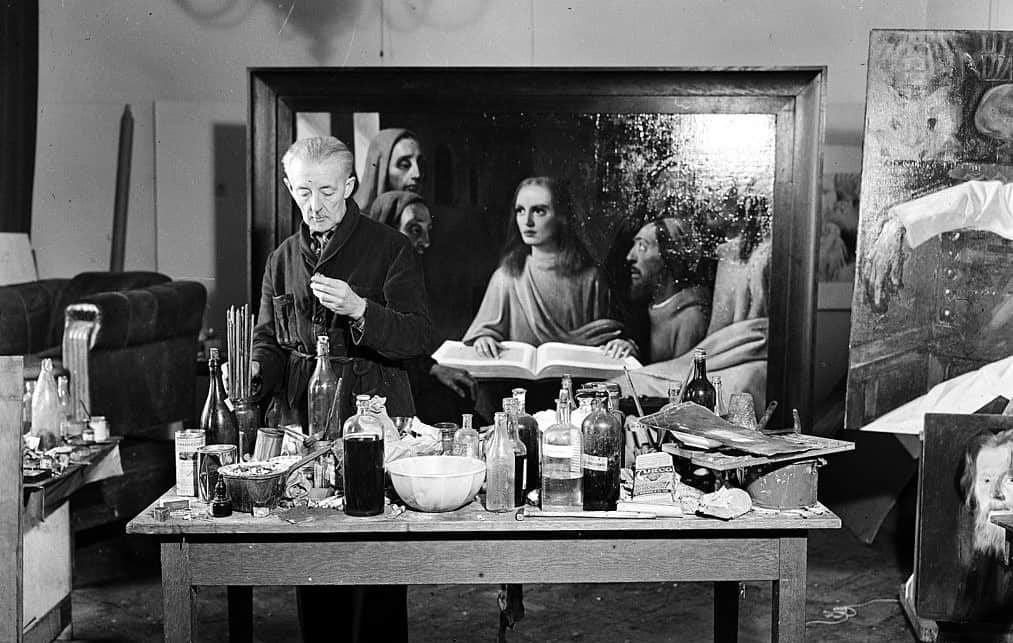
The National Gallery of Art is busy wiping the egg off their faces and consoling themselves that at least they didn’t pay a cent for the painting. Not all their colleagues have been so fortunate. Master forger Hans van Meegeren alone sold “Vermeers” to seven other museums for a total of $20 million. As for the highly respected Metropolitan Museum of Art in New York, 40% of the works in their collection are fakes, according to its former director Thomas Hoving.
I’m always shocked by such revelations. My mother brought me up to revere museums as temples of civilization’s achievements. In college, my art history professors taught me to respect art for revealing unsuspected truths about our culture and ourselves. It’s demoralizing to know so many museums I’ve loved are filled with knock-offs and pirated goods, like the lair of a successful con artist.
Staff member Xiao Yuan said he spotted fakes on the first day of his job as chief librarian at the Guangzhou China Academy of Fine Arts. After a while, he decided to get in on the action. Over time, he made 143 copies, leaving them in place of originals he auctioned off for $3.5 million. Then he discovered he wasn’t the only one getting up to such hijinks.
“
I realized someone else had replaced my paintings with their own because I could clearly discern that their works were terribly
bad
.
” At least Yuan still had some aesthetic standards.
And what about Jackson Pollock’s paint drips or Mark Rothko’s fuzzy rectangles? A math professor in Queens created such convincing “new” works by these and other modern artists that New York’s venerable Knoedler Gallery bought them for twenty years — and sold them for enormous profit. There’s still hot debate about the legal outcome of the $80 million scandal, as told in the film,
Made You Look: A True Story of Fake Art
.
OK, I agree it’s hard to work up sympathy for billionaires bilked by greedy art dealers. But what about nations whose historic treasures have been looted? Most famously there are the Elgin Marbles, hacked off the Parthenon in the nineteenth century, sold to the British government, then donated to the British Museum. Lord Elgin claimed he’d obtained permission from their legal owner, the Ottoman Empire, but the documentation is dubious, an English translation of an Italian transcription of the lost original. The Greeks want their sculptures back, but the prevailing attitude has been, “Finders keepers.”
“We can’t even think about returning the Elgin Marbles to Athens until the Greeks start caring for what they already have,” said archaeologist Dorothy King, author of
The Elgin Marbles
. “If you knew a woman was abusing her child, you wouldn’t let her adopt another. And that’s what the Greeks are asking for.” What? No, it’s not! In that scenario, the Greeks are the mother demanding the return of her kidnapped child. The Greeks kept the sculptures safe for 2000 years, the Venetians blew them up, and the British damaged them with wire cleaning brushes. Who’s the fit custodian? Rumors abound that the Elgin Marbles will someday be “shared” with Greece. I’m not holding my breath.
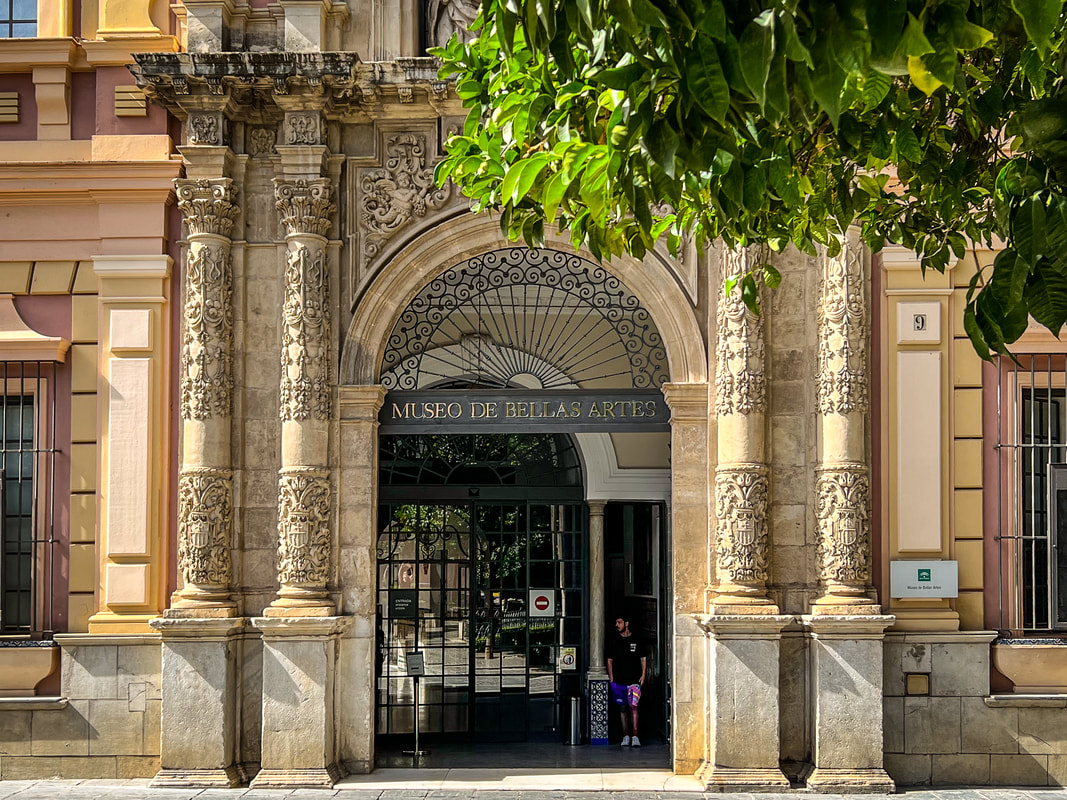
You can’t actually call it looting, but Seville’s
Museo de Bellas Artes
(Fine Arts Museum) is likewise filled with ancient works of art removed by force from their original home. During the nineteenth century, Spain’s government decided to redistribute some of the wealth of the Catholic Church by closing down convents and monasteries and seizing their possessions, including art and real estate. Priceless paintings and sculptures went to museums or were sold to enrich government coffers. Among the seized real estate was the 17th century Convent of
La Merced Calzada
, now home to the
Museo de Bellas Artes
, which I visited this week.
The room marked
Colección permanente
houses some wonderful medieval works, and from there the galleries continue chronologically through the Renaissance and pieces by such Spanish grand masters as Velázquez, Goya, Murillo, and Zurbarán.
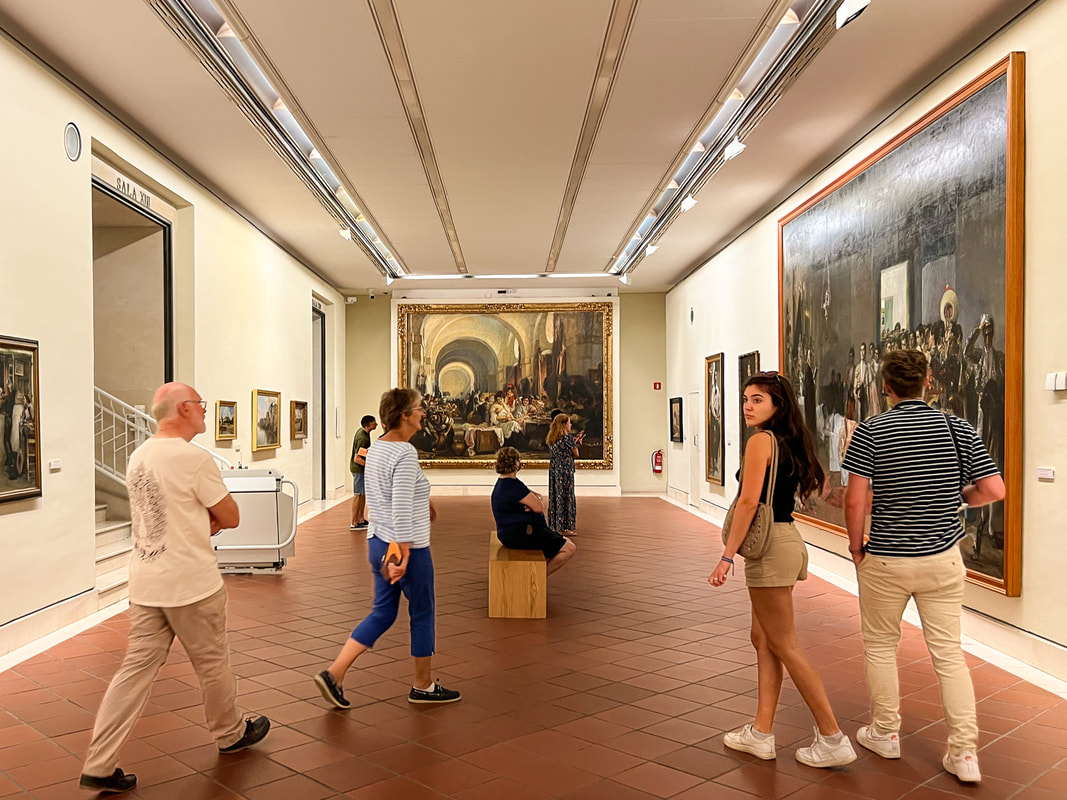
But for me the exhibits really come alive in rooms XII, XIII, and XIV, which house more modern paintings that certainly never graced the walls of religious institutions. This is where my Spanish teacher took me so I could witness Andalusian life in the 19th and early 20th centuries.
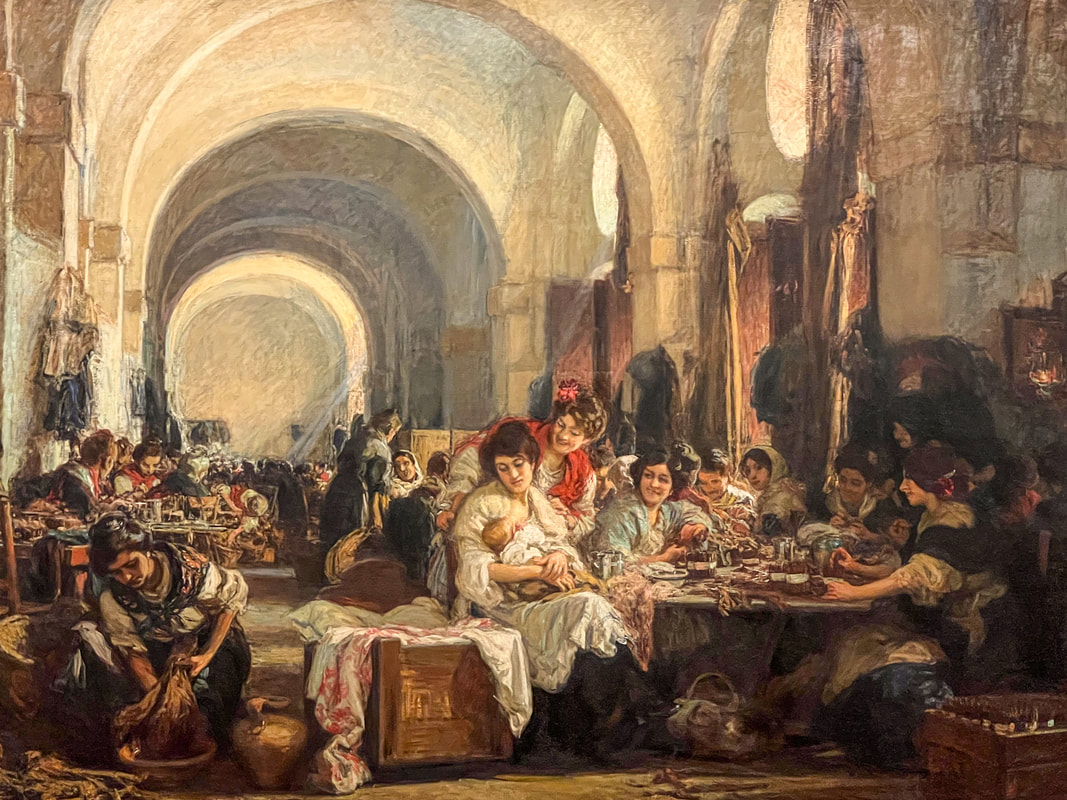
Las Cigarreras
(The Cigar-makers, 1915) is one of my favorites. When tobacco began arriving from the New World, Seville built a huge factory and hired women for their agile fingers and lower wages. It became one of the first places women could work at a paying job outside the home (or the streets). Women brought their nursing babies, inspiring artist Bilbao Martínez to give the central figure a Madonna-like pose.
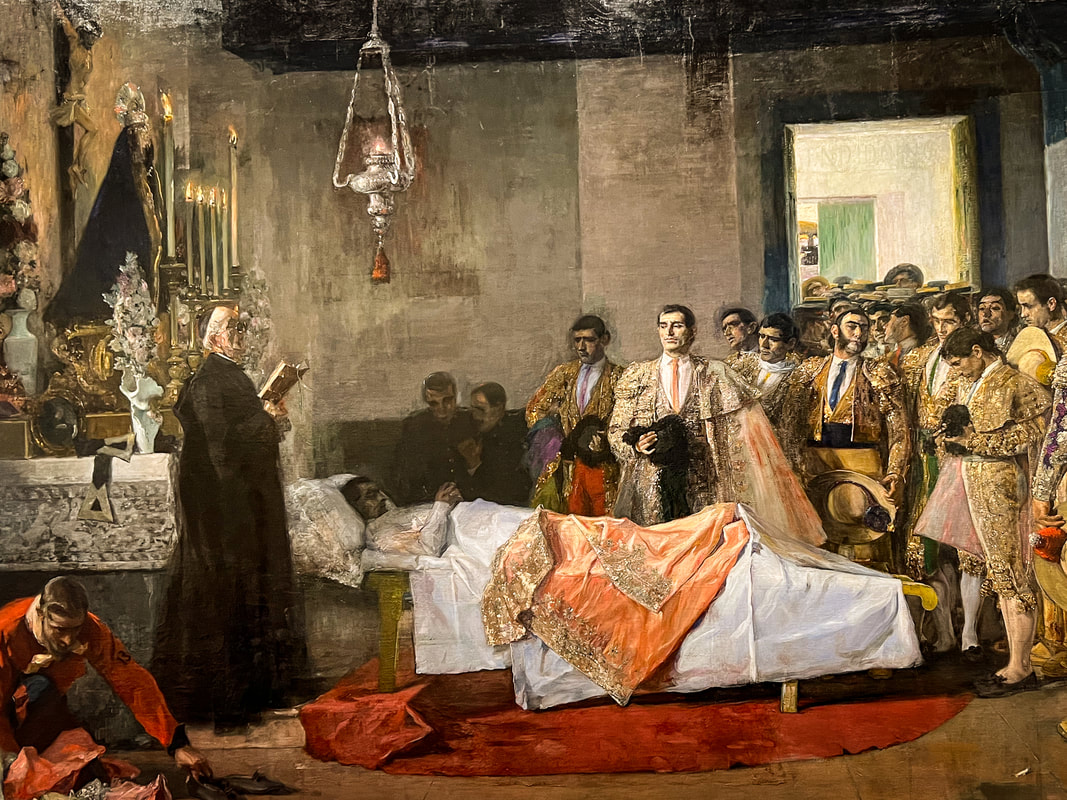
Bullfighters rarely die in the ring itself. In
Muerte del Maestro
(Death of the Master, 1913), artist José Villegas Cordero shows Bocanegra on his deathbed after being tossed and gored in Seville’s bullring in 1880
.
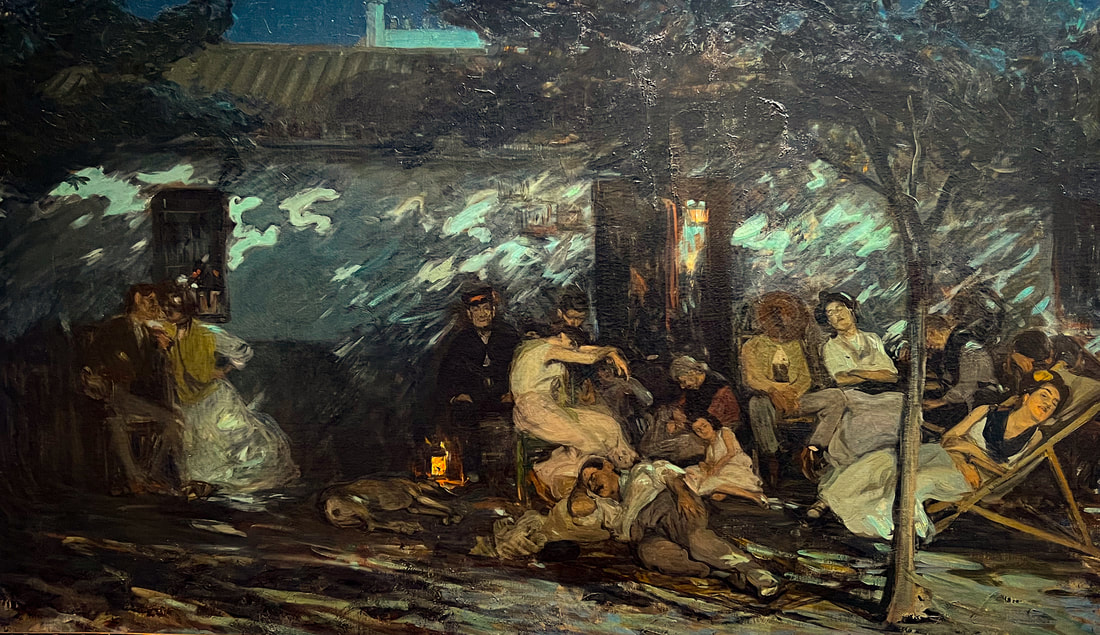
Before air-conditioning rendered the steamy Andalucian summer nights more bearable, people used to go sleep by the river, with the night watchman in attendance.
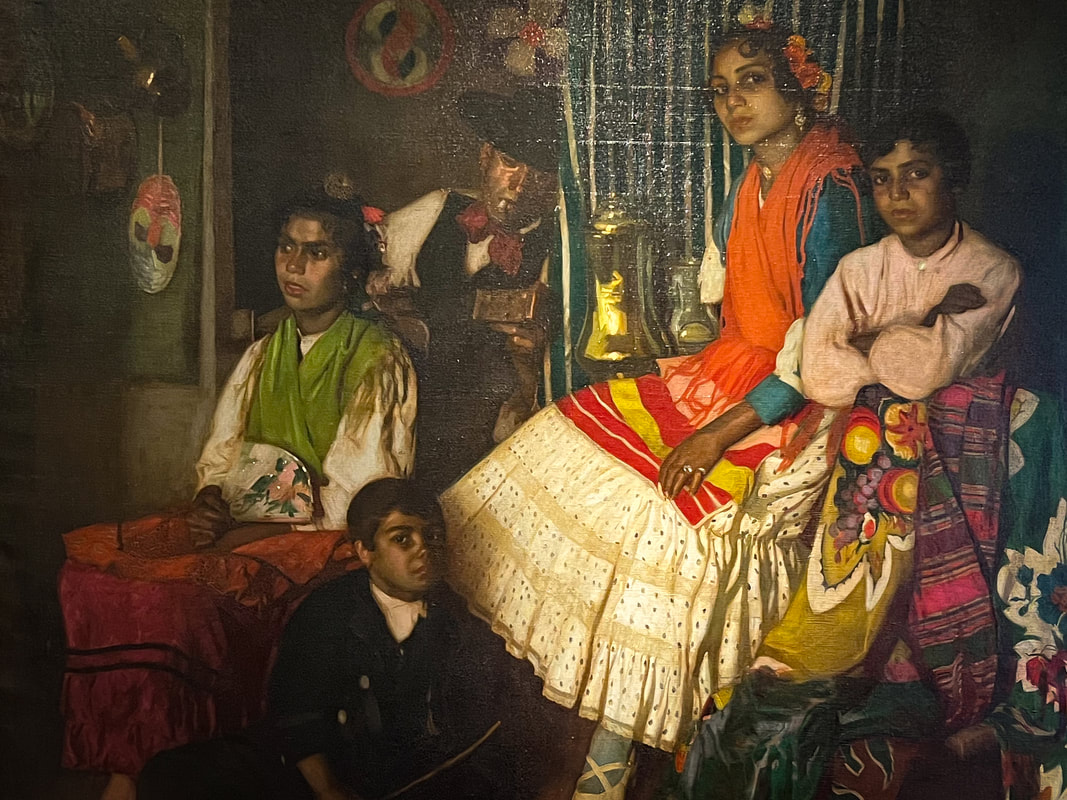
The Romani people have been part of Seville’s culture for as long as anyone can remember, introducing flamenco to Europe and inspiring the colorful dress worn in Seville’s annual
Feria de Abril
(April Fair).
I can’t swear there isn’t a single fake in the
Museo de Bellas Artes,
although if I were a forger, I’d certainly stick with more marketable, lucrative artists like Pollock and Rothko. Spain considers this museum second only to the Prado in importance, but you don’t really come here for celebrity artists, you ramble about enjoying intimate glimpses of the past. “Don’t go to a museum with a destination,” advised New York art critic Jerry Saltz. “Museums are wormholes to other worlds. They are ecstasy machines. Follow your eyes to wherever they lead you, stop, get very quiet, and the world should begin to change for you.”
WELL, THAT WAS FUN. WANT MORE?
If you would like to subscribe to my blog and get notices when I publish,
just send me an email. I’ll take it from there.
[email protected]
Yes, my so-called automatic signup form is still on the fritz.
Thanks for understanding.
YOU MIGHT ALSO ENJOY
THE ART OF BREAKFAST IN SEVILLE
SEVILLE’S VIBRANT ART COMMUNITY
SEMI-DEBUNKING THE VIRGIN OF THE NAPKIN

Leave a Reply