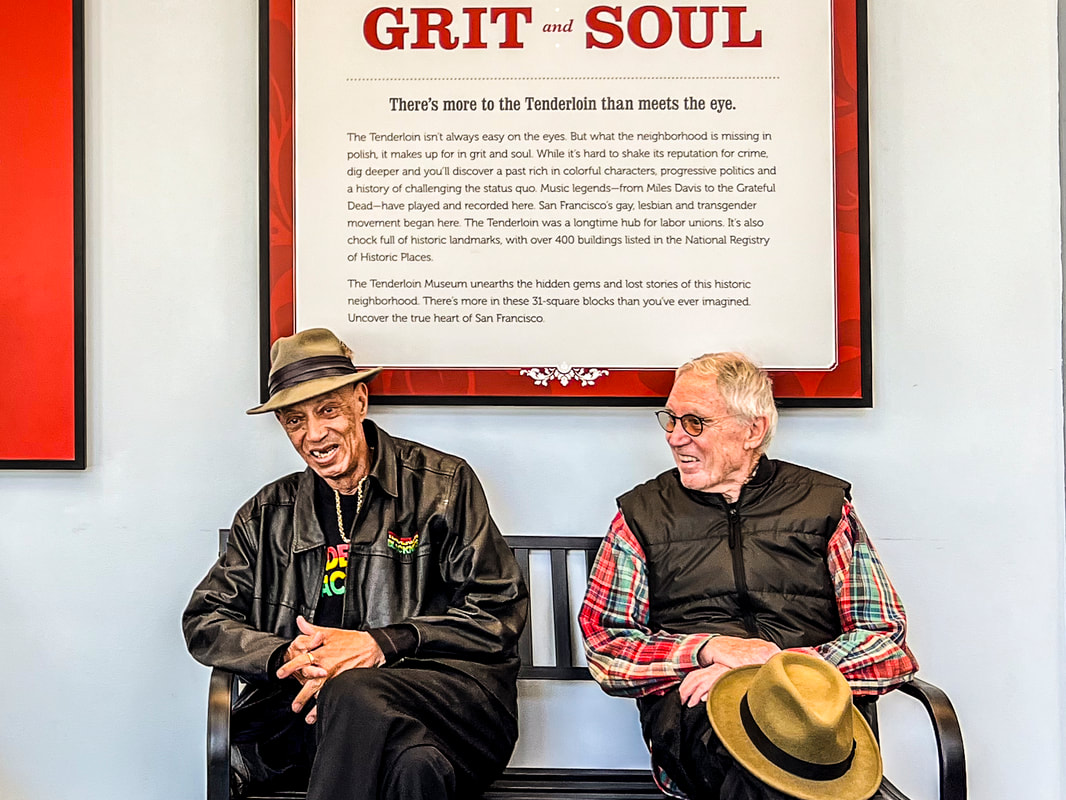
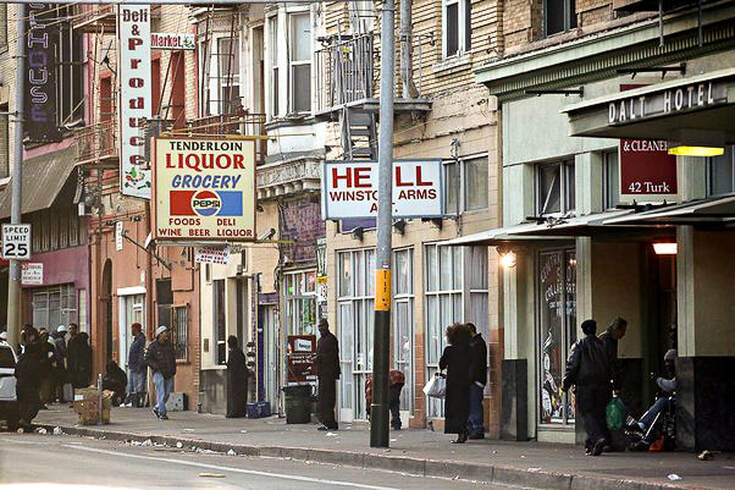

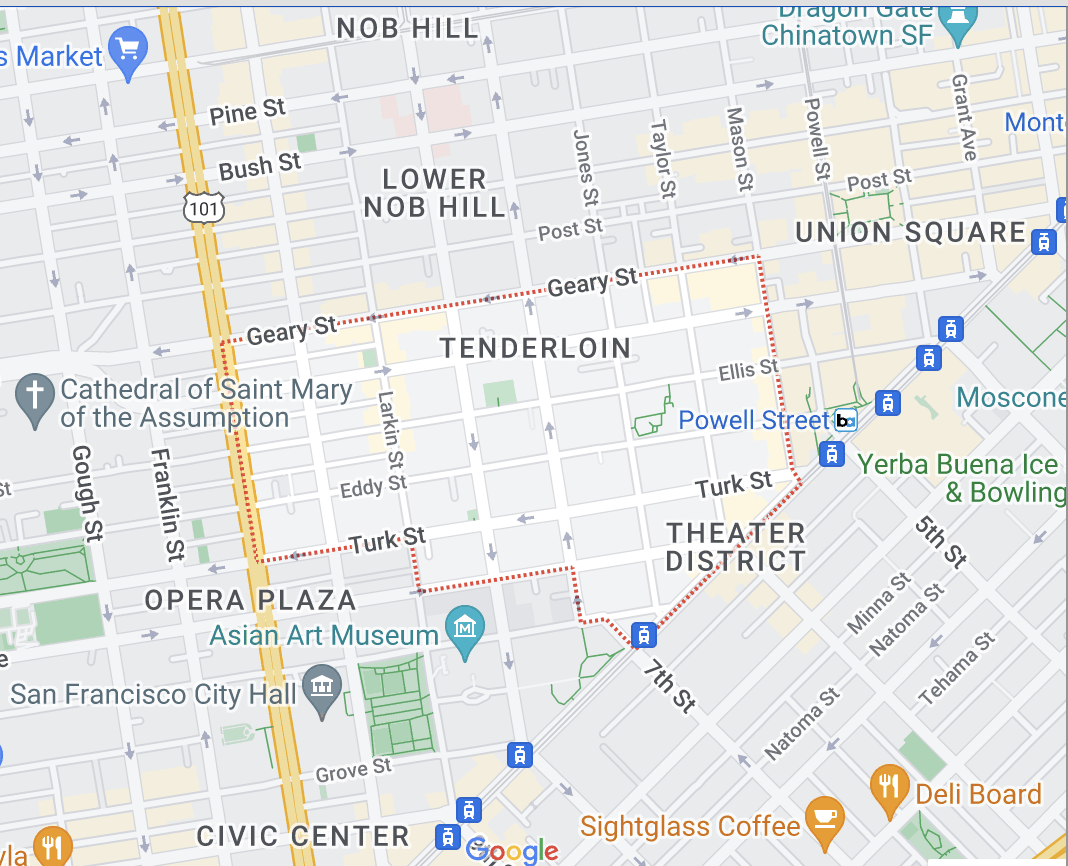
“The Tenderloin isn’t always easy on the eyes,” says the museum poster, in a massive understatement. “But what the neighborhood is missing in polish, it makes up for in grit and soul.” Thrill-seekers that we are, Rich and I decided to take a walk on the wild side this week and visit San Francisco’s most notorious district, the 31 square blocks known as the Tenderloin.
Naysayers consider it the epicenter of the apocalypse where crime, poverty, and drugs are dragging San Francisco down into the ninth circle of Hell. Young friends tell me they go there often, without fear, for work and play.
So what’s the truth? I decided go see.
All this week, whenever I told friends that Rich and I would be touring the Tenderloin, I got horrified looks and questions about whether my shots, my running shoes, and my estate planning documents were all in order. I kept assuring everyone Rich and I had a very, very good chance of getting through the visit alive and unscathed. Not to keep you in suspense, we did.
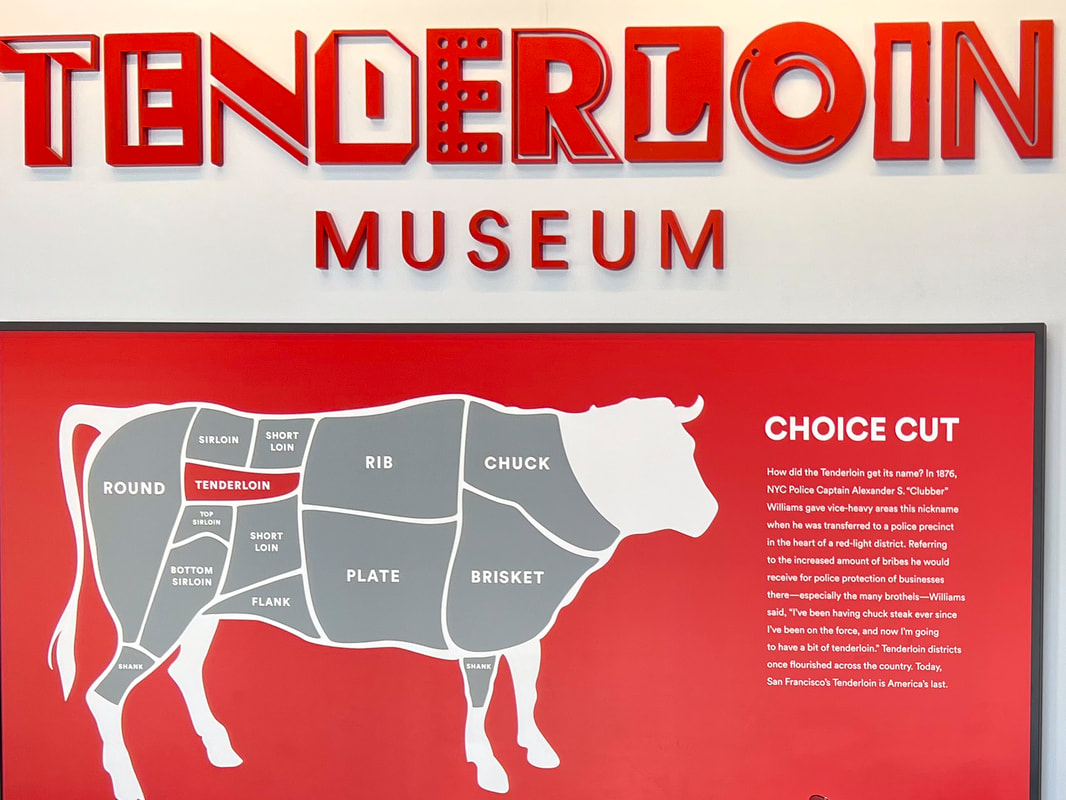
San Francisco’s Tenderloin is the last of its name in the nation, but a century ago many major American cities had a Tenderloin district where people went to commit shenanigans they didn’t want their neighbors to see. The name was allegedly coined in 1876 by NYC Police Captain Alexander “Clubber” Williams when he was assigned to a notorious red light district. Thrilled at the prospect of collecting higher bribes, he wisecracked, “I’ve been having chuck steak ever since I’ve been on the force, and now I’m going to have a bit of tenderloin.”
Do-gooders keep trying to rename San Francisco’s Tenderloin, most recently in 2011 when PETA (People for the Ethical Treatment of Animals) pressured then-mayor Edwin M. Lee to
call the neighborhood “the Tempeh District.”
Not surprisingly, the idea of giving the Tenderloin a soy-based vegan makeover didn’t fly.
Growing up in the Bay Area, I had a sketchy idea the Tenderloin’s history involved houses of ill repute, Prohibition-era speakeasies, LGBTQ bars, gambling joints, pinball parlors, jazz clubs, adult theaters, drug dens, and frequent police raids. Miles Davis, the Grateful Dead, Queen and other artists made music on its sound stages. Dashiell Hammett wrote
The Maltese Falcon
there. Muhammad Ali, George Foreman, and Sugar Ray Robinson trained in the boxing ring in the basement of the Cadillac Hotel. It was a happening place.
But the tide of drugs and homelessness kept rising, and decades of election-year promises made by politicians to clean up this “zone of terror” were about as effective as most election year promises. Which is to say not at all.
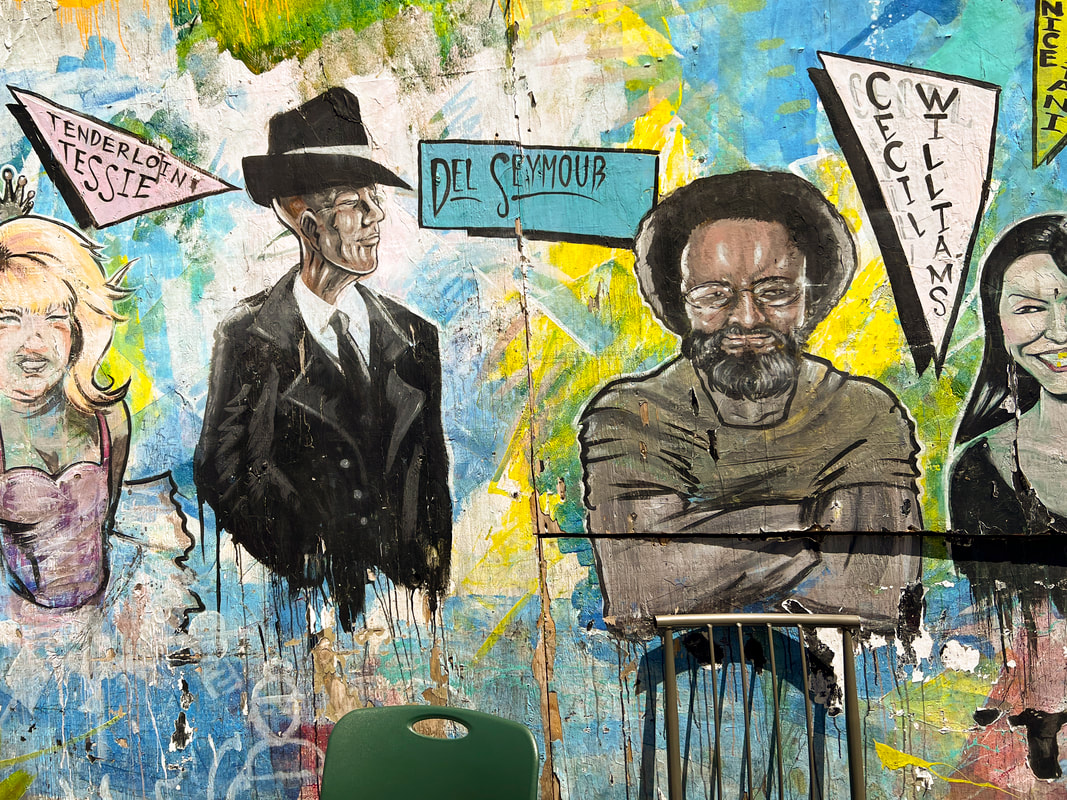
Luckily, the Tenderloin had its very own patron saint in Glide Memorial’s legendary pastor, Cecil Williams, and a street-savvy unofficial mayor called Del Seymour.
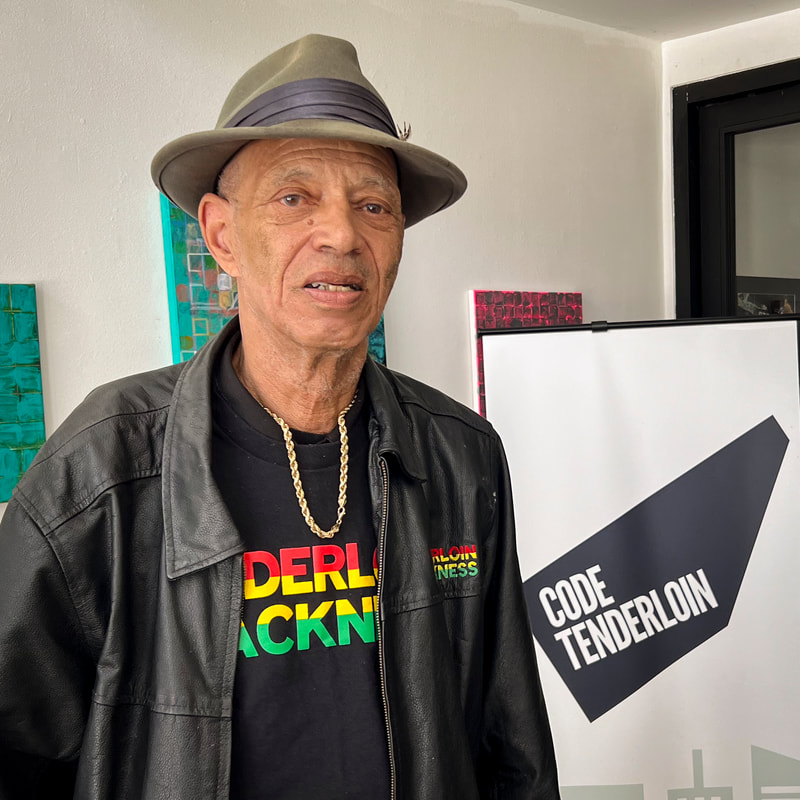
Among his many forms of outreach and public service, Del provides tours of the Tenderloin. “There’s a rich history here. I show what’s vibrant in a neighborhood that’s considered ‘gritty’ and ‘seedy,’” he says. Filled with curiosity, Rich and I signed up and met Del at his headquarters.
“I run a school, it’s called Code Tenderloin,” Del explained. “And what we do, we take people as they are, right off the street, out of our shelters, out of our missions, out of our tents … and we get them ready for jobs in the tech industry.” He also assigns people to stand on street corners and keep the peace. Judging by the complete lack of violence or even raised voices everywhere I went, they are good at it.
Our first stop was Glide Memorial Church. When Cecil Williams became pastor in 1963, it was a sleepy congregation of a few dozen souls. He transformed it into a countercultural icon and one of the most famously liberal churches in America. His pastoral vision included caring for “the least of these” with everything from hot meals to genuine respect. After mandatory retirement at 70, he was hired as the Minister of Liberation, a post he held until last year; he passed last month at the age of 94.
Today the Glide Foundation runs 87 social services such as childcare, after-school programing, emergency supplies, shelter beds, HIV testing, Covid vaccines, and three meals a day.
“It’s fried chicken day,” Del said, as the heavenly smell wafted through the pristine dining room. “It’s very popular.”
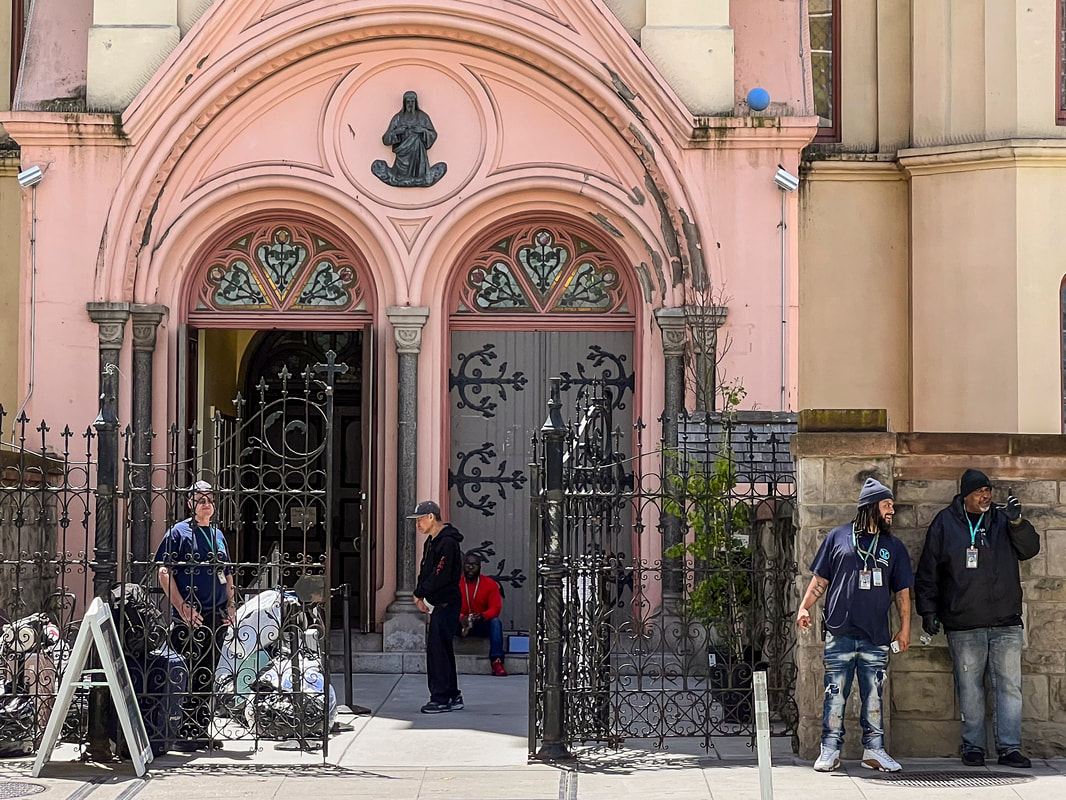
Del wasn’t kidding about the chicken’s popularity; the line outside extended for blocks. As we walked along it, I can tell you that yes, the general look was pretty rough — somewhere between the barroom scene in
Star Wars
and a demilitarized zone. But everyone was remarkably well-behaved; nobody was about to jeopardize their chance at that fried chicken. Dozens greeted Del by name, with a smile, a handshake, a few words of appreciation.
Our tour took us all over the neighborhood: to the lively and engaging Tenderloin Museum, St. Anthony’s free family medical center, America’s first official Transgender community, and a new housing project. I began to appreciate the complex web of financial support — from government, churches, community groups, and private donors — that enabled 25,000 marginalized residents to come together and function, however loosely, as a community.
I suppose to some this must seem like rearranging deck chairs on the
Titanic
. You might be wondering if there’s any point. Can the cycle of poverty and drugs be broken? Are such lost souls ever saved?
Well, just ask Del about that.
Del’s life started off much like Rich’s, with Catholic schools and military service in Vietnam. After that he became a firefighter in LA, with a home and family. “Then I came to San Francisco, ran into a neighborhood called the Tenderloin, and to make a long story short, it took me 18 years to get that crack pipe out of my mouth,” he said in his TED talk. “Living homeless, living in tents — when I wasn’t in jail.”
Then one day Walter Hughes, an elder of the Tenderloin’s San Francisco Christian Center, met Del in a park, bought him a suit, and invited him to church. “They embraced a crackhead in the middle of the church.” I could hear the awe and gratitude in Del’s voice as he recalled that day. “And we prayed together, we cried together. He wasn’t pushing me. He just started showing me the way to a better life.”
Del’s words reminded me of the old story about a man walking along the beach after a storm had washed up thousands of starfish on the sand. He picked up one and threw it in the water, then another. A passerby said, “What are you bothering with that for? There are way too many, you’ll never make a difference. “
The man threw another into the sea. “Made a difference to that one.”
Taking the Tenderloin tour was a valuable reminder that the world is full of stranded starfish; sometimes we’re one of them, sometimes we’re the guy on the beach, and sometimes we’re the passerby, wondering how to make sense of it all.
Del’s Tenderloin Tour
:
[email protected]
The Tenderloin Museum
: 398 Eddy at Leavenworth
Glide Memorial Church
: 330 Ellis Street
This post is part of my ongoing series
OUT TO LUNCH IN SAN FRANCISCO
My goal is to discover some of San Francisco’s most colorful neighborhoods so I can check out what’s really going on in this zany town. Are we in a doom loop? Already on the rebound? Still fabulous? And where should we eat afterwards? These and other questions will be explored in upcoming posts.
DON’T MISS OUT!
If you haven’t already, take a moment to subscribe so I can let you know when I publish my weekly posts.
Just send me an email and I’ll take it from there.
[email protected]
And check out my
best selling travel memoirs & guide books
here
.
PLANNING A TRIP
?
Enter any destination or topic, such as packing light or road food, in
the search box
below
. If I’ve written about it, you’ll find it.

Leave a Reply