
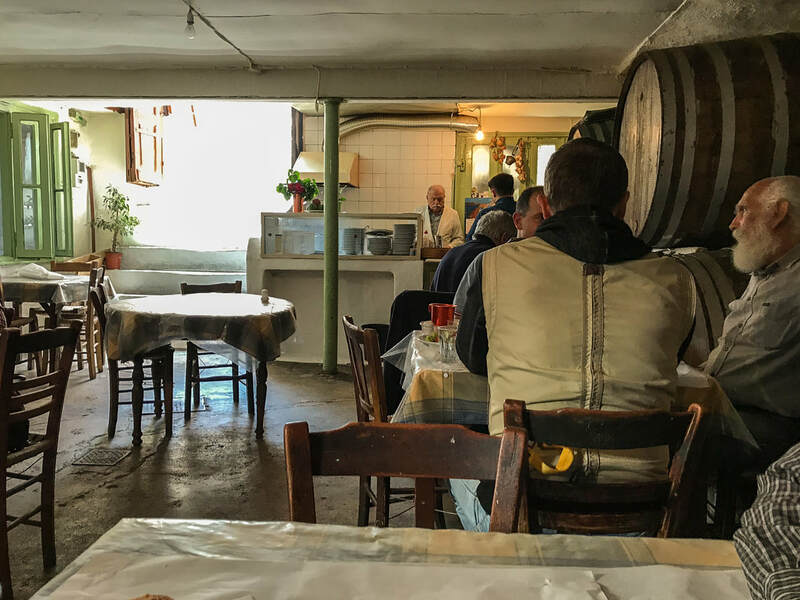
If I’d blinked, I would have missed the snails completely. We were passing a dusty parking lot in an unfashionable section of Chania, Crete when out of the very corner of my eye I caught the flash of a yellow chair under a tree beyond the cars. Someone’s private dining spot? No, wait; turning, I saw more chairs and a scattering of tables. A battered sign said helpfully,
ΠΕΡΠΕΡΑΣ
. Rich and I strolled in to take a closer look.
And that’s how we met Yannis, chief cook and proprietor of
Perperas
. He gave us a warm welcome and presented us with a handwritten English menu that was short on descriptions and long on intriguing possibilities. The meal was a delight:
tzatziki
made from thick Greek yogurt, garlic, and cucumber; grated zucchini patties sautéed in olive oil; a pie that might have been quiche’s Cretan cousin.
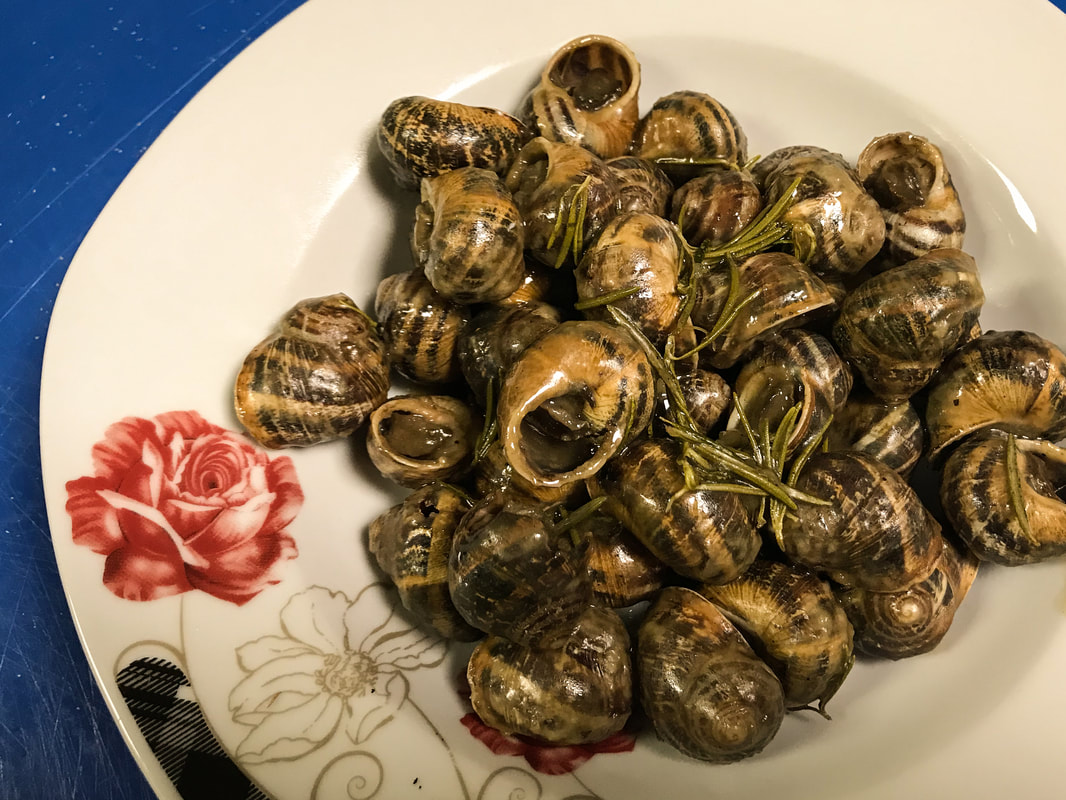
Snails are everyday fare in Crete, the local equivalent of American burgers or British fish and chips. During the 40-day Lenten fast, when people are expected to refrain from eating meat, fish, even dairy, it’s OK to consume snails and shellfish; they’re exempt on the technicality of not having a backbone. It’s customary to eat snails on the Thursday before Easter, and Yannis very kindly agreed to let me come into his kitchen last week, on Orthodox Holy Thursday, so I could be initiated into the mysteries of
hohli bourbouristi.
Brace yourself, because the process is a gruesome one. More so for the snails, obviously, but fairly distressing for humans of tender sensibilities as well. Captured when spring rain forces them out of their underground dens, the snails are sequestered in a mesh cage or simply a circle of salt, which they can’t cross because salt is
lethal to snails
. For at least three days, often a week or more, the captives are fed a bland diet of flour or dry pasta, which is said to make them excrete all their toxins. Then they are thrown live into a pot of boiling water which is soon covered with a white froth of snail saliva. Cookbooks advise keeping an eye out for those trying to escape so you can catch them and toss them back in.
As you can imagine, the creepy backstory did nothing to enhance my appetite. “I’m calling this post ‘Snails from the Crypt,’” I whispered to Rich. Fortunately I was spared the grim necessity of witnessing these atrocities in the flesh. Yannis explained a family of snail collectors in the nearby village handled all that, delivering the snails to his kitchen clean and ready to cook.
Yannis rinsed 30 large snails in water, then dusted them with a third of a cup of flour. (He never measured, so all quantities are very approximate.) Then he poured a quarter of a cup of olive oil into a frying pan and set it on the burner. He pressed the fleshy foot of each snail into salt then set it in the pan. “They go in ‘face down,’ as we say,” he told me. “The name
bourbouristi
comes from the Cretan
abouboura
, which means ‘face down.’” When the snails were sizzling, he pulled leaves off of two sprigs fresh rosemary and sprinkled them on top, adding a pinch of pepper. Pouring half a cup of strong red wine vinegar over everything, he let it cook for about three minutes until the liquid reduced to a thick sauce. “Done!” he said.
He took them outside to our table and set them down with a flourish.
It was love at first bite. “Oh my God,” I kept gasping. “Wow!”
Using the outermost tine of his fork to pry out a morsel, Rich slurped it down. He kissed the shell he held his fingers. “These snails,” he said, “were not sacrificed in vain.”
Lenten observances in Greece are big on sacrifice, starting with 40 days of fasting and culminating on the eve of Easter when Judas Iscariot, the apostle who betrayed Jesus, is burned in effigy in towns all across the island. We witnessed the ritual in Loutro, a village on the southern coast of Crete.
The evening began with the traditional Orthodox liturgy held in a church so small people took turns going inside to pay their respects then gathered outside chatting quietly. Eventually the priest emerged and sang into a microphone held by an altar boy, reading the lyrics off a cell phone tucked into a hymnal. Men and boys took turns ringing the church bell. After the kiss of peace, everyone lit their candles; some kids carried fancy ones decorated with unicorns, Barbie, or Spiderman. Then the bonfire was ablaze on the beach, and altar boys, bell ringers, and Spiderman fans began throwing fire crackers into the blaze, making everyone jump. As flames consumed the effigy, fireworks exploded overhead. Once again, sin had been vanquished.
Easter Sunday was a quieter affair as families released from fasting gathered to feast on lamb, the traditional symbol of sacrifice and salvation. In Greece, the practice of animal sacrifice dates back to
Neolithic
times; more recently it appears as the Passover lamb, first offered during the Israelites’ Exodus from Egypt, and in New Testament passages where John the Baptist refers to his cousin as “Jesus, the Lamb of God who takes away the sins of the world.” For us, more prosaically, lamb was simply lunch.
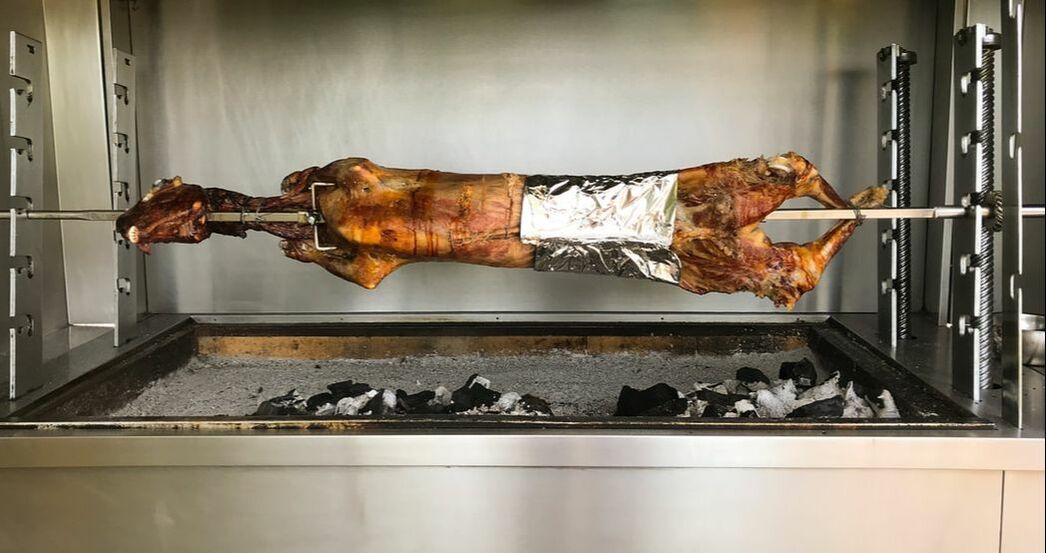
For this meal, Rich and I had chosen a family-run restaurant on the hill just above the church, and during the morning we dropped by to see how the roasting was coming along. The lamb was turning slowly on the spit, looking all too much like a human sacrifice. There was aluminum foil draped over its loins, like the white cloths strategically placed on naked figures in old church art.
“Boy, these guys really know how to work a theme,” I said to Rich.
The snails, bonfire, and lamb of Easter — as well as the island of Crete itself — are now just fond memories. Yesterday we took a ferry north to Greece’s Mani Peninsula, a rural area on the southern tip of the Peloponnese. Our modest hotel overlooks the island of Gytheio, where Paris of Troy and Helen of Sparta spent their first night together, having the sex that launched a thousand ships, culminating in the Trojan War. Rich and I don’t expect our further adventures in Greece to be quite that exciting, but we are looking forward to more good food and fun times. Stay with us on the journey!
LEARN MORE ABOUT OUR MEDITERRANEAN COMFORT FOOD TOUR.
SIGN UP TO RECEIVE UPDATES AS WE GO.
AND SEND US YOUR COMMENTS BELOW!
YOU MIGHT ALSO ENJOY
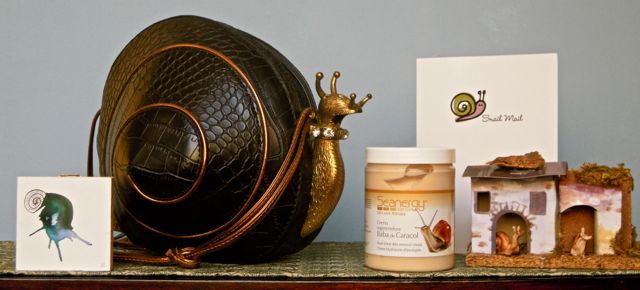
DID I EVER TELL YOU ABOUT MY SNAIL MUSEUM?
WHY MEDITERRANEAN FOOD IS SO IRRESISTIBLE
BUT THAT TAVERNA WAS RIGHT HERE TWO DAYS AGO

Leave a Reply