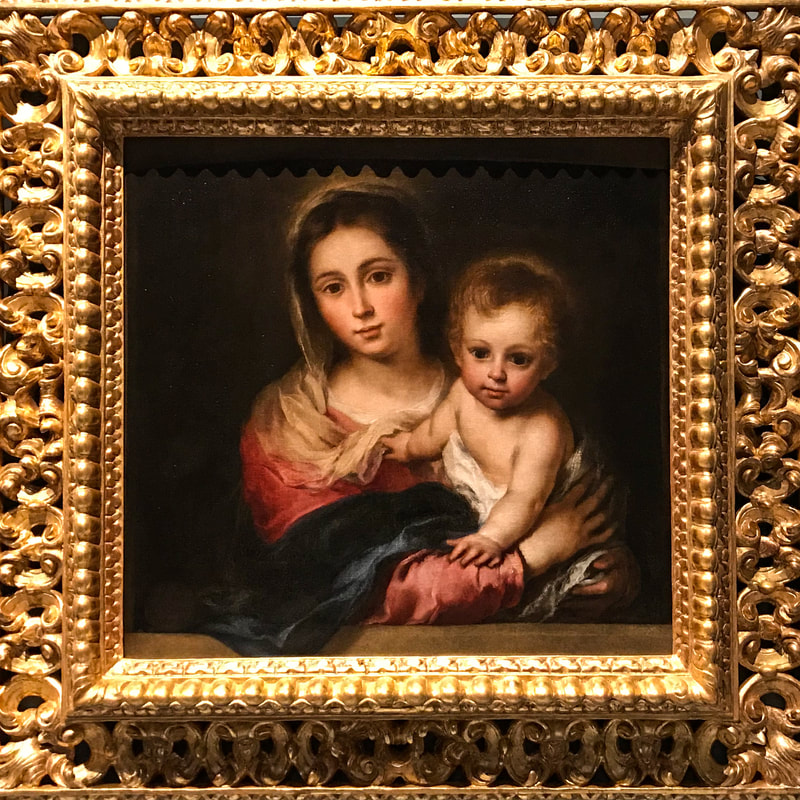


“And this is the Virgin of the Napkin.” My Spanish friends beamed fondly at the painting, hung in its own exquisitely lit niche in Seville’s
Museo de Bellas Artes
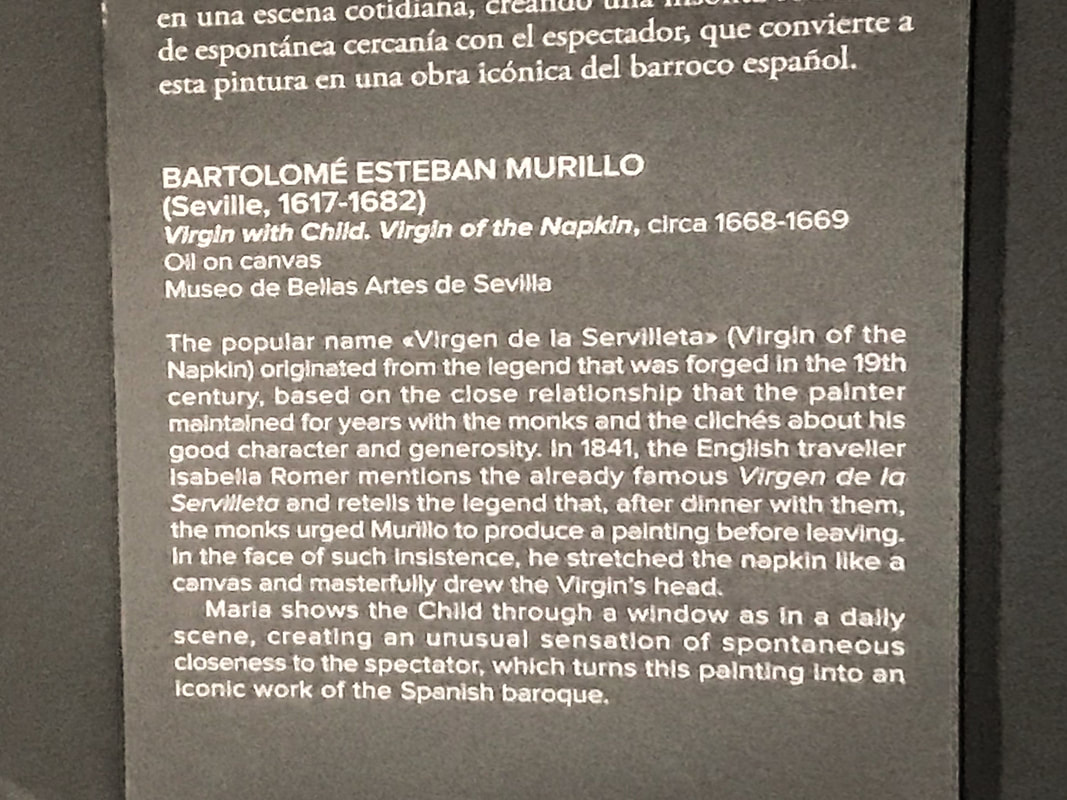
(Fine Arts Museum). Sometimes both talking at once, each one jumping in with colorful details, my friends explained that the famous seventeenth century artist Bartolomé Esteban Murillo had painted this incredible work on the back of a napkin one night after dinner. He’d been dining with some monks here in the city, and afterwards they’d asked him to paint a little something for them as a memento of the evening. Murillo, who apparently had brought along his painting gear, picked up a napkin (presumably not the one he’d been wiping his lips with during dinner), stretched it like a canvas, and began this work.
“
Increíble!”
I exclaimed, as I was clearly meant to do.
“
Casi un milagro.”
Incredible. Practically a miracle. My friends glowed with pride and pleasure.
That was fifteen years ago. And while I naturally had my doubts about this story — for a start, even a painter as gifted as Murillo couldn’t dash off a work that detailed in a single evening — it was still a shock to arrive at the museum ten days ago and discover that the painting had been thoroughly debunked. Yes, the work was indeed painted by Murillo, but the legend involving napkins and monks originated in the nineteenth century and soon went viral thanks to British travel writer Isabel Romer, who loved digging up colorful, offbeat stories for her readers. (A woman after my own heart.) The painting has been moved to a lesser position next to some of Murillo’s larger works; clearly it’s now a mere footnote in the great man’s story.
Having a cherished legend debunked is one thing; it’s considerably more disconcerting to discover wild inaccuracies in our very concept of what our planet looks like. Remember the world map that hung on the wall in your grammar school classroom? It’s all wrong.
That image of world geography got its start in 1579, when Gerardus Mercator cleverly represented the world as a grid that navigators could follow using straight compass lines, eliminating the need for constant, tricky course corrections. Fast forward nearly 400 years to when my husband was in the navy, and the
Mercator projection
was still the gold standard, used on his ship to navigate the route between Norfolk, Virginia and Gibraltar. The Mercador projection may be great for sailors, but it has the unfortunate side effect of distorting the size of land masses, enlarging those further from the equator until Greenland (836,330 square miles) looks bigger than South America (6,890,000 square miles) or even Africa (11,730,000 square miles).
Today there’s growing support for the
Gall-Peters projection
, which attempts to correct the geographic distortion of Mercator’s approach. Naturally, this new work is surrounded by its own controversies, with some cartographers sneering at James Gall (a 19th century clergyman) and Arno Peters (a 20th century German filmmaker) as unqualified hacks. The Controversy section on the Wikipedia page reads like a Facebook rant. Nevertheless, the Gall-Peters projection is gaining traction; it’s now being promoted by UNESCO and has been adopted by a growing number of British and American schools, where it’s viewed as a more accurate and equitable representation of the planet’s geography.
Ours is a world full of controversy and dissension, and just about the only thing we can all agree on is that we live in an age of disinformation. Sometimes it helps to remind ourselves that there’s nothing new about distorting information and disseminating it far and wide. Just this morning at breakfast Rich was talking about the party line telephones of his childhood. For younger readers, this was back in the dark ages before everyone had their own phone, and houses in a neighborhood would often save money by sharing a single land line. When the phone rang, everyone would run pick up, and when it was for you, the neighbors were supposed to hang up — but of course they secretly stayed on the line, listened in, and then proceeded to share all your news and gossip with everyone within their orbit. Rich calls it “the forerunner of Facebook.”
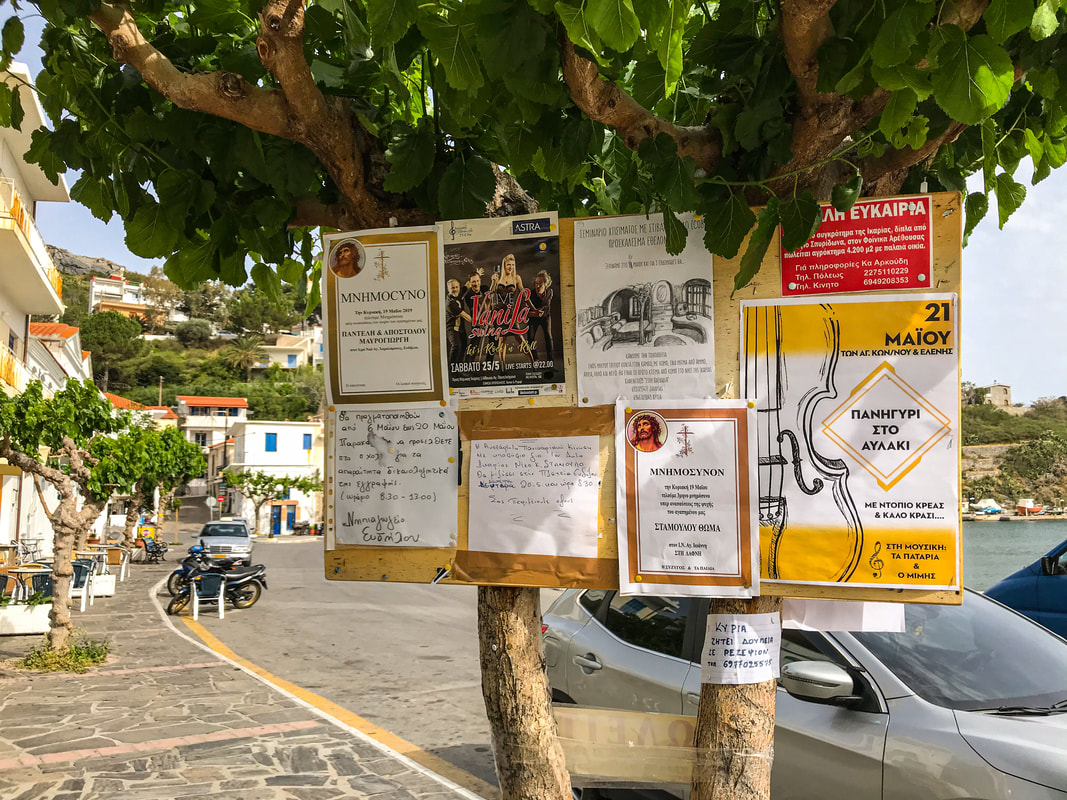
With disinformation ramping up online, I find it comforting to spend time in countries that haven’t (yet) been overwhelmed with bot-fueled globalized thought manipulation. One night in May, I was on the Greek island of Ikaria, famous for the remarkable health and longevity of its residents. An election was coming up, and a meeting had been called in the village of Evdilos; chairs were set out under the trees near the wharf, and what appeared to be the entire population of the village gathered at twilight to sit and listen to the candidates. Here, politics was still a face-to-face business that didn’t rely on sound bites and social media. In its own small way, it was breathtaking.
It’s easy to feel helpless in the face of globalization and mass disinformation. But standing at the back of that crowd on Ikaria, I was reminded that we still live in human communities. It is our nature to talk among ourselves, sharing information, weighing facts, exploring ideas, arguing, attempting to winkle out the truth of a subject. We do it with friends and family at home and, if we’re lucky, with those we meet during our journeys.
“The antidote to misinformation is exchange: to send truth-tellers around the world,” said former U.S. ambassador Jeffrey Bleich. “Truth-tellers—mathematicians, scientists, musicians—return from places and can tell people objectively what they saw and experienced and learned, and restore critical and analytical minds.”
Being a truth-teller is important work, and every traveler can do it. When we have the good fortune to spend time talking with people of other cultures, we bring home fresh perspective not only on their culture but our own.
“Travel,” says globetrotting author
Rick Steves
, “challenges truths we were raised thinking were self-evident and God-given.” And that’s a wonderful thing. Because it shows we don’t have to live in a “post-truth” world, as some in the media would have us believe. Yes, there are plenty of people around who are careless, callous, and conniving with the truth. But there are still millions of us who persist in caring about the nature of reality, verifiable facts, and the precise shape of our world. And that’s truth worth knowing.
YOU MIGHT ALSO ENJOY
THE TRUTH ABOUT THE PROPAGANDA MUSEUM
CRAZY EMERGENCY MEASURES EVERY TRAVELER SHOULD KNOW
WHO IS THE REAL ROSIE THE RIVETER?
Leave a Reply