Waymo’s driverless taxis move through traffic like my high school driver’s ed teacher: maintaining the exact speed limit, meticulously obeying all laws, showing an excess of caution and courtesy at all times. Unlike some human cabbies I’ve known, my invisible robot drivers are never drunk, stoned, lecherous, lost, or seething with road rage. They never talk your ear off or expect a tip, either.
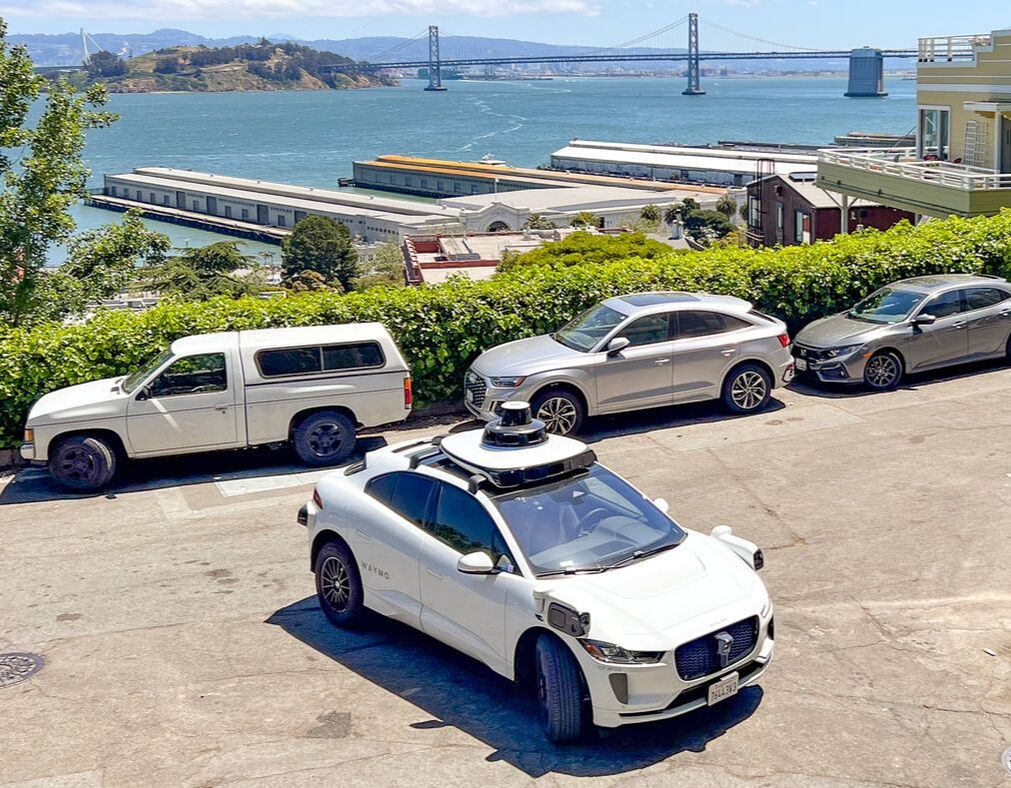
So you can imagine how gobsmacked I was when my driverless taxi seemed to suffer a panic attack in a tiny cul-de-sac near the top of San Francisco’s Telegraph Hill.
It happened last Friday, right after Rich and I got out and started up the steps leading to the summit. Our Waymo — apparently noticing for the first time just how tight the cul-de-sac was — began saying in a loud, cheerful voice, “Hey there, I’m planning to move but need more space. Can you back up please?”
Unfortunately, it was making this request to a row of parked cars. Not surprisingly, they remained unmoved.
“Hey there,” repeated the Waymo. “I’m planning to move but need more space. Can you back up please?” Maybe it was my imagination, but by the fourth or fifth repetition, I had the distinct impression a note of panic was creeping in to its tone.
“Hey there…!”
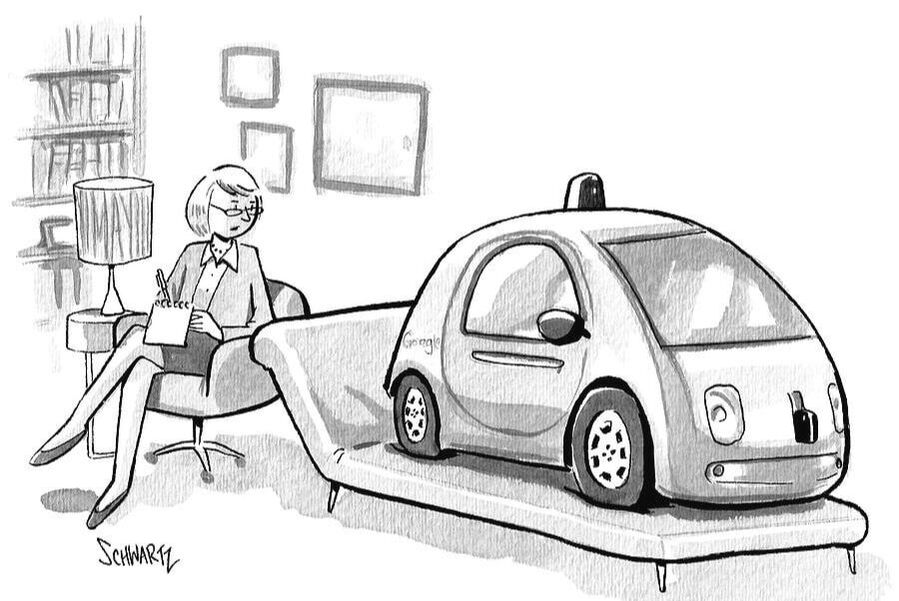
“You do know that Einstein said, ‘Insanity is doing the same thing over and over and expecting different results.’”
Finally it fell silent, as if thinking furiously.
By now a few amused pedestrians had gathered on the sidewalks to enjoy the spectacle of the flummoxed robot.
What I suspect happened next was that a distress signal alerted somebody in the mothership — I’m guessing a human — who proceeded to override the vehicle’s programming and navigate by remote control.
Eventually, with the reluctant air of one acting against its better judgement, the Waymo inched forward into the middle of the intersection and stopped, its rooftop sensors whirling around anxiously. Then it executed a glacially slow, cautious three-point turn and drove off, followed by the spectators’ chuckles.
“Whew,” said Rich. “For a minute I thought we were going to have to push it out of here.”
We resumed our climb upward toward one of San Francisco’s highest, most famous, and least visited landmarks, Coit Tower.
Every article I read suggested the best way — nay, the only way — to visit Coit Tower is to walk up the 600 stairs known as the Filbert Steps, so you can pause and admire the views from every angle. Obviously these articles were written by youngsters too inexperienced to realize you get the same views going down, with a lot less stress on your knees. Being savvy travelers, Rich and I took Waymo as high as we could; from the cul-de-sac, I’d heard it was “just” a three-minute walk up some steps.
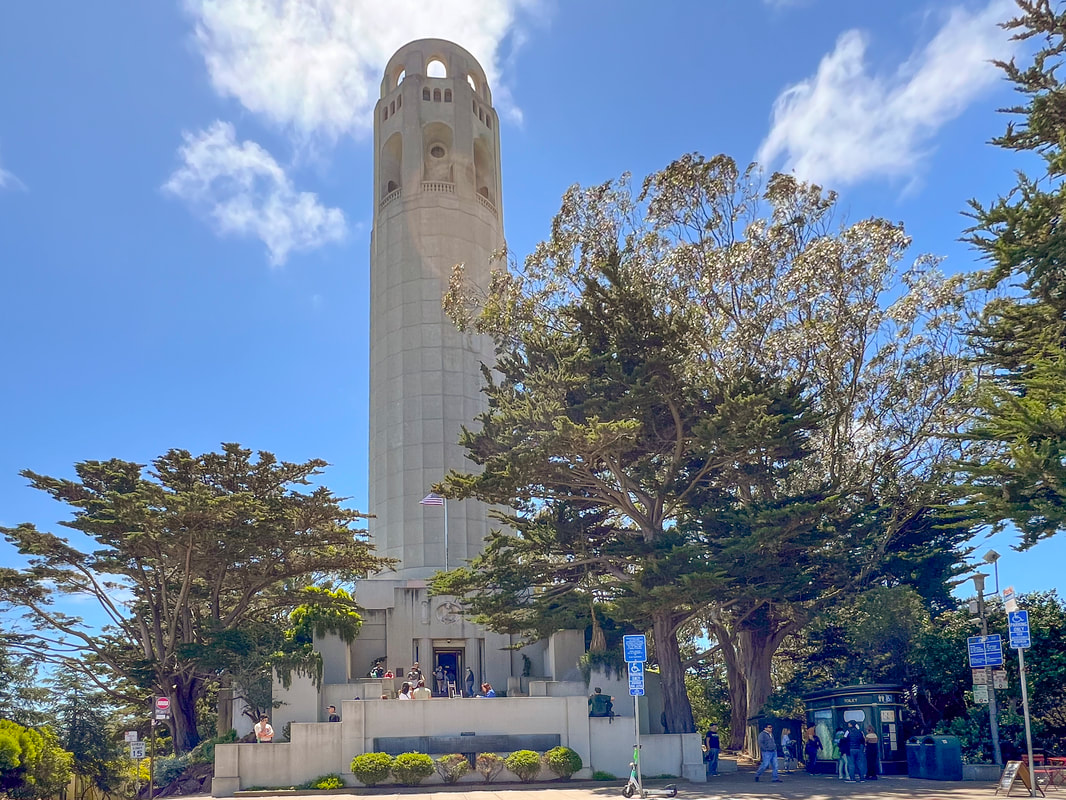
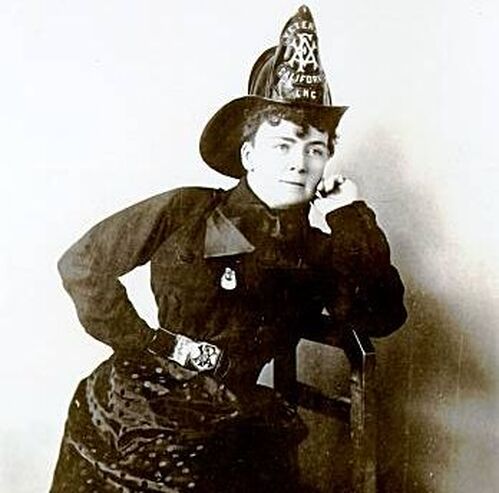
Whew! Arriving breathlessly at the top, I paused to admire the 210-foot tower built to honor the dying wishes of the wild, wealthy, eccentric Lillie Coit (1842 – 1929).
At the age of seven, “Firebelle Lil” watched her mother burn the family plantation rather than lose it. Two years later, SF firemen rescued Lillie from a flaming building. When she was fifteen Lillie ran to help firefighters struggling to push an engine up Telegraph Hill. She soon became an honorary firefighter, riding along when the brigade was called out, participating in banquets and parades. A true Victorian thrill-seeker, she was a sharpshooter and wore trousers so she could sneak into male-only North Beach clubs to gamble and smoke cigars.
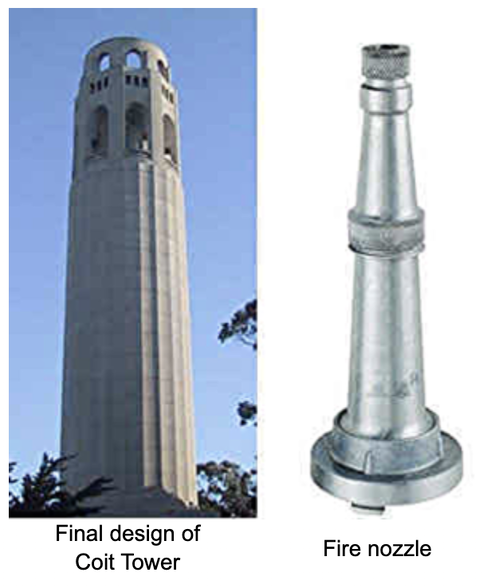
Upon her death, Lillie was cremated and interred with firefighting memorabilia. She bequeathed a third of her fortune to the city to add something to its beauty. Coit Tower opened in 1933, and to this day, officials insist it’s NOT supposed to represent a firehose nozzle. They can’t understand why nobody believes them. I’ll let you be the judge.
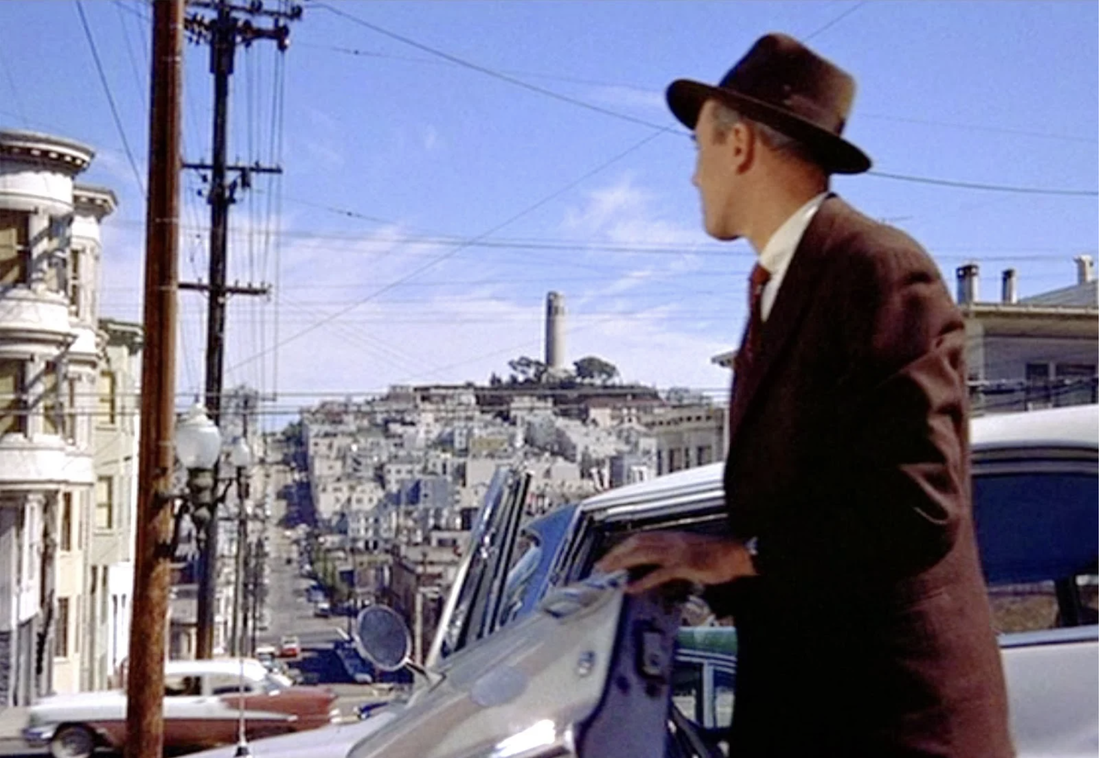
Coit Tower appears in many films, including
Vertigo
, where you constantly see it behind Jimmy Stewart. Asked why, Hitchcock said, “It’s a phallic symbol.” I guess it’s all in the eye of the beholder.
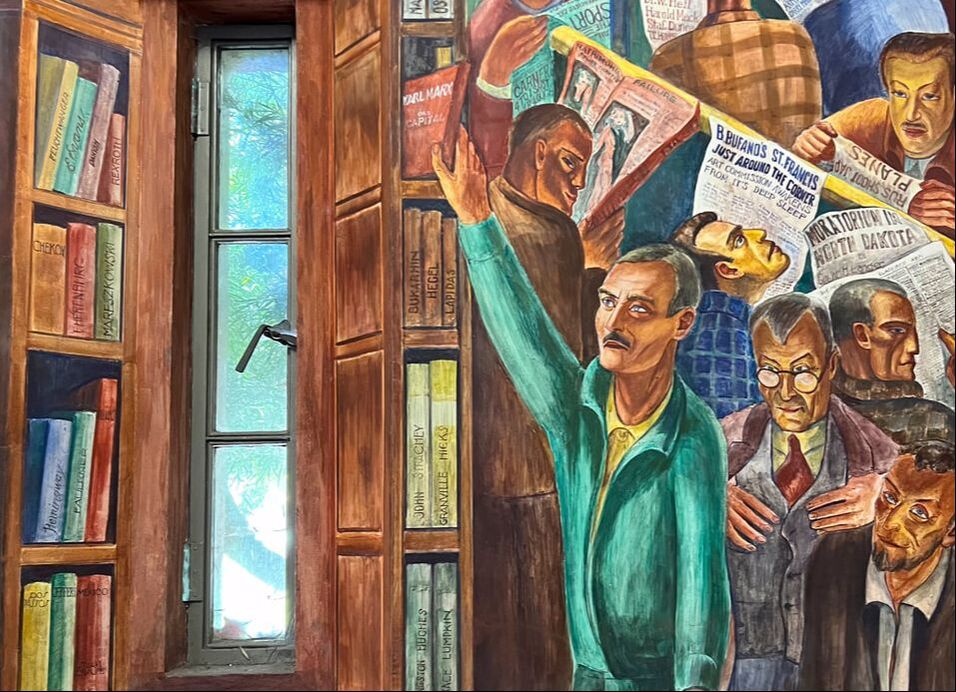
Inside, Coit Tower’s walls are filled with spectacular murals from a 1934 pilot project for what would become the New Deal’s WPA. Told to paint “aspects of life in California,” many artists indulged in sharper social commentary than expected.
Shortly before the grand opening, horrified officials noticed commie themes — the hammer and sickle provided the first clue — and in the ensuing uproar, changes were demanded and refused. In the end, someone painted over the hammer and sickle and the banner for the communist periodical
Western Worker
, but everything else remained. Here, for instance, the man in green pulls out a copy of Karl Marx’s
Das Capital
(spelled incorrectly; it’s
Kapital
).
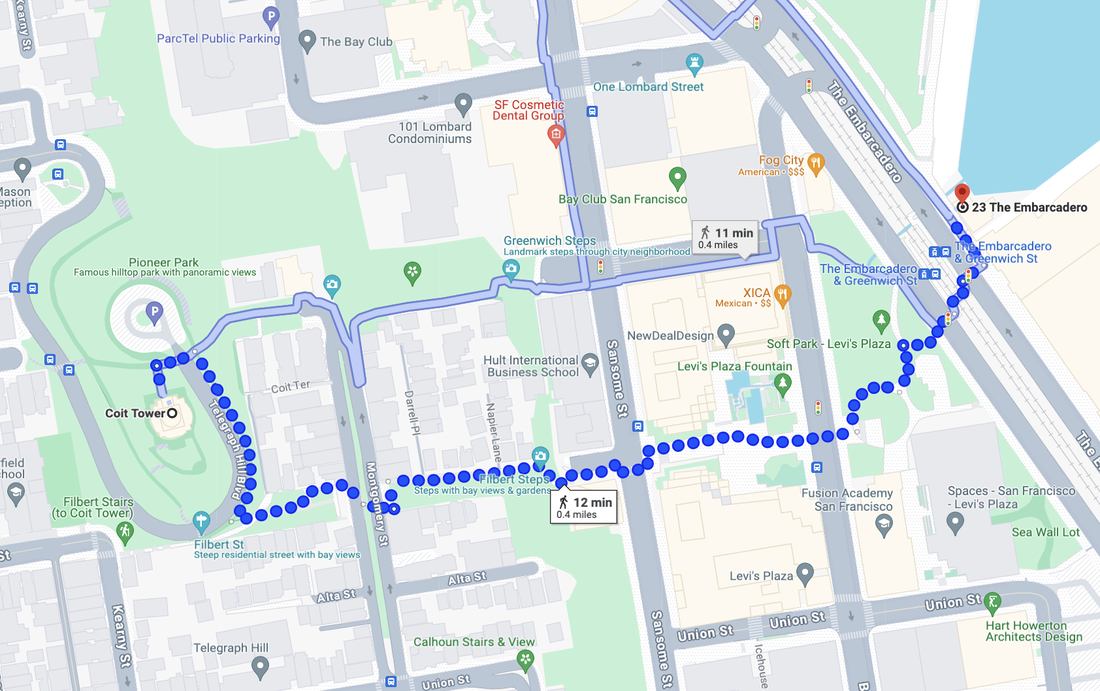
The 91-year-old elevator was out of order, and Rich and I decided not to pay $10 for the pleasure of climbing 234 stairs (each way!) to see the view. We figured descending 600 Filbert Steps would be enough exercise to work up an appetite for lunch.
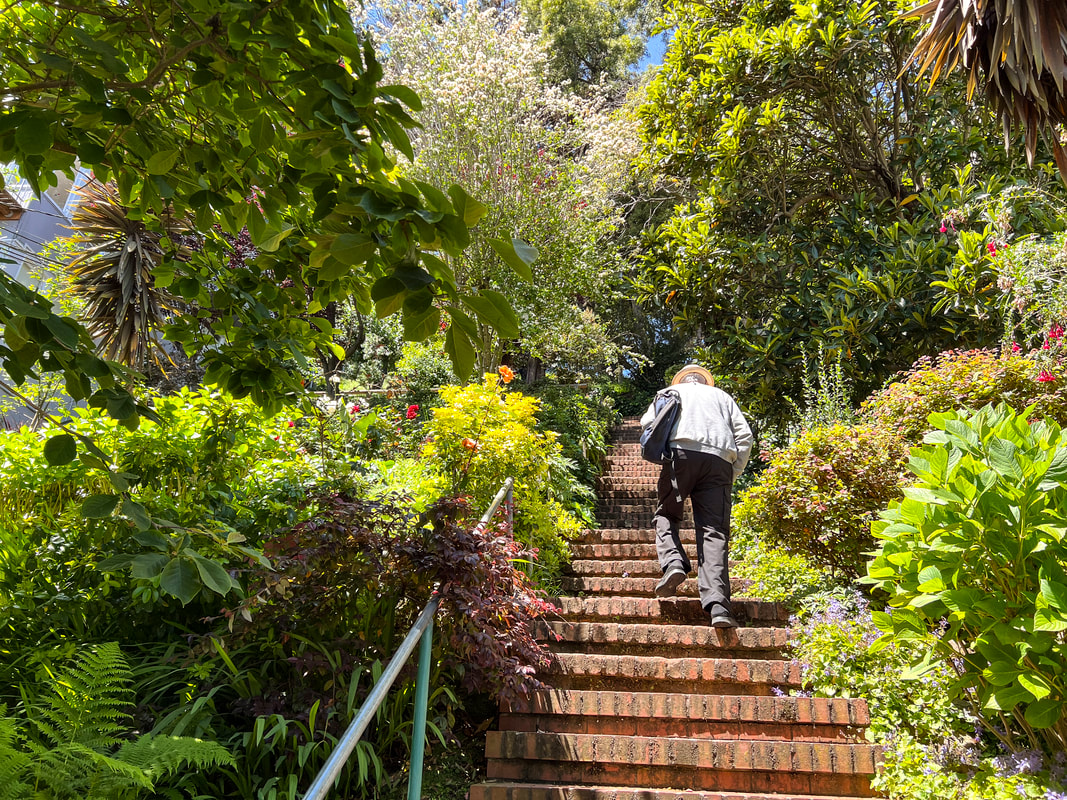
The gardens along the steps were a delight, thanks to the green thumb of Grace Marchand. In 1949 the 63-year-old artist, former stuntwoman, and Liberty Ship builder moved into a house at the corner of Filbert Steps and Napier Lane. She began planting flowers, and over the next 33 years, the garden became a community treasure. After Grace died at home in her own bed at 96, neighbors kept up the gardens, protecting them from developers, coyotes, and other predators.
I kept an eye out for the cherry-headed conures made famous by the heartwarming, award-winning 2003 documentary,
The Wild Parrots of Telegraph Hill
, the story of a formerly homeless musician who adopts a flock of feral parrots. The film is now being remastered to show in theaters.
Sadly, I didn’t see any wild parrots, although to be fair I was too busy concentrating on my footing to look around properly. At the bottom of the hill, I stumbled gratefully onto level ground and made a beeline for one of my favorite bars, Pier 23.
This classic waterfront eatery was a haunt of Rich’s back in the 1980s, when happy hour was enlivened by a woman who played two saxophones at once. There’s plenty of loony memorabilia, including a vintage condom machine, a poster for a 1951 noir film shot at the pier, and a plaque about local egg wars that concludes with “All’s well that ends shell.” Ouch!
They offer some of the biggest and best chicken quesadillas I know; Rich and I split one ($21), and it says something about our keen appetites that it wasn’t until the next-to-last bite that Rich said suddenly, “Hey, aren’t you going to photograph this?”
Catching the ferry home required only a short stroll down the waterfront, so we didn’t summon another Waymo, but I won’t hesitate to call one again. The meltdown on Telegraph Hill was caused by an excess of caution, and frankly, I’m fine with that. If I ever have to hang up my car keys for good, I’m hoping there will be an invisible robot driver at my beck and call, one wise enough to prefer looking foolish to making sudden, rash moves. Now, if we could only get humans to do the same.
They say the walk down Filbert Steps takes just 12 minutes, but be sure to allow extra time for gawking at the views, admiring the gardens, and looking for parrots.
This post is part of my ongoing series
OUT TO LUNCH IN SAN FRANCISCO
My goal is to discover cheap and cheerful eateries in some of San Francisco’s most colorful neighborhoods while I check out what’s really going on in this zany town. Are we in a doom loop? Already on the rebound? Still fabulous? Stay tuned! These and other questions will be explored in upcoming posts.
DON’T MISS OUT!
If you haven’t already, take a moment to subscribe so I can let you know when I publish my weekly posts.
Just send me an email and I’ll take it from there.
[email protected]
And check out my
best selling travel memoirs & guide books
here
.
PLANNING A TRIP
?
Enter any destination or topic, such as packing light or road food, in
the search box
below
. If I’ve written about it, you’ll find it.

Leave a Reply