
“
We ought to do good to others as simply as a horse runs, or a bee makes honey, or a vine bears grapes season after season without thinking of the grapes it has borne.
”
Marcus Aurelius
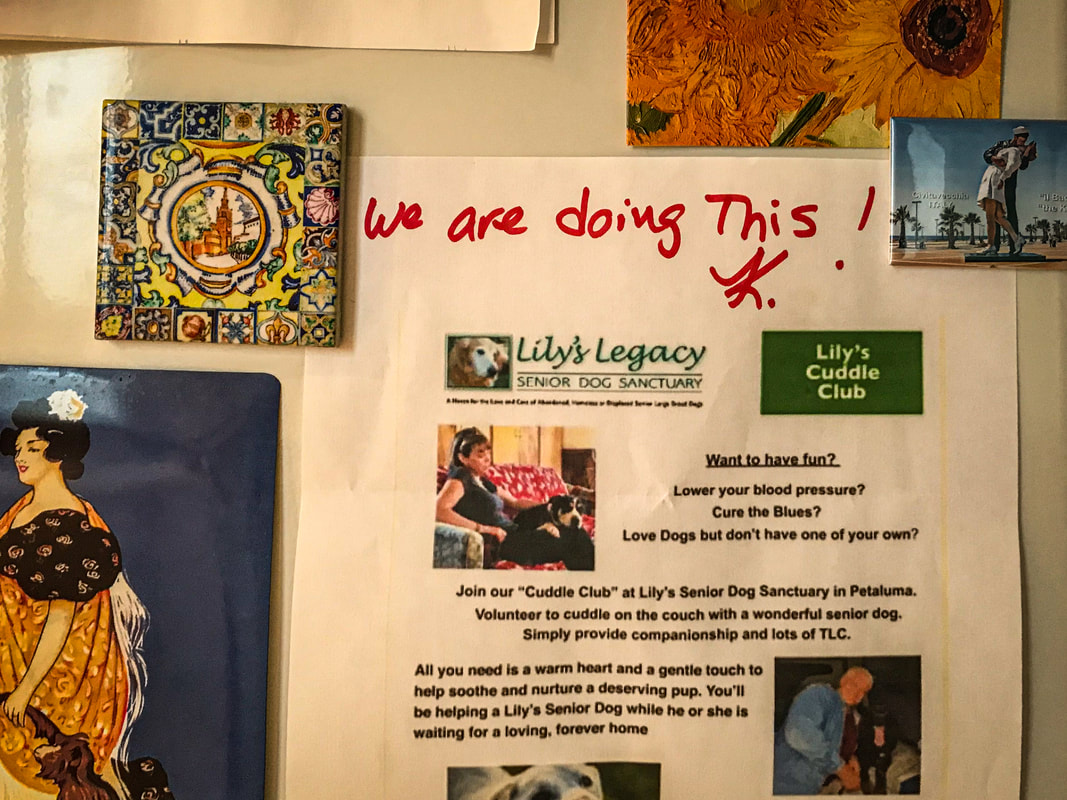
Right now, in pride of place on my refrigerator, I’ve stuck a printout from a site called
Lily’s Legacy
, on which I’ve scrawled, in large red letters, “We are doing this!”
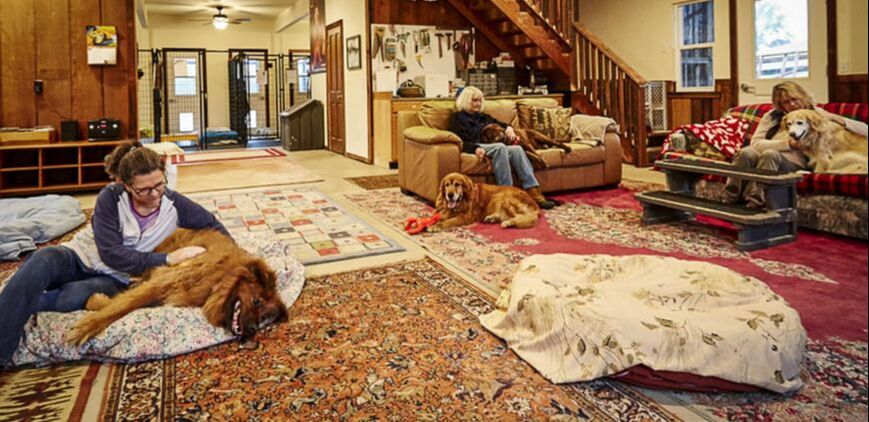
Lily’s is a California sanctuary for older dogs who find themselves alone in the world. And while founder Alice Mayn is busy trying to get them adopted, neighborhood volunteers in the “Cuddle Club” spend time on her comfy couches, petting these sweet old animals and letting them know they are still loved. When Rich and I return to California next month for a long visit, one of the first things we’re doing is signing up for that job.
In theory, of course, it’s for the dogs’ benefit. But frankly, I think we’ll be the ones getting the better deal here. For a start, it’s a chance to deploy our siesta skills, honed during fifteen years of living in Seville. Rich is particularly gifted at dropping off to sleep anywhere, and I foresee he’ll be doing some deep, cozy snoozing with the beasts. And then there are all those tremendous
health benefits that come from hanging out with dogs
, including boosting our immune system, strengthening our hearts, lowering our cholesterol, making us more allergy resistant, and reducing the modern world’s pervasive sense of isolation and depression. I wouldn’t be surprised if Lily’s Legacy added many dog years to our lives.
One of the great things about community service is that it comes in all shapes and sizes: soup kitchens, hospice, or just cherishing an abandoned animal. And the benefits tend to flow freely in both directions. These days, I get the impression some think that working for the common good is an old-fashioned virtue, if not an outright sign of weakness, but I am convinced it makes us stronger, as individuals and a community. Studies have shown that just
witnessing acts of kindness and compassion
gives us a high known as “moral elevation” that boosts our optimism and inspires us to more altruistic behavior. If we start an upward spiral of altruism, there’s no telling what might happen.
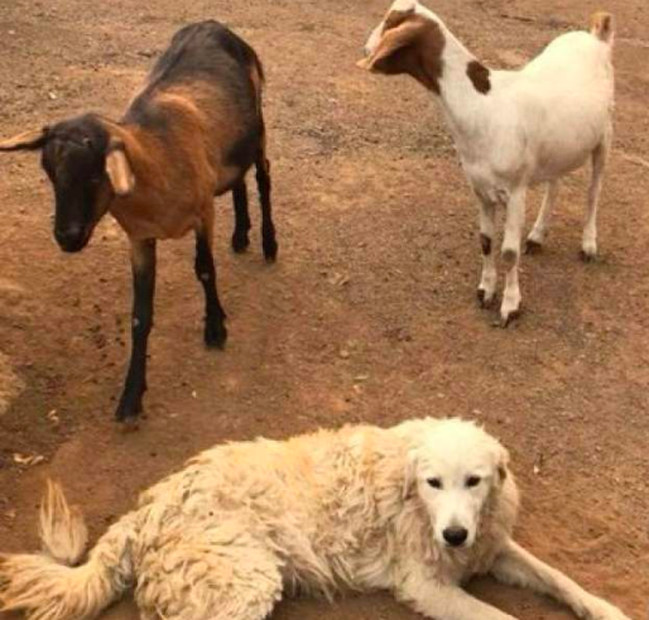
More good news: you don’t need to be a saint to indulge in altruistic behavior. In fact, you don’t even need to be human. (Although if you are reading this right now, I suspect you probably are.) Take the story of Odin, a Great Pyrenees dog that refused emergency evacuation during California’s devastating Tubbs Fire of 2017.
“Despite the sounds of exploding propane tanks, twisting metal, and the hot swirling winds,
Odin refused to leave our family
of eight bottle-fed rescue goats
,” said his owner Roland Hendel. “He was determined to stay with the goats and I had to let him do it.” He added, “I was sure I had sentenced them to a horrific and agonizing death.”
Incredibly, all the animals all survived. Oden emerged with a singed coat, melted whiskers, and a limp, but he’d stood fast, protecting the goats and a few terrified baby deer who joined the little flock. Hailed as a hero by his family, Odin will, I suspect, be fed steak dinners for the rest of his life.
There have been countless human heroes in the Californian wildfires, too, including nurse Allyn Pierce, who in 2018 drove straight through the Camp Fire inferno to
rescue patients in the intensive care unit
he manages. Eventually, after two trips through the flames, he and other first responders got everyone to safety. “I just kept thinking, ‘I’m going to die in melting plastic,’” Pierce recalls. He posted this photo of his truck, toasted to a color he now refers to as “Custom Campfire Marshmallow.”
I don’t think any of us knows what we’re capable of in a truly desperate situation, and sometimes an entire nation can astonish you. I particularly love the story of young King Zog, the first and only monarch of Albania, who came to the throne in the turbulent run-up to World War II. As leader of a small, beleaguered nation with a population that was three-quarters Muslim, King Zog had plenty on his plate already. But he quietly let it be known that the entire population of Albania stood ready to help European Jews who were fleeing for their lives. Why? Because the Albanians have an
ancient code of honor
that forms the backbone of the national character, and one of its key concepts is
besa
, offering shelter to those in need. For the Albanians, it would have been unthinkable to do anything except welcome and protect their desperate neighbors.
“Jews, who had escaped from other countries and who had literally been branded on the forehead with a J, were astonished to learn that the local population was jostling amongst themselves for the honour of sheltering them, for the honour of saving their lives,” wrote the publication
Diplomat
. “Neighbours even shared the privilege, based on their ability to contribute to the welfare of their ‘guest.’ In one case, a rich neighbour fed the people in their care, while a poor neighbour gave them a bed to sleep in each night. No threats of punishment or death could cause these people to waver in their commitment.” Albania was the only country in Europe whose Jewish population grew tenfold during World War II.
This chapter of Albanian history remained largely unknown until an American photographer named Norman H. Gershman stumbled on the story and began photographing those who had hidden Jewish families — in some cases housing them in the attic while German soldiers were billeted downstairs.
“How many people,” asks the film, “would lay down their lives for a stranger?” Most of us (thank God) will never be called on to make that kind of sacrifice. But there are plenty of smaller ways to show our decency and compassion. Often they’re nothing noble, or even particularly dignified — bringing a meal to a sick friend, buying the person in line behind you a cup of coffee, sprawling on a couch with a drooling Labrador and trying not to wonder if it has fleas. Sometimes it’s a simple as a thoughtful message on social media.
Five minutes ago, as I was putting the finishing touches on this article, I learned that yesterday, February 17, was
Random Acts of Kindness Day
. For a moment, I felt a pang of regret that I’d missed it. Then I realized I was looking at it all wrong. I now have 364 days to pay it forward in preparation for the next one.
YOU MIGHT ALSO ENJOY
WHEN YOU NEED A LITTLE EXTRA COMFORT
PACKING FOR CALIFORNIA’S DANGER ZONE
CAN YOU STILL RELY ON THE KINDNESS OF STRANGERS?
Leave a Reply