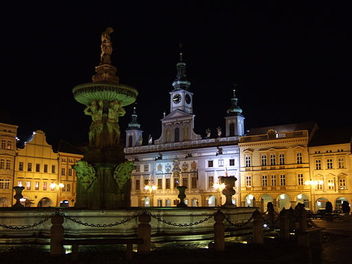
The Erratic Boulder is said to be near this fountain. (Photo: Ecelan)
It’s a curious but well-known phenomenon among travelers that once you’ve been presented with a list of must-sees in the district, you feel almost honor-bound to pay each one of them a visit. Even if you’d never heard of, say,
The Erratic Boulder of České Budějovice
in the Czech Republic, suddenly you have the uncomfortable sensation that you’re letting down not only yourself but all of touristkind if you don’t go and pay homage to it.
What’s The Erratic Boulder, you ask? A stone that marks the former site of a hangman’s scaffold;
according to legend, if you pass over it after ten o’clock at night, you’ll be wandering the streets until dawn,
unable to find your way home. It’s far from the most exciting monument in Europe, in the Czech Republic, or even in České Budějovice. But I am still faintly annoyed with myself for missing the chance to pass over it after ten and see whether I could make it safely back to my hotel.
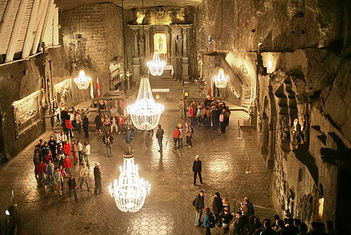
Wieliczka Salt Mine near Krakow. (Photo: Cezary p)
However, as last summer’s
three-month train trip
progressed, Rich and I became increasingly cavalier about neglecting monuments both great and small. In fact,
we began to take pleasure in blowing off must-sees wherever we went
. In Salzburg alone, we ignored Mozart’s birthplace, the castle, the cathedral, the palace of the Prince-Archbishops, various abbeys and churches, and Schloss Klessheim, a Baroque palace (now a casino) where Hitler used to hang out with Mussolini. We also skipped Prague’s Gates of Hell (said to be the actual entrance to Netherworld), Krakow’s famous salt mines, and all of the vampire graves in Transylvania.
Instead, we reveled in
the delightful sensation of being completely free to structure our days however we chose
, consulting our preferences and whims rather than Wikitravel’s lists. We spent days simply wandering city streets, stopping at sidewalk cafés to sip espresso and watch that particular corner of the world offer itself to our interested gazes. We felt extraordinarily rich in that rarest of commodities: time.
It was in
Veliko Tarnovo
, the old capital of Bulgaria, that I first heard the expressions
“time rich” and “time poor”
from an Australian who’d been on the road half a year. “Most people feel time poor,” he said one night over some eye-watering Romanian brandy. “They have the idea they have to jam as much as possible into each day because there are so few hours available to them. Doing less opens up your day. You realize that you really are time rich. It’s true luxury.”
Ever since that conversation,
I have been attempting to embrace a “time rich” attitude. It isn’t easy.
At the moment, I’m blogging, writing another book, corresponding with friends all over the world, staying active on social media, itching to get back to a neglected painting, expecting a houseguest, hosting three events in the next three days, and heading out soon to California – where my schedule looks even busier. However (pause for a deep breath) there are 8534 hours left in 2014. I will accomplish everything that’s really important to me, and let go of tasks that, like seeing The Erratic Boulder of České Budějovice, aren’t really crucial to my happiness.
A friend once told me about a woman she knew who liked to go on holiday but hated to make arrangements, preferring to tag along on trips others had organized. “
A lot of the time she didn’t even know what country she was in
. For her, travel was just moving from one pub to another. ”
I was rather cheered by this disclosure. Judged against this low bar, I am not doing too badly. I may not visit every must-see in Fodor’s, but I always know what country I’m in, and on a good day, I remember that I have all the time I need to enjoy it.
In keeping with my new policy of not trying to cram in absolutely everything, I want to let you know that I may not be posting on this blog next week, as I’ll be on the road. I’ll be back with you as soon as time permits.
Leave a Reply