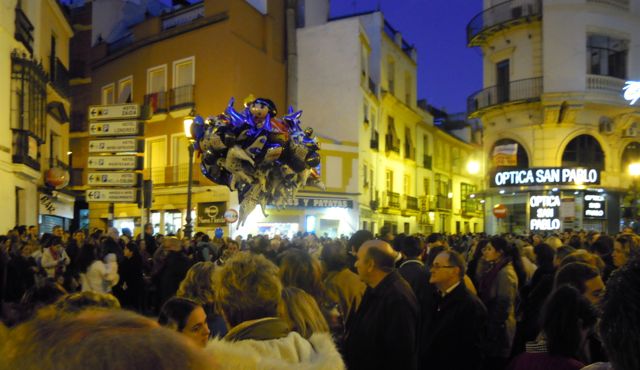
Being showered with sweets sounds enchanting, but when frenzied kids are flinging handfuls of rock-hard candies at your head, it feels a lot like being stoned – in the Biblical sense of the word. I would have tried to duck out of the way except that I was jammed shoulder-to-shoulder with the entire population of Seville. Everyone turns out for this glorious culmination of the holidays, the parade of the Reyes Magos (Three Kings), whose feast day is known in liturgical circles as Epiphany.
Here in Spain, the Reyes Magos bring gifts to good boys and girls on January 6th, and on the eve of that happy event, the Cabalgata (Cavalcade) sweeps through Seville, distributing 80,000 kilos (176,000 pounds) of treats from 33 glittering floats. The planners announced that this year 80 percent of the candies would be soft, but I can tell you those weren’t marshmallows and gumdrops bouncing off my skull. Of course, a few lumps on the cranium are a small price to pay for such a dazzling spectacle.
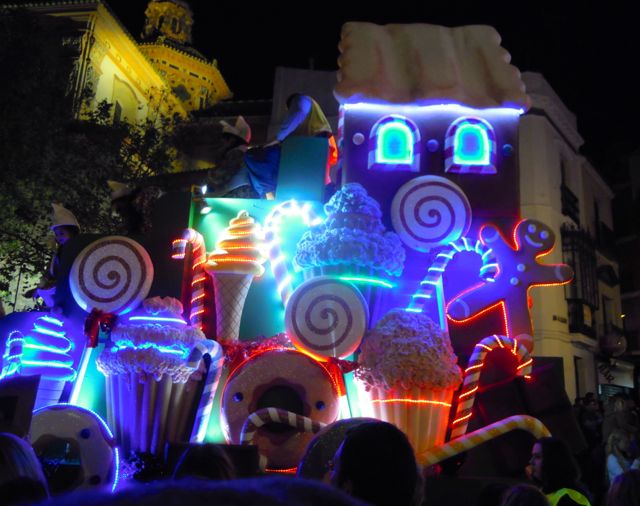
This year we saw fewer Disney-themed floats (sponsorships must have been harder to get) and more classic fairy tales, such as Hansel and Gretel; historical motifs including Roman Seville; and obscure local cartoon characters like the clown Yupita, who lives in the World of the Potato. As each brilliantly lit float appeared out of the darkness, bystanders would shriek and wave frantically to attract attention and candy. Some held up bags to catch the treats; skilled veterans snatched them out of the air; kids scrambled underfoot for fallen pieces. I saw one guy in a wheel chair with crushed candy and scraps of wrappers gumming up his wheels, but he didn’t seem to mind as he rolled away with his lapful of sweets.
Flinging treats to the shrieking crowd is a heady – and expensive – honor. Most floats are filled with children whose parents have paid about 2000 euros per kid to get membership in the organizing group plus the necessary costumes and candy. I can’t even begin to guess what it costs to be one of the stars of the show, the kings Melchor, Gaspar and Baltasar. By far the most popular is Baltasar, the African king, played this year by the famous matador, Eduardo Dávila Miura, who no doubt paid a king’s ransom for the privilege.
For Sevillanos, this is an especially big year for the Three Kings, as Pope Benedict, in his new book,
The Childhood of Jesus
, says they were likely from right here in Andalucía. As you can imagine, this was pretty
hot news
. Of course, elsewhere in the book, His Infallibleness says they may not have existed at all. But try telling that to those of us who staggered off into the night with aching heads and pockets full of candy. We know they’re real!

Leave a Reply