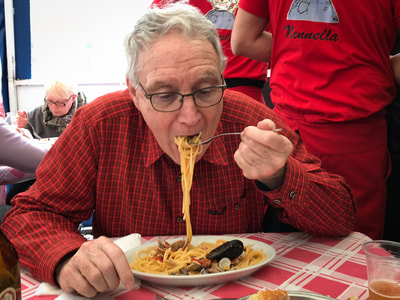
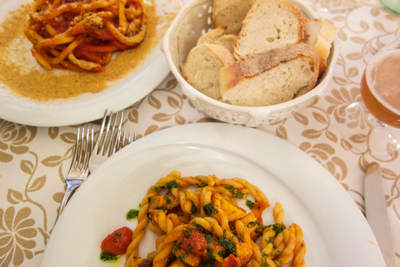
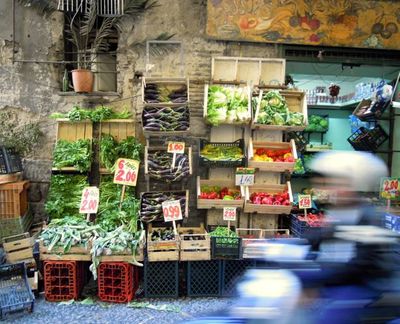
The first thing they always tell you about Napoli (aka Naples, Italy) is, “Don’t go.” And for a lot of travelers, that’s good advice. The city is insane. Every cab journey is “Mister Toad’s Wild Ride” from Disneyland. Attempts to cross the street on foot are like traversing the Grand Prix. The lodgings are tricky to locate and full of surprises. My first time there I slept in an abandoned spa with revolving colored lights. On my last visit, I stayed in an old lady’s apartment full of erotic art and had to
pay a coin-operated elevator
every time I went in or out of the building. Nothing in Napoli is plain vanilla.
Which is precisely what I love about the city.
The chaos of Napoli
always makes me feel more vividly alive. The streets are teaming with people, half of them on Vespas, all rushing about their daily affairs with tremendous zest. Everyone seems to be talking at once, using their whole body to underscore key points with flamboyant gestures. Rules are ignored, and creativity, not organization, is prized; I always picture the parents teaching their kids to color outside the lines and eat dessert first.
There’s an exhilarating, anything-goes atmosphere, and back in the day, one of its riskier innovations developed into the world’s favorite comfort food: pizza.
The idea of putting toppings on flatbread didn’t start in Napoli. It goes back to — well, I’m guessing the day they invented flatbread, which was sometime during
the Neolithic era
. But it took think-outside-the-box Neapolitans to have the courage (or madness) to add tomatoes, which were widely viewed as toxic ornamental plants when they arrived in Europe from the New World. When the trailblazers survived the experiment, everyone started adding tomatoes to the traditional toppings of olive oil and cheese, and pizza became a local favorite. Italian immigrants brought it to the USA in the 19th century, but it didn’t go mainstream until American GIs discovered it during World War II and came home demanding more. And they got it. Today, Americans consume three billion pizza pies a year — that’s 100 acres of pizza a day, or 46 slices (23 pounds) per person per year.
Luckily for all of us, pizza has maintained the Napolitano anything-goes attitude. While some purists argue that the only “true” pizzas are the
marinara
and the
margherita
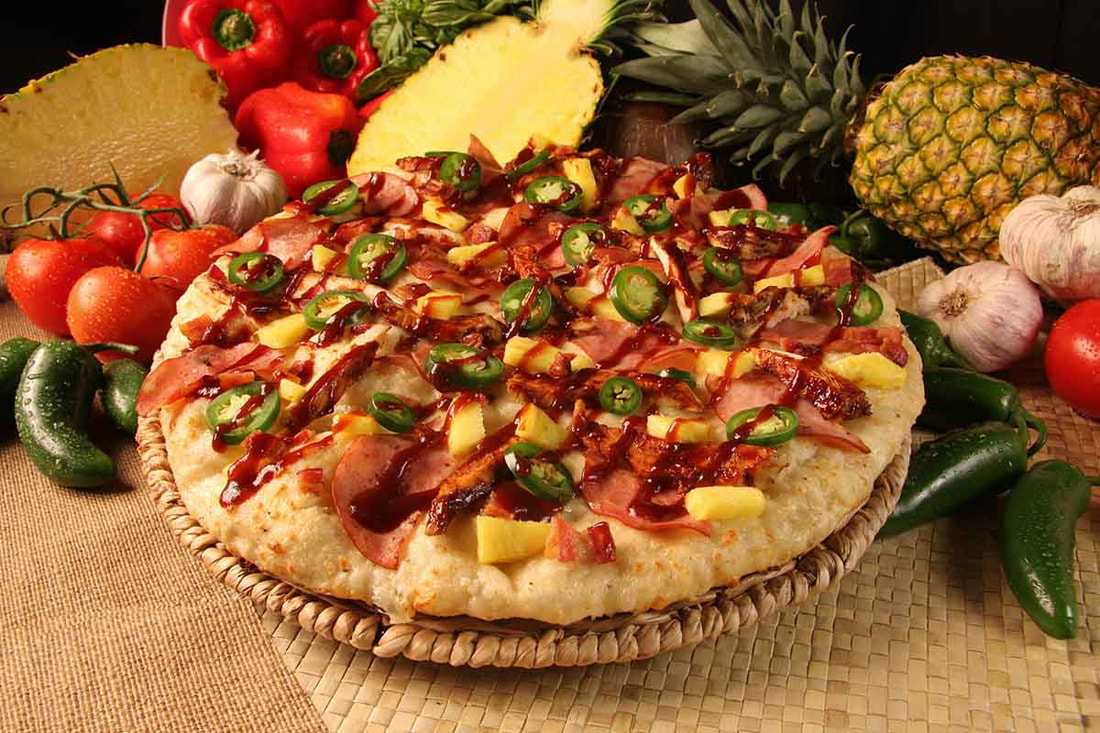
, the world disagrees, enthusiastically embracing countless varieties. Oh sure, there was a bit of a flap over Hawaiian pizza when Greek-Canadian
Sam Panopoulos
introduced it in 1962; some felt adding sweet pineapple was an abomination. Just last year Iceland’s president,
Guðni Th. Jóhannesson
, caused a media firestorm when he casually told some students that he was fundamentally
opposed to pineapple on pizza
and would ban it if he could. Jóhannesson later clarified: “I like pineapples, just not on pizza” and suggested topping pizza with fish instead. And the debate rages on.
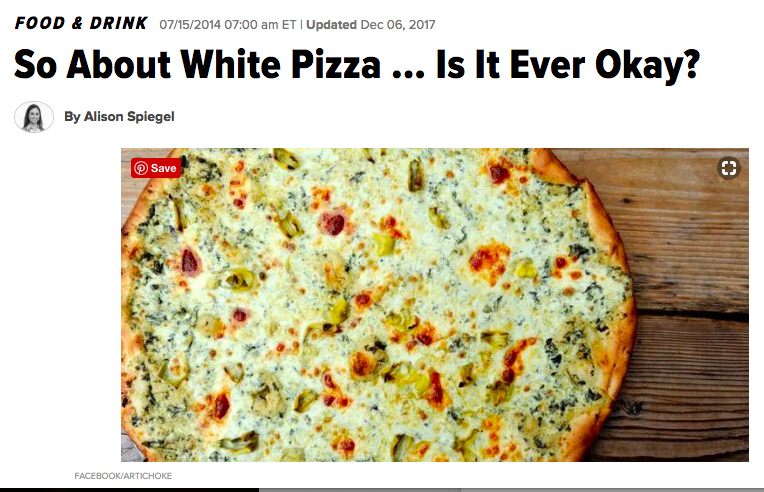
Some have been equally scathing about white pizza. In a Huffington Post article, lifestyle editor Alison Spiegel
dissed white pizza as “difficult to pull off”
and often “gummy and gooey … gloppy … offensively boring.”
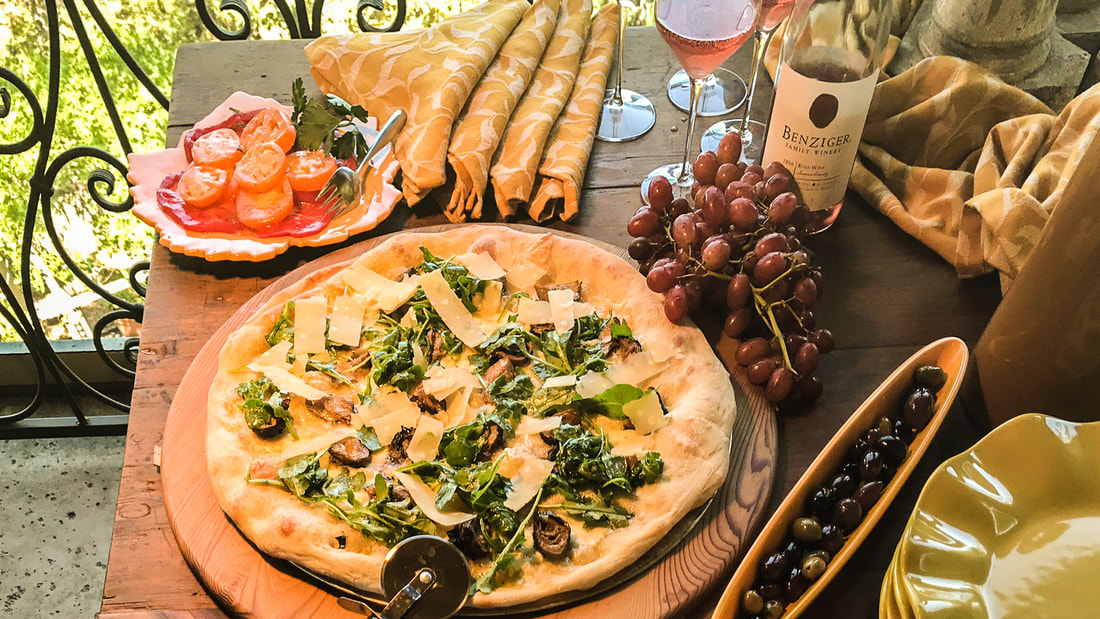
I beg to differ. As evidence I site the recent morning I spent in the kitchen of my friend Karen Adelson, who lives in California’s wine country and is one of the finest cooks I know. She’d offered to make me her favorite white pizza and I jumped at the chance to see this controversial dish done right.
As a starting point, she consulted the recipe for
Pizza with Arugula and Shaved Parmigiano Reggiano
from Joanne Weir’s
Wine Country Cooking
. But in the true spirit of
pizzaiolos
everywhere, my friend didn’t slavishly follow directions. She
added artichoke hearts,
sliced rather than grated the mozzarella, and baked the pie on a pizza screen rather than the customary pizza stone or metal pan. And instead of making her own, she bought the dough to save time and fuss. A cook after my own heart.
There was absolutely nothing boring, gooey, or gloppy about Karen’s white pizza. The flavors sang with garlic and lemon juice, balanced beautifully by three creamy cheeses, fresh arugula, tangy artichoke hearts, and the light, yeasty crust. Spiegel and the pizza purists don’t know what they’re missing!
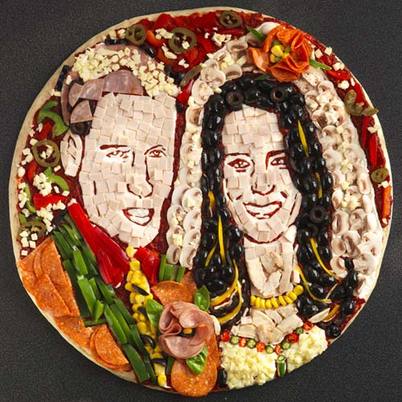
Pizza portrait of British Royals; amusing or creepy? You decide.
Of course, you can take innovation too far. I myself am aghast when I hear about people topping pizza with
Nutella, frog’s legs, an entire Happy Meal, or pizza-flavored ice cream
. But I will staunchly defend their right to experiment any way they like — so long as they don’t make me eat it.
Wildcat experimentation is what gave us pizza in the first place, and its comforting presence helps us keep going when the going gets tough. As entertainer Henry Rollins put it, “Pizza makes me think that anything is possible.” In these uncertain times, when the entire world can seem as chaotic as Napoli, we need pizza more than ever. Justine Sterling wrote in
Food & Wine
, “In a recent Harris Poll, Americans revealed their favorite classic comfort foods (eaten when sad or stressed), celebratory comfort foods (eaten when happy or during a special occasion) and curative comfort foods (eaten when sick).
Unsurprisingly, the overall winner was pizza
.” And on days when I need an extra helping of comfort, I go with what Yogi Berra said: “You better cut the pizza in four pieces because I’m not hungry enough to eat six.”
Recipe:
Pizza with Arugula and Shaved Parmigiano Reggiano
What’s your favorite pizza? Are there any kinds you wouldn’t eat?
YOU MIGHT ALSO ENJOY
NAPLES, ITALY: EMBRACE THE CHAOS
MAKE THEM A PESTO THEY CAN’T REFUSE
NAPOLI’S WRONGS ADD UP TO SOMETHING RIGHT
WANT MORE ON TRAVEL, COMFORT FOOD, AND LIVING ABROAD?
Sign up here for updates and a free copy of my three-book set, Enjoy Moving Abroad.
YES! SEND INFO & FREE BOOKS

Leave a Reply