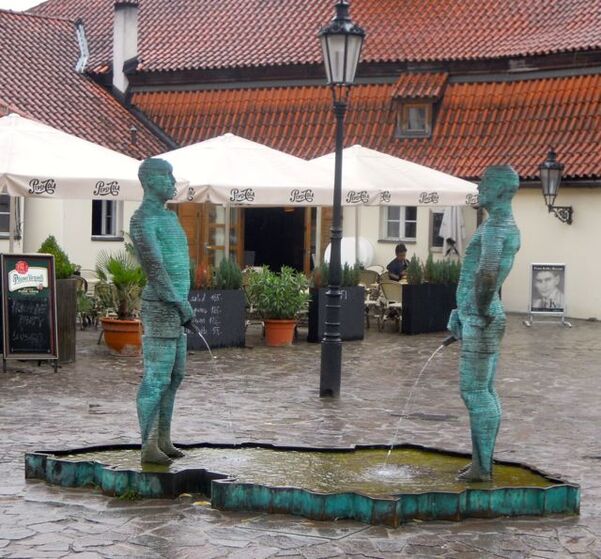
The very best thing about the
Franz Kafka Museum
is the automated statue out in front of it, showing
two naked men, peeing into a fountain shaped like the Czech Republic
, spelling out famous Czech literary quotes with their “urine” (
see video
). Sadly, it’s all downhill from there. Kafka, as you may recall, wrote the one about
the guy who turns into a giant cockroach
. As Prague’s favorite literary son, he is everywhere, on tote bags, post cards, t-shirts, and ads for his museum. Before heading over there, I perused
Lonely Planet’s review
, which concluded, “Does [this museum] vividly portray the claustrophobic bureaucracy and atmosphere of brooding menace that characterized Kafka’s world? Or is it a load of pretentious bollocks? You decide.”
It didn’t take us long to cast our vote. We suffered through a ridiculously convoluted ticket purchasing procedure (
claustrophobic bureaucracy!
), viewed the handful of photos and letters surrounded by lots of black space (
brooding menace!
)
, and saw a grainy B&W film of old Prague, distorted with a ripple effect (
existential angst!
). Additional angst was provided by the fact that we spent the equivalent of $15 for the 15 minutes it took to tour the exhibits. We could hardly wait to get back outside into the pouring rain.
Coincidentally, a load of pretentions bollocks was precisely what we
didn’t
find at
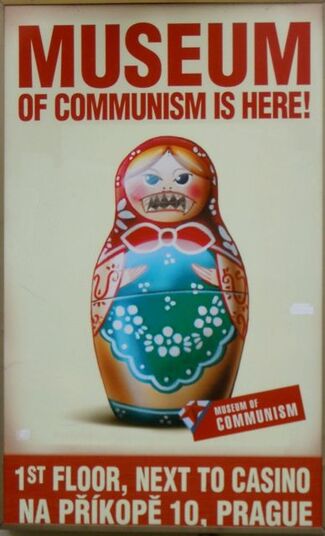
the Museum of Communism
, an institution that deals soberly with an important subject without ever taking itself too seriously. When it opened,
two large men from the museum dressed like KGB agents and followed tourists
through the city streets, acting sinister (
see video
). When noticed, they handed the tourists a flier that read, “Experience How Life Was Under Communism,” and stood around talking with them about the museum’s theme: “Communism: The Dream, The Reality, The Nightmare.”
Exhibits show the rise of communism, the Nazi occupation of Czechoslovakia, the Russian “liberation” of the region, and the years of repression, starvation, and indoctrination under communism. There’s a short film of the1989 student demonstrations that led to the Velvet Revolution and freedom. Even knowing the eventual outcome,
it was harrowing to watch those young Czechs face down the riot troops
advancing toward them swinging clubs. I was awed by the sheer courage it must have taken for those students to risk everything – their bodies, their freedom, their lives – to take their stand. It occurred to me that while I’ve spoken out for many causes over the years, I’ve never really risked much of anything – a little social ridicule, maybe; once the loss of a client – and I wondered what choices I would have made if I’d been a Czech student in 1989.
And then there’s
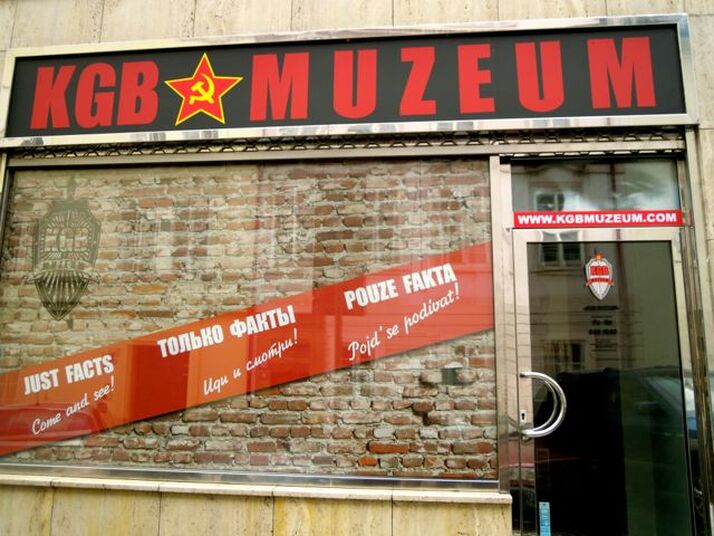
the KGB Museum
. Well, it’s not so much a museum, really, as a sort of
recruitment outpost
. A place to keep the flame alive. I’d visited their website, which proudly proclaims the exhibits include “things that belonged to the first persons of the Soviet state” and such must-sees as Lenin’s death mask and Trotsky’s murder weapon. “The bright part of the KGB museum is the photo exposition ‘Prague 1968 in the eyes of KGB officer.’” Yes, what could be more heartwarming than that?
The museum turned out to be a small storefront, whose dim entryway, festooned with KGB posters and curtains, seemed deserted when we arrived. Hearing a murmur of voices, we called out, and a very stern young man in battle fatigues with a bandaged arm emerged from behind a curtain. In answer to my question he barked, “Is open every day!” Turning on his heel, he disappeared again.
Rich and I scurried away, vowing never to return. Call me paranoid, but my basic survival instinct said we should just stay away from these people. I didn’t want to pay for the tour (a very capitalist $18 a person) by credit card, share my email address with them, or visit
their Facebook page
. Unfortunately, the museum was located almost directly across from our apartment, so Rich and I walked past it several times a day, with our jacket collars flipped up and our hats pulled down over our eyes, hoping to evade notice. In fact, for these few moments each day, our Prague experience became positively Kafkaesque.

Leave a Reply