“And now you will see the most famous thumbs in the city,” said our guide Luis.
Rich and I exchanged delighted glances. What new nuttery was this? Were we visiting the town’s Picasso, famous for its distorted hands? The miraculously preserved relics of Saint Eubondiga the Eight-Fingered? A science experiment run amok? The legendary vanishing hitchhiker?
After two weeks on the road, my capacity for surprise should be exhausted, but somehow I’m continually stunned by what Spain shows off to visitors.
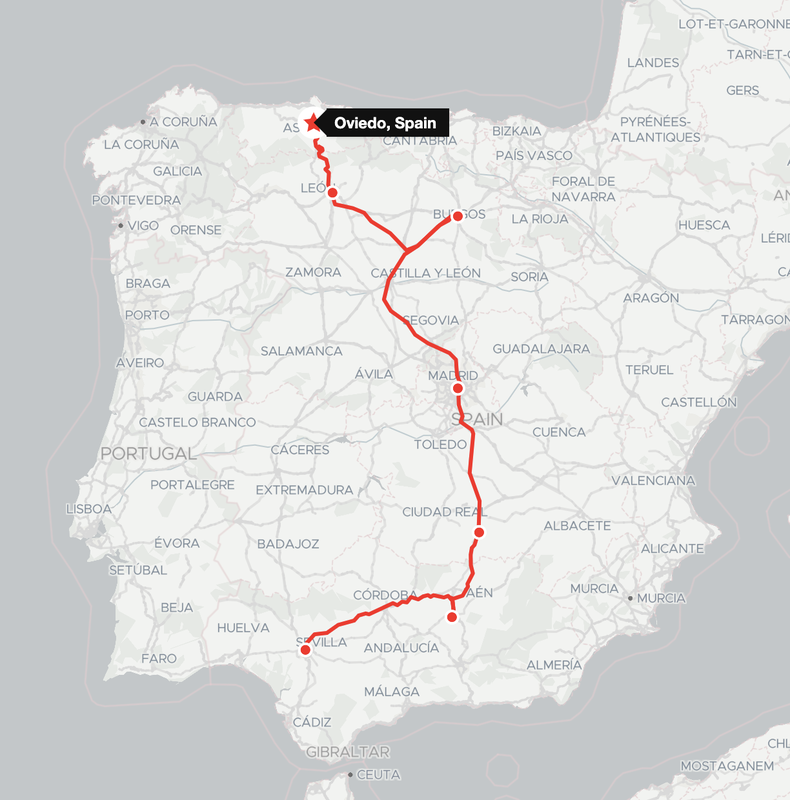
Rich and I had headed north from Burgos to Léon, a city roaring with life. My theory is the town still reflects the character of the Roman legion that founded it 2000 years ago. Those guys were known for their kick-ass attitude on the battlefield and in the barroom. Their commander-in-chief, Julius Caesar, blamed some of this on those “damn Spaniards for whom drinking is living.” Even now, the presence of those formidable Romans can still be felt throughout the city.
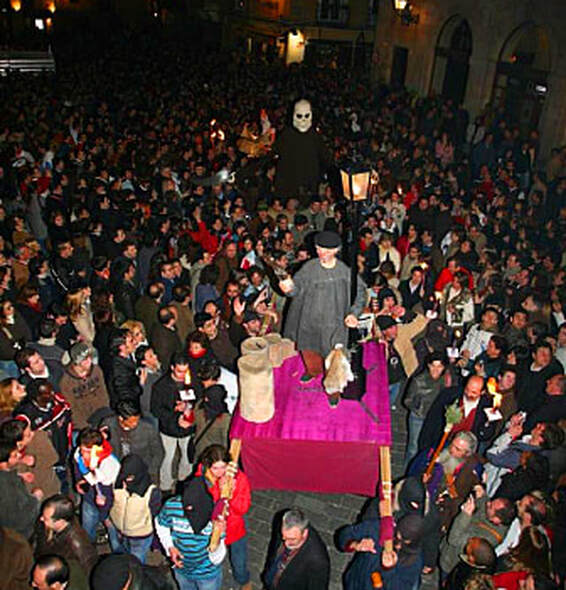
This week Léon pays homage to its most famous over-indulger, the late, legendary Genaro Blanco Blanco. On Holy Thursday night in 1929, the old rogue was very drunk, and while reeling along beside the Roman wall, he paused to answer the call of nature against its ancient stones, as had so many before him. Just then, the driver of the city’s first municipal dump truck took a turn too fast, lost control of the vehicle, and crashed into Genaro, killing him instantly.
The tragedy would have soon been forgotten except for four witty bohemians, who decided to pay humorous homage to his memory with an annual Last Supper, poetry reading, and procession. Now, crowds continue to gather every Holy Thursday, in the midst of the grandeur and solemnity of pre-Easter processions, for this irreverent, wine-soaked revelry. How Genaro himself would have loved to be part of it.
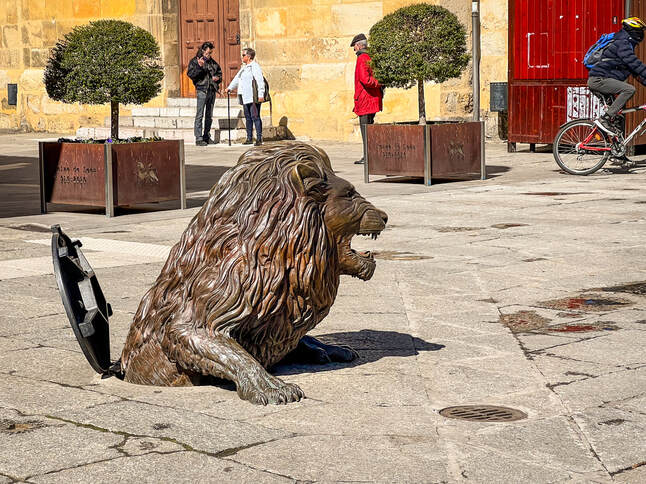
Léon’s ripsnorting atmosphere has inspired some bold architecture, including Casa Botines built by Antoni Gaudí. If you’ve seen his undulating works in Barcelona, you’ll be as surprised as I was to discover here his style was sternly gothic. In fact, it was designed to look like a dragon, with a door suggesting an open mouth, spiky railings, roof slates in the shape of scales, and (in case you missed the point) a statue of St. George dispatching a giant reptile on the front.
When it opened in 1892, the upper floors were apartments for the prosperous middle class, while the bottom floor was a textile warehouse and shop. It’s now a museum with a goofy special effects screen that lets you see how you’d look in fashions from the era.
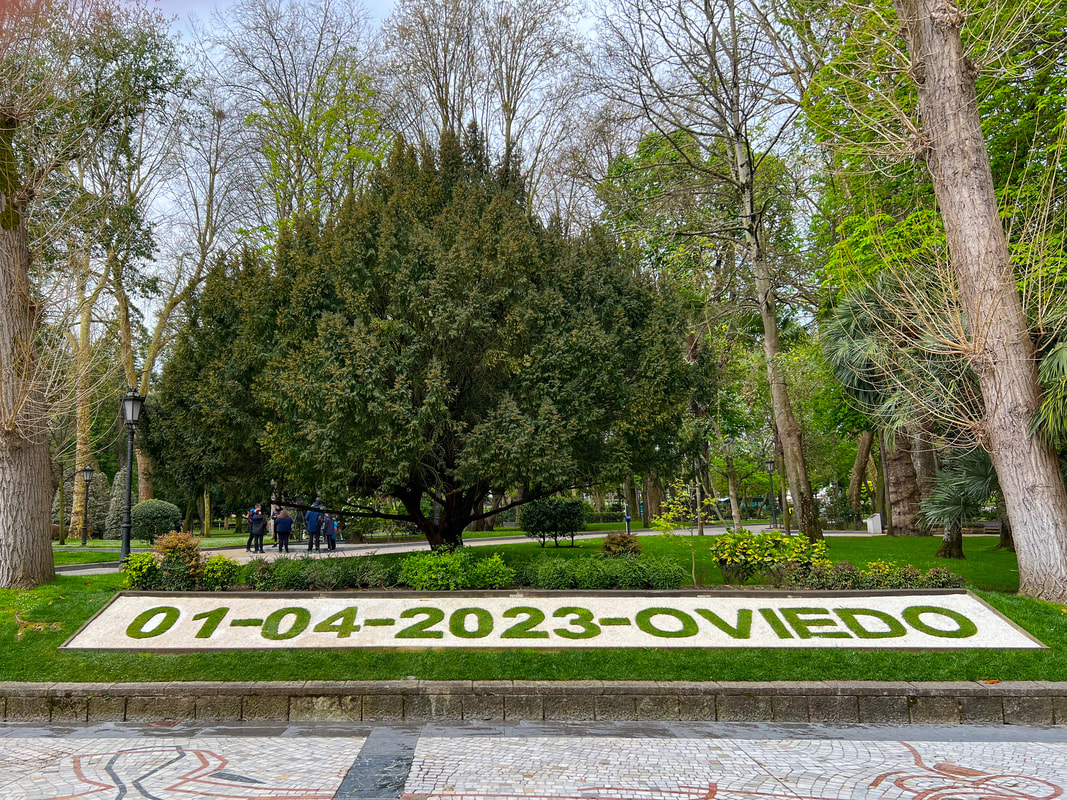
After Léon, it was something of a shock to arrive in Oviedo, the sober and stalwart capital of the Asturias, a region nicknamed Switzerland by the Sea. Luis told me Ovieda’s been voted the cleanest city in Europe nine times, and twice ranked cleanest in the world. To say it’s orderly is like saying the Camino of Santiago is a good-ish walk. Take this date sign, created of pristine white gravel and living grass, which is changed daily (presumably at the stroke of midnight). If this was Seville, people would steal half the grass numbers and letters for souvenirs and rearrange the rest to spell out some pithy political or social commentary. Here, there’s not even a pebble of gravel out of place.
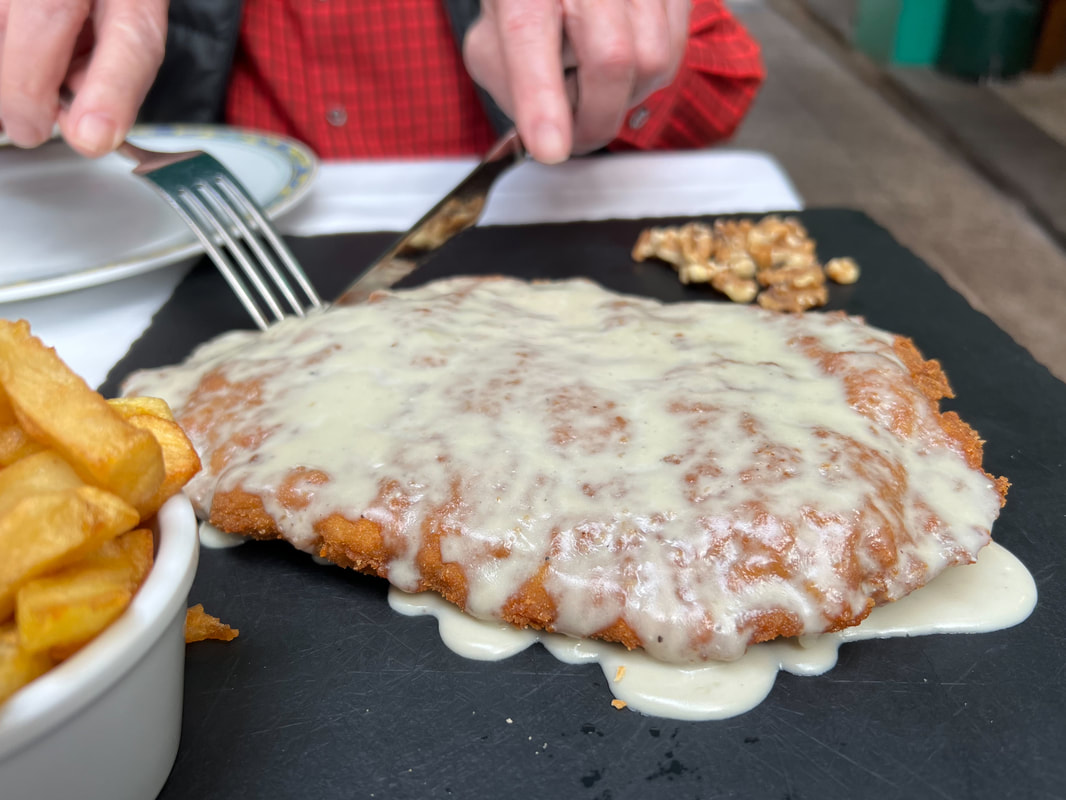
While the atmosphere may be Swiss, the food is straight from heaven. In the global ranking of cuisines, Spain is currently third, after Italian and Greek, and it’s easy to see why. Oviedo’s headliner is the traditional
cachopo
, a sort of veal sandwich in which two large pieces of veal serve as the “bread,” which is then stuffed with jamón (cured ham) and cheese, covered with a breadcrumb mixture, and fried. Not exactly health food! But I felt I owed it to my readers to perform a taste test, and wow, it was delicious. And I’m almost sure my arteries will recover before my cholesterol test in August.
Another regional favorite is
fabadas Asturianas
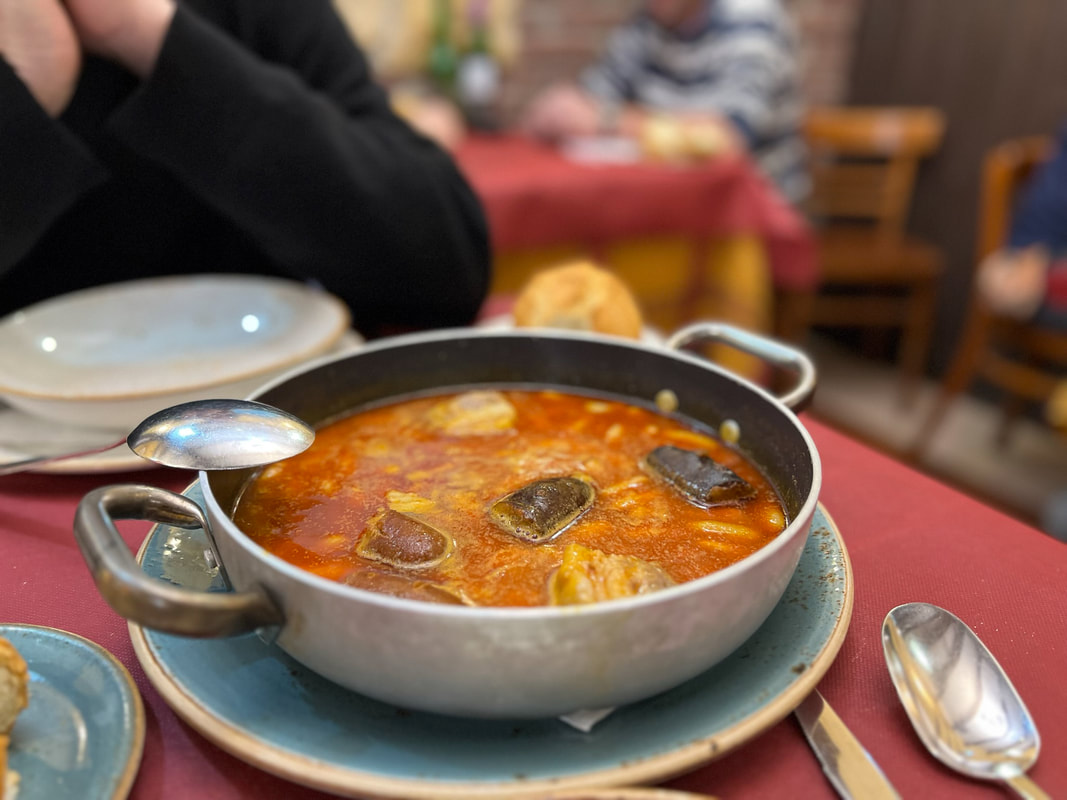
(bean stew with chunks of sausage and pork belly), a specialty of the unfortunately named El Fartuquin restaurant. There Rich and I were surrounded by workmen on their lunchbreak, and we watched with awe as they consumed a bowl of
fabadas
, followed by
cachopo
or a half chicken, washed down with tinto de verano (red wine mixed with a soft drink), topped off with flan and coffee. The lunch of champions.
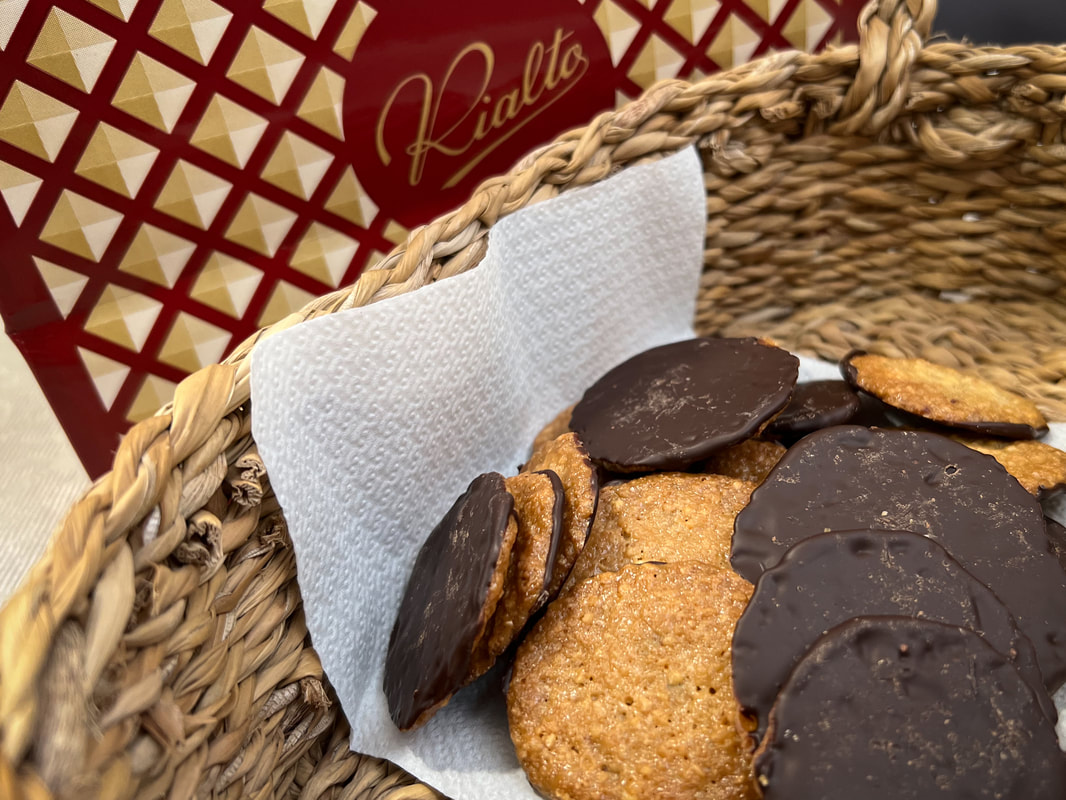
Our selfless dedication to culinary research included a visit to the Rialto, home of Moscovitas: chocolate almond cookies with a famously secret ingredient and a legend claiming the recipe was found inside a set of Russian nesting dolls a traveler brought home from the USSR. Recent labeling laws forced the Rialto to reveal the secret ingredient: higher-fat almonds. (I didn’t know that was possible. See how educational travel can be?) Efforts by the Rialto to squash the legend, including an 80th anniversary box printed with their protests and images of Russian nesting dolls, naturally had the opposite effect — as perhaps was intended.
By now I’ve seen countless churches, but I couldn’t pass up Oviedo’s cathedral because its relic collection is quite possibly the most extraordinary on the planet. Inside the
Cámera Santa
(Holy Chamber) is the
Arca Santa
, a box said to contain a piece of the True Cross, shards from the Crown of Thorns and Holy Sepulchre, bread from the Last Supper, a wine jar Jesus used for his miracle during the wedding at Cana, and some of the Virgin’s breast milk. Of course, not being possessed of x-ray vision, I couldn’t actually see any of these marvels for myself.
However I was able to view the Sweat-Cloth of Jesus, allegedly used to clean his face after the crucifixion. Naysayers point out radiocarbon dating places the age of the cloth at 700 AD; believers insist that can’t be right because stories about the cloth go back to 500 AD. Which is still off by five centuries, but who’s counting?
The next day, when Luis led us to Oviedo’s most famous thumbs, Rich and I both stared in disbelief then burst out laughing. Evidently we’d misheard him; he wasn’t taking us to see thumbs but to see
tombs.
The handful of others on the tour looked at us oddly, but that’s nothing new for us. Confusions and misunderstandings are a way of life on the Nutters Tour, and luckily they give us plenty to chuckle about along the way.
WHERE ARE WE NOW?
JUST JOINING US? HERE’S THE NUTTERS TOUR SO FAR
Travel Alert: You Can’t Always Get What You Want..
.
(Madrid & Burgos)
Gobsmacked at Every Turn but Embracing the Chaos
(Ja
én & Valdepeñas)
All Aboard for the Nutters Tour of Spain (Packing & Organizing)
THAT WAS FUN. WANT MORE?
Subscribe to receive notices when I publish my weekly posts.
Just send me an email and I’ll take it from there.
[email protected]
Curious?
Enter any destination or topic in
the search box
below
. If I’ve written about it, you’ll find it.
And be sure to
check out my
best selling travel memoirs & guide books
here
.

Leave a Reply