As the old saying goes, “There are only two seasons in Ireland: This winter and next winter.” Just days ago I was sitting in a Dublin pub, sipping a pint of stout and peering through a rain-streaked window at pedestrians scurrying through the icy downpour, chasing inside-out umbrellas, cursing in half a dozen languages.
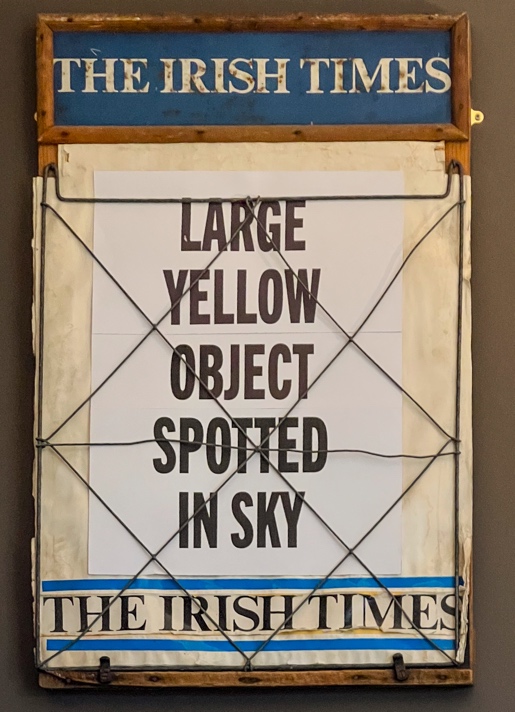
To be fair, hours earlier there had been a brief dry spell, with a break in the cloud cover, prompting craned necks and the kind of stunned surprise immortalized in this famous newspaper headline:
As a fourth-generation Californian currently living in southern Spain, I consider sunlight my birthright and strenuously object to prolonged bouts of cold, grey, soggy weather. But the Irish blithely refer to such conditions as “a fine, soft day” and sometimes look askance at clear skies.

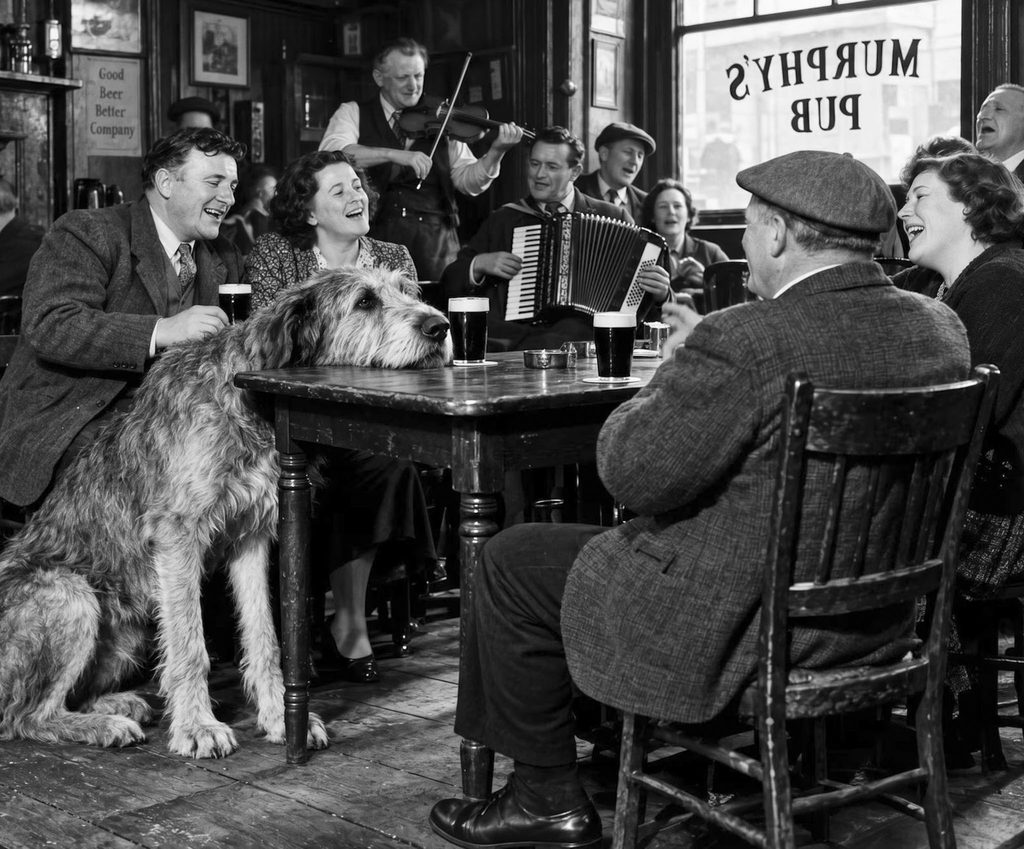
Whatever their views on the weather — usually “What? You call this weather?” — the Dubliners I met were remarkably cheerful souls who were never too busy to pause for a bit of banter and chitchat. As The Little Book of Dublin puts it, this is “a small, cultured, curious city with an ear for a well-told story. (In Dublin, conversation is not an art. It’s more of a sport, played in sitting rooms all over the country.)” And not just sitting rooms but in museums, restaurants, bookshops, elevators, lines for the loo, and of course, Dublin’s 772 pubs.
In other words, these are my kind of people.
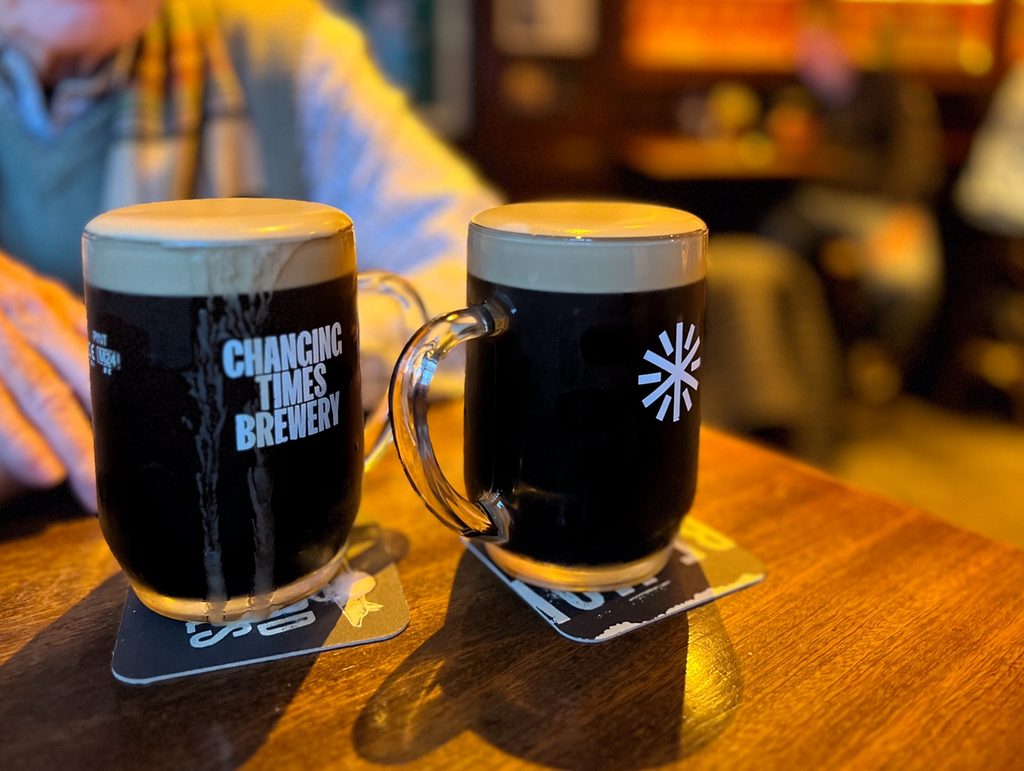
Rich and I both have Irish ancestors, although the details, especially on my side, have grown fuzzy with time and embroidery. No matter; it’s clear we come from long lines of convivial folks who have passed down their gift of gab and the desire to mark significant occasions with extravagant toasts. Which is why Rich and I found ourselves in Dublin twice during the last two weeks, thanks to days-long stopovers flying to and from a family funeral in New Jersey. It was a worthy sendoff; glasses were raised, praises sung, stories told and retold with ever growing gusto and less slavish devotion to accuracy.
Here’s what I do know: my relatives arrived in America in the mid-nineteenth century, a time when nearly 90% of Irish lived in poor rural communities, so it’s a fair bet mine were fleeing the An Gorta Mór (the Great Hunger), aka the Potato Famine.
At the time, most Irish produce was shipped to England, and farm workers were subsisting on the cheap, prolific Lumper Potatoes, consuming 10 to 14 pounds a day. Then in 1845 the Lumpers were devastated by blight, launching a famine that would leave a million dead and thousands of desperate families flooding into Dublin, living ten to a room in tenements like 14 Henrietta Street.
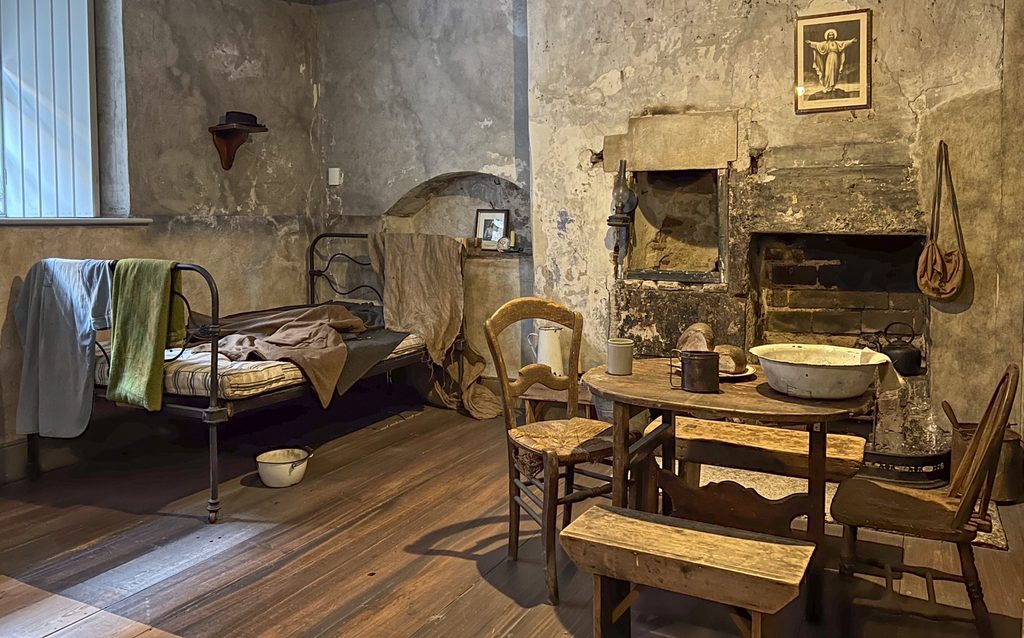
At the museum, our guide Sean, who had grown up in a similar tenement a block away, explained that 14 Henrietta Street housed 100 people in what had originally been a single rich family’s home. Rooms were divided, water taps and toilets were shared.
“There was one toilet and one tap on the third-floor landing and two in the garden,” Sean said. “People queued, sometimes fifty or sixty at a time.” When need’s must, people used chamber pots and emptied them out the windows. Heads-up everybody!
The best, brightest, and strongest went overseas in hopes they could find work and send for the rest of the family. Learning Dublin had a life-sized reproduction of one of the ships moored down at the docks, I was curious to see what the journey was like for the 1.75 million Irish who wound up on America’s shores.
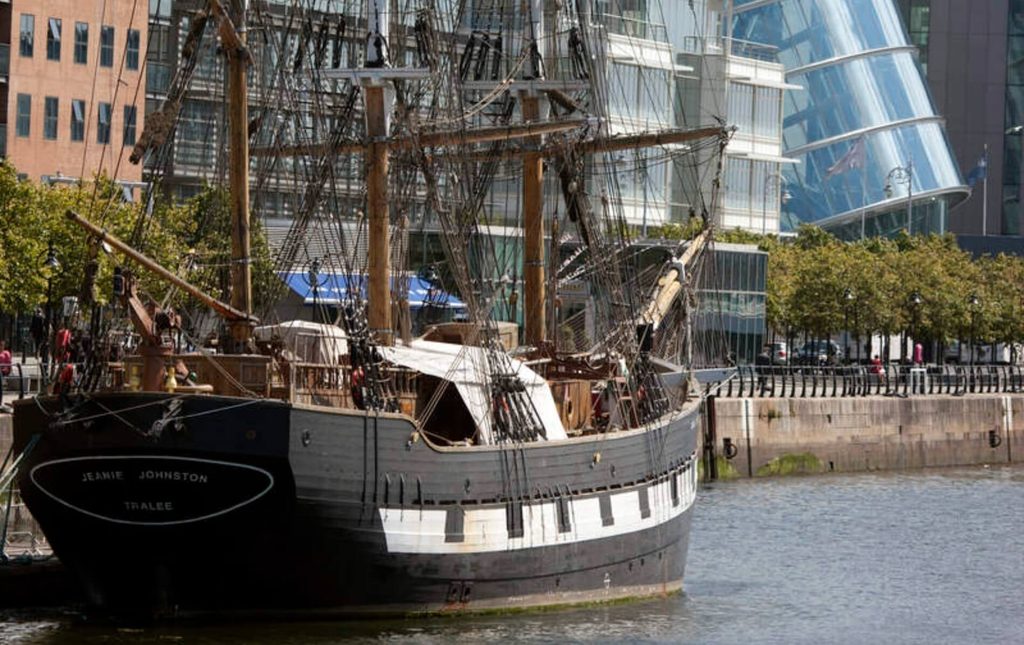
“Good lord,” I muttered to Rich as we walked down the gangplank. “Look how small it is. I wouldn’t sail across Lake Erie in this thing.” But here I did the Jeanie Johnston an injustice; she was famously the safest ship ever to make the North Atlantic crossing, completing 16 round trips between Ireland and the New World without ever losing a single passenger.
She measured 154 feet — the distance an average adult can walk in 34 seconds — and was blessed with a captain who wanted to run a decent ship. He took “only” 200 passengers, fed them adequately, provided a doctor, and built beds to make it harder for the rats to reach them. Other ships packed in twice as many people, with everyone sleeping on the deck, and they tended to lose 30% of their passengers to disease and starvation, earning them the name “Coffin Ships.” And even those horrific conditions were vastly superior to those of the slave ships.
So by the standards of the day, the Jeanie provided grade A accommodations. How luxurious were they?
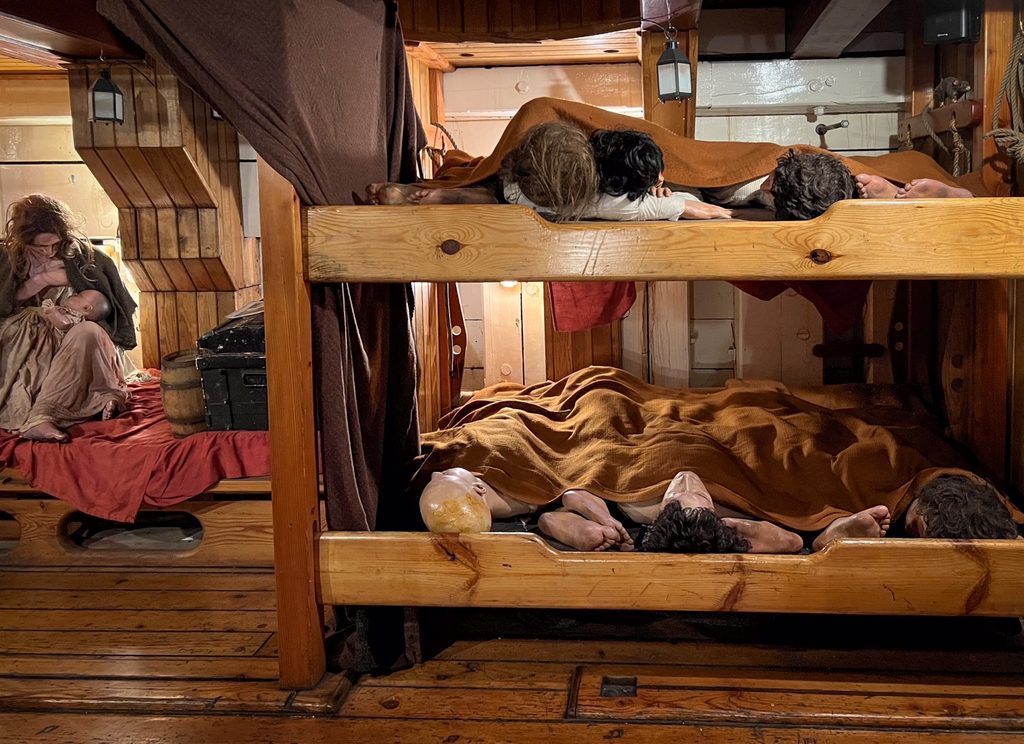
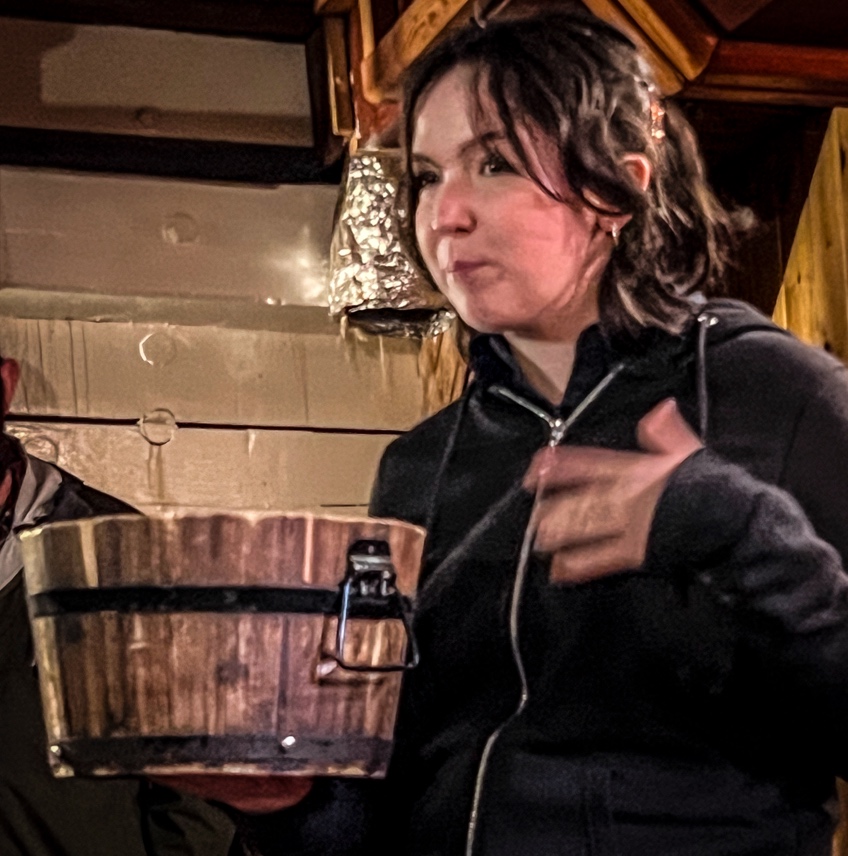
“Passengers slept five to a bed using the nose-to-toes method,” explained our guide. “As for sanitation, they used buckets like this. Imagine trying to do that on a stormy sea.”
My mind reeled. “How long was the voyage?” I asked.
“About six weeks.”
I began to develop a new, even deeper respect for the hardy souls who had made the trip to the New World. Were my people on a boat like the Jeanie? Something better? Worse? I’ll never know, because even my loquacious relatives chose to remain silent about their experiences on the high seas, taking their memories to their graves.
But science has demonstrated that memory isn’t about archiving the past, it’s about building a toolkit for the future. What we learned yesterday provides us with a framework for connecting the dots today, so we can make decisions about tomorrow in a broader context. Whether or not they spoke about it, whatever those hardy souls learned on the voyage stuck with them through the years.
So what were the take-away lessons? For a start, they learned the value of grit, determination, endurance, and vision. As Oscar Wilde put it, “We are all in the gutter, but some of us are looking at the stars.”
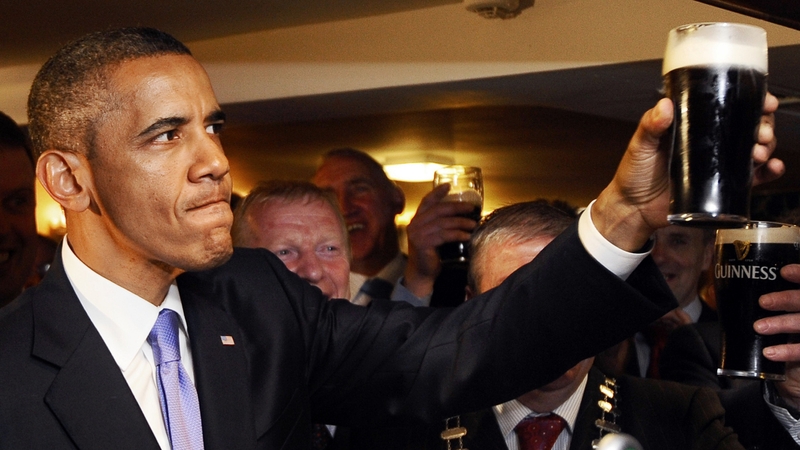
Among those tough, visionary Irish immigrants and their descendants are 23 American presidents (yep, half of them!), including Andrew Jackson, Grant, Truman, Kennedy, Johnson, Nixon, Ford, Carter, Reagan, the Bushes, Clinton, Obama, and Biden. (No, the current occupant of the White House doesn’t have a drop of Irish blood, which may account for his incoherent oratory style.)
We can be sure of few things in life except this: like the weather, our fate will change often, when we least expect it, in ways we could never predict. Our job to ride out the storms and whenever possible do a little dancing in the rain. Those of us blessed with resilient immigrant ancestors grow up knowing the truth of Voltaire’s words: “Life is a shipwreck, but we must not forget to sing in the lifeboats.”
I’ve just heard about the devastating loss of life in today’s rail disaster on the line between Madrid and Andalucía. My heart goes out to all those bereaved families. Having ridden those rails countless times, I know how lucky Rich and I are to be alive in this moment.



Leave a Reply