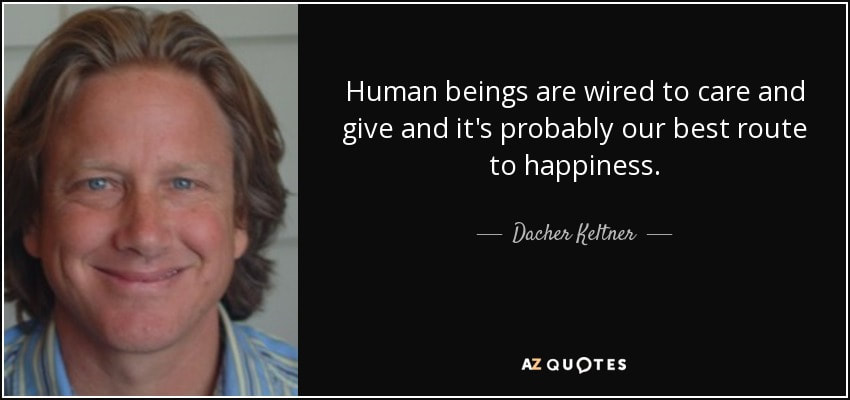



“Imagine that scientists have created a happiness machine. A machine that could make you as happy as you like with the push of a button. Would you use it? Would you push the button?” asks Dacher Keltner, director of UC Berkeley’s Greater Good Science Center. “I’ve asked that question of my students for years, and most of them say no. Most of them want to find true happiness on their own, in a genuine way. But how do you do that?”
Great minds have been debating that one for the entire 200,000 years Homo Sapiens has had the power of speech. And today, my husband, Rich, is going to put in his two cents worth on the subject, having just completed the
Science of Happiness course
presented by Keltner and Emiliana Simon-Thomas, science director of the GGSC.
“I consider myself to be a happy person,” Rich told me in an exclusive interview at our kitchen table. “I became interested in the question of why. I wanted to know what it takes to be a happy person. Also, my wife encouraged me to do it.”
“She sounds like a very wise woman,” I replied. “What did you learn?”
“Probably the biggest surprise was that 50% of your happiness is inherited, 10% is your life situation, such as your profession and how comfortable you are economically, and 40% is what you do with your life and how you view your life.”
“How can you inherit happiness? Is it built into your DNA?”
“A surprising amount is physiological,” he said. “For instance, the
vagus nerve
runs from the brain throughout the body. Some are born with more of it. It’s the thing that responds physically when you see a beautiful sky that takes your breath away.” Simon-Thomas has said that “Physically speaking, our
vagus nerve represents our sense of connection
and closeness.” Rich added, “There’s a dopamine stimulator in the brain called
Oxytocin
(not to be confused with the opioid OxyContin). The more it’s stimulated, the more caring people are. Again, some of us are just born with more of it.”
Obviously there’s not much we can do about our DNA, but we can work with the 40% of happiness that is under our control.
“Being happy takes a lot of work,” Rich said. For a start, you can’t go after it directly. “If you’re seeking happiness all the time, you are going to fail. Life doesn’t work like that. Happiness is really a byproduct. The ancient Greeks called it
eudaimonia
, human flourishing and blessedness, achieved by a life of virtue and ethical wisdom. Contrary to what it says in the Declaration of Independence, you can’t pursue happiness; you pursue something else and receive happiness.”
“Like what?” I asked. “What can you pursue in life that will lead to flourishing, blessedness, and happiness?”
“Help others and show gratitude,” he replied promptly. “It’s all about kindness. Kindness leads to compassion. Compassion leads to altruism. Compassion makes you want to do something for others; altruism is actually doing it. All that is totally different from empathy, pity, or sympathy, which don’t call you to action. ‘I feel your pain’ isn’t action and doesn’t lead to happiness.”
“How do we start?” I asked.
“The Buddhists tell us to stay present to what’s going on. And listen. One of the skills they encourage in this course is listening. Humans go mind-wandering 45% of the time; instead of focusing on the present, the mind is drifting into the past or future.”
Paying attention, he said, lets us notice opportunities to help others. “It’s the little things. Like the time you helped that old lady up the steps of the café in Greece. Or the other day, when we passed those two beggars and one said, ‘Spare any chocolate?’ and you had some in your purse so you gave it to them.” I had to laugh, remembering the surprise and delight on the beggars’ faces; they’d been kidding around with the request, and now they were each holding a foil-wrapped square of high-end dark chocolate with sea salt caramel — something I know from personal experience will brighten anyone’s day. The four of us laughed together and parted on a little buzz of joy.
“I get how helping others makes you happy,” I said. “Where does gratitude fit in?”
“Expressing gratitude is underrated; we rarely do it except in eulogies. The presenters suggested writing a letter to someone who did something you appreciate, and then calling them up and reading them the letter. They also recommended keeping a gratitude journal, or developing a nightly habit of climbing into bed and thinking of three things you’re thankful for from your day.”
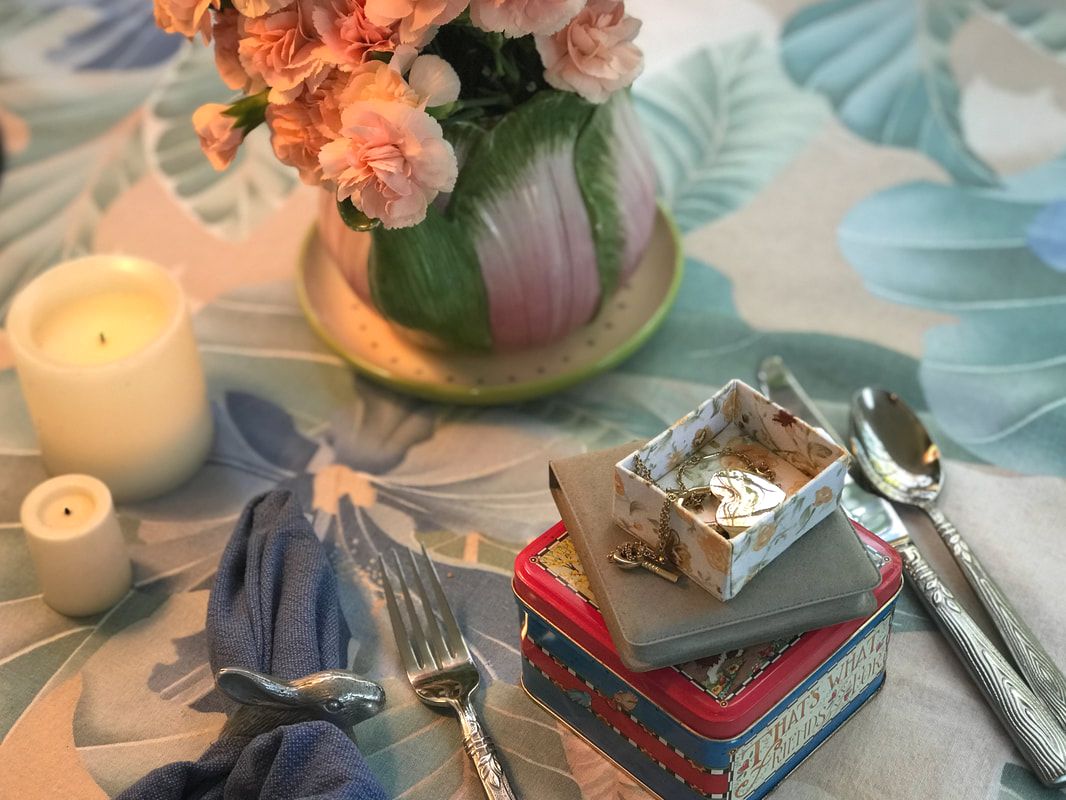
I heard lots about this a few weeks ago, when Rich was going through the gratitude section of the course. That Sunday, I suggested we each bring to lunch three objects representing things we were thankful for. I showed up with three small boxes. One held the heart-shaped locket Rich gave me for our 30th wedding anniversary. The second held pieces of wisdom I’d scribbled down on Post-It notes and pasted above my work desk, such as “Never chase a missed train … get a pastry and wait for the next one.” The third box held the keys to this house, our safe haven during quarantine.
“Taking this course during pandemic gave me the opportunity to reflect more deeply,” Rich said. “When everything is ‘normal’ you tend to accept things as they are. Now, faced with a life-changing situation, you can view it as an opportunity to learn or an impediment. The pandemic allowed me to learn about myself in a difficult situation. When daily stuff gets me aggravated — yes, I’m thinking of
our struggles with the Spanish bank
— I try to see it in the context of all the small, good things happening to me, and ask myself if it’s really that important.”
He thought for a bit, and then he added, “Even in these challenging times, you can find small blessings that make you grateful. And those blessings make it possible to remember that every day is sacred.”
Has anyone done something kind for you lately? What are you grateful for these days? Have moments of joy helped you survive the pandemic? If there was a happiness button, would you press it? Please let me know in the comments section below.
YOU MIGHT ALSO ENJOY
THE SCIENCE OF HAPPINESS COURSE DETAILS
WHY COLLINS GAVE AWAY ALL HIS MONEY
SIMON-THOMAS ON WELL-BEING DURING COVID-19
This post is part of my ongoing series of articles on surviving the pandemic, if possible with some remnants of our sanity and good humor. Each week I provide tips, strategies, and reasons for hope.
Sign up HERE to get free stories in your inbox each week.
Feel free to share this post link
with family and friends.
https://www.enjoylivingabroad.com/my-blog/the-happiness-course-rich-tells-all
Leave a Reply