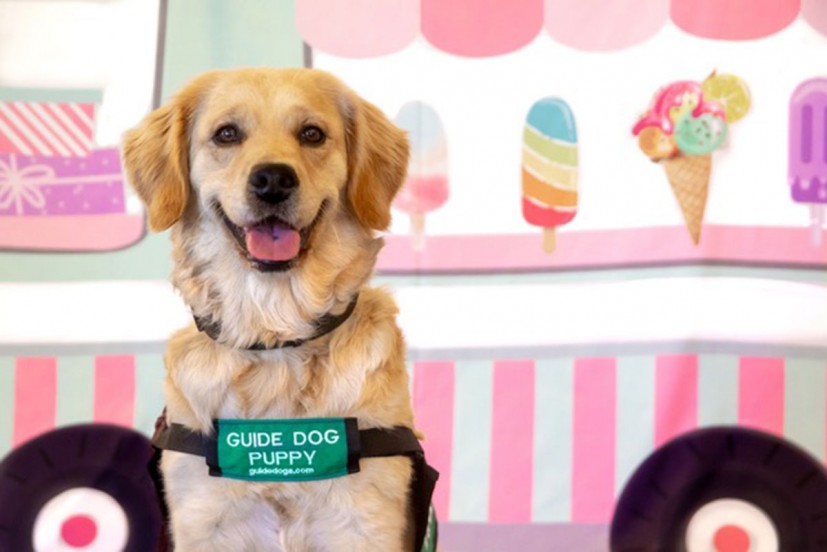
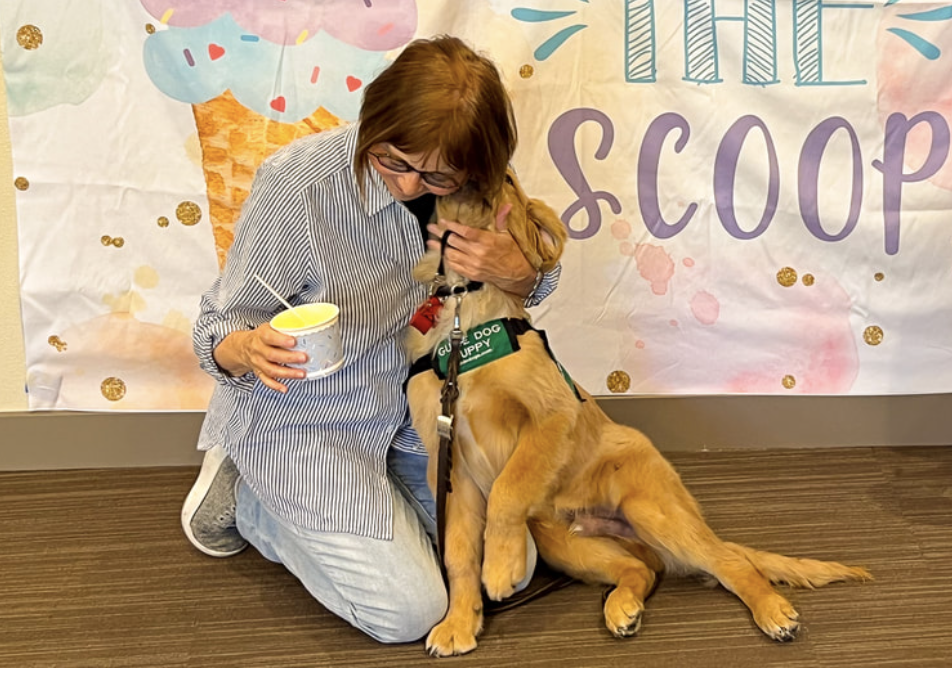
Rich has always had a firm grasp on life’s essentials. When I mentioned the Puppy Ice Cream Social, he said, “You had me at ice cream.”
For me, the irresistible draw was the chance to play with puppies. In these challenging times, there seems to be greater truth than ever to Charles de Gaulle’s famous line, “The more I get to know men, the more I find myself loving dogs.”
Humans and dogs have hung out together for 35,000 years, and it’s worked out pretty well for both of us. We give them food, lodging, medical care, treats, toys, and massages, and they pretend to think we are gods. Fair exchange! Ann Landers used to warn, “Don’t accept your dog’s admiration as conclusive evidence that you are wonderful.” Naturally, humans never took her words seriously.
Of course, worship is only one of a dog’s responsibilities.
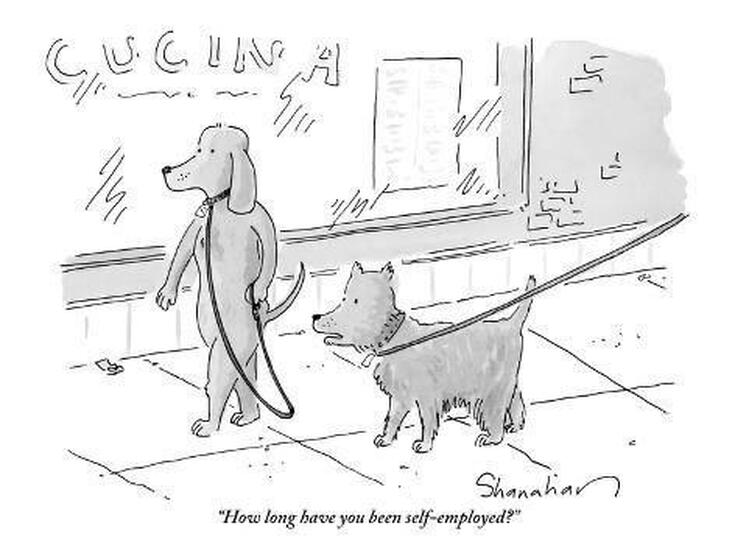
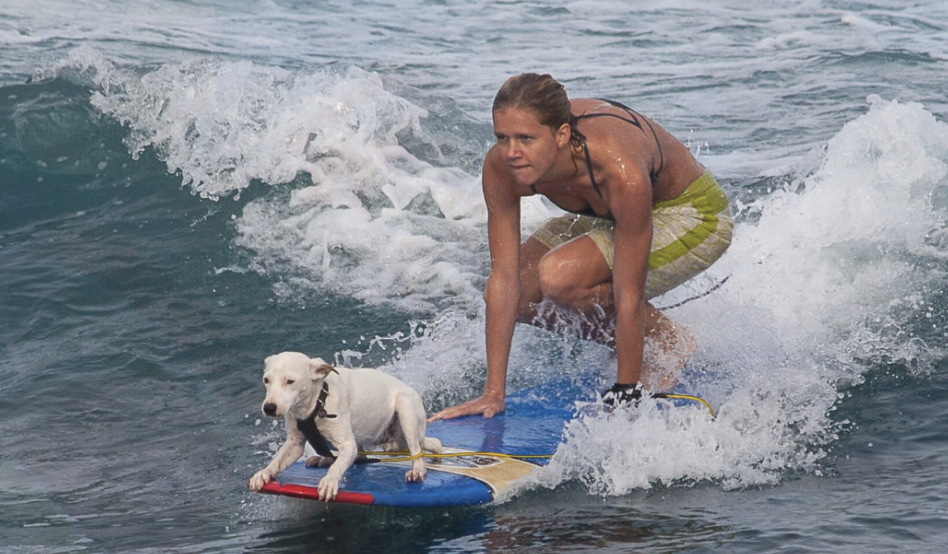
Back in the day, they chased off wolves and disposed of our food scraps. Since then they’ve branched out into herding sheep, finding truffles, and rescuing little Timmy whenever he falls into the river on an episode of Lassie. In the 13th century St. Francis of Assisi remarked he’d seen “a blind man who in a path was led by a little she-dog.” The Soviets sent them into space. Canines have always had a gift for making the most of new career opportunities.
“Why is someone throwing an ice cream social for dogs?” Rich asked. “I thought dogs weren’t supposed to eat ice cream.”
True; all dogs, once they are weaned, become lactose intolerant to one degree or another. Our last dog didn’t care; she was a total chow hound who loved to steal bites of ice cream. I guess that’s what we got for calling her Eskimo Pie. (For short she was Pie, Pi, or 3.14159.) She never seemed to suffer any ill effects, unless you count her expanding girth. She was not a slender reed.
“They give the puppies that fake ice cream made for dogs,” I said. “As for the occasion, it’s a graduation party for the latest class of guide dogs for the blind.”
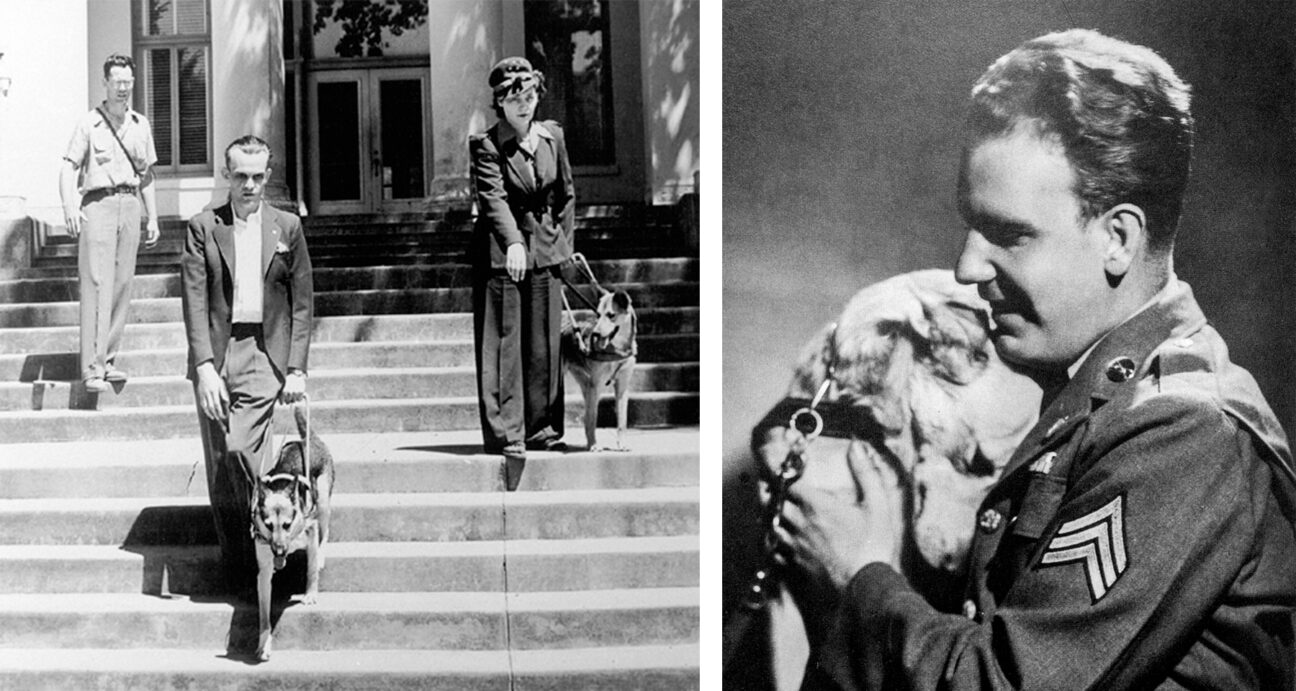
As it happens, our county is home to America’s biggest training center for what used to be called “seeing-eye dogs.” Guide Dogs for the Blind (GDB) began in 1942 and was soon helping servicemen who had sacrificed their eyesight on WW II battlefields.
In nearby San Rafael, I often see puppies in training harnesses, learning to navigate crosswalks and to resist the tempting French fries that fall to the ground in sidewalk cafes. Over the past 83 years, 16,000 dog-human teams have graduated from GDB; about 2000 are active right now. When I heard the latest class was celebrating with a party and inviting the community, I was all in.
It was a surprisingly sedate affair. When I think of puppies, I think of boisterous play; I have dozens of stories about young Pie stealing hamburgers at picnics, chasing squirrels and raccoons, and jumping through hula hoops to entertain kids. But these young dogs were chosen for their responsible personalities, and a year of training had taught them to pay respectful attention to their human handlers. Frankly, I was in awe and asked one of the trainers how she managed this miracle.
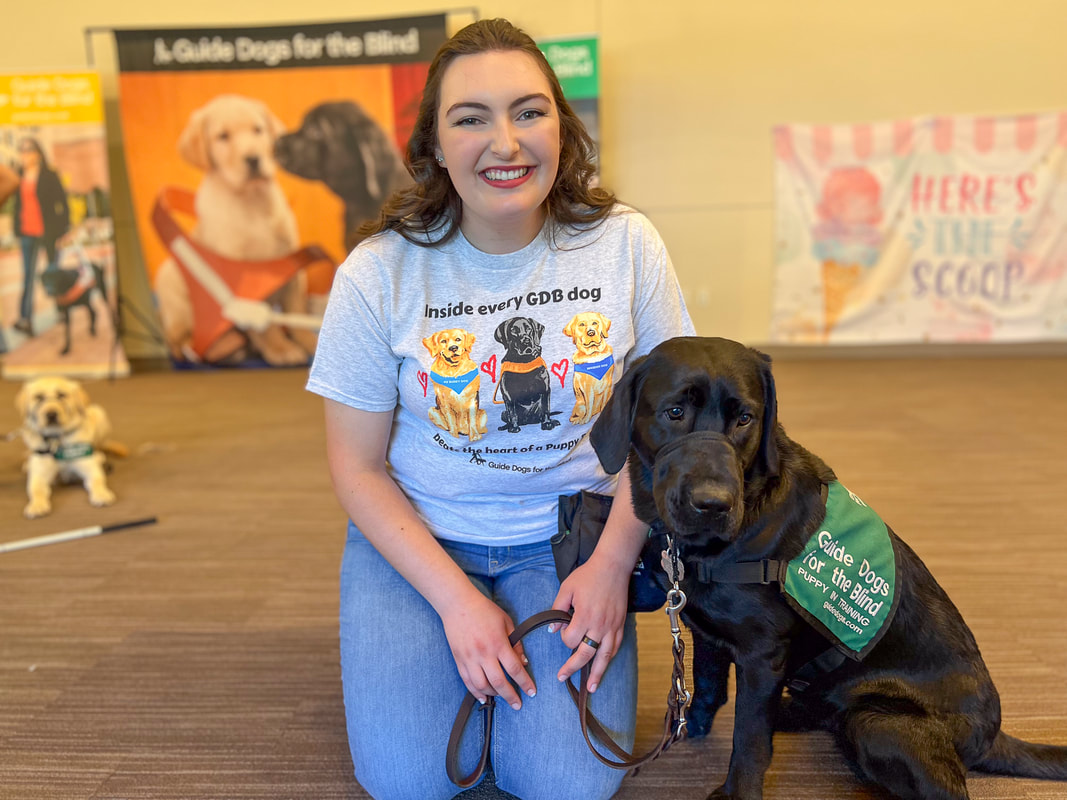
“I started puppy raising in my sophomore year of high school,” Kat told me. “A friend of mine mentioned to me that her mom puppy-raised. An industry like service animals, where you’re helping people but also hanging out with cool dogs all day, was perfect for me. It was magical to go through high school with a dog.”
With GDB’s detailed guidelines, curriculum, and active support, Kat has trained six puppies so far. She also fosters dogs who need a temporary home, for instance while recovering from surgery or a stressful kennel visit. Aside from those volunteer jobs, she holds a paying gig as an administrator in a company that provides diabetic alert dogs, which raise the alarm when their human’s blood sugar begins to get out of whack.
“Between my last two dogs, had a little bit of a break, and it was weird,” Kat recalled. “I’d go to the grocery store and I’d be like, ‘I’m missing something.’ Because I’m used to having a leash in my hand and a dog with the vest on, and it felt so weird; it felt like going naked.”
I asked if it was hard to let go of a puppy after the training year. “It’s such a beautiful journey. Every graduation that I have a dog go through, I cry. The whole time. And it’s not because I’m missing my dog. It’s because this is what the magic in the world is.”
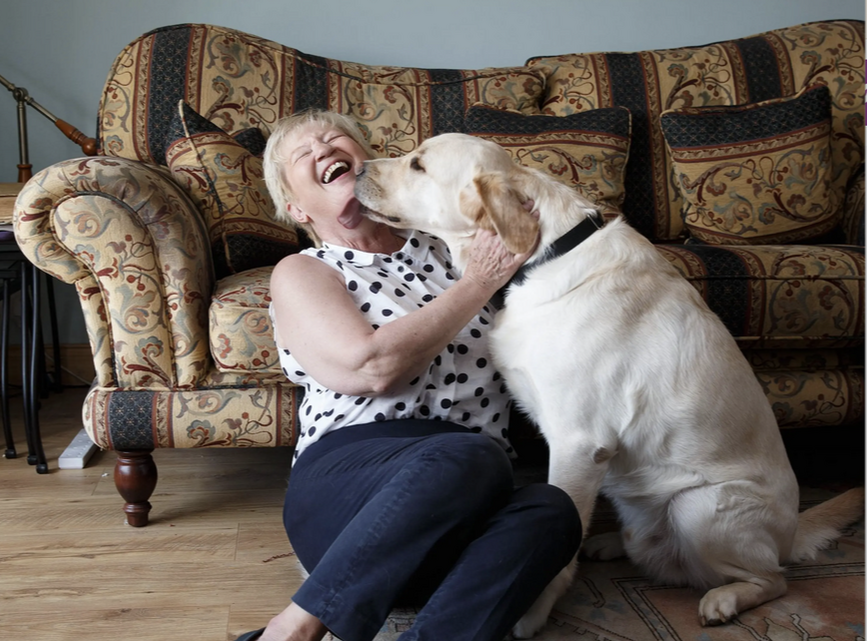
Puppies and humans are carefully paired on the basis of personality and temperament, taking into account the person’s lifestyle, activity level, family, other pets, and living arrangements. Most guide dogs work for six to eight years, and while some continue to live with their handlers during retirement, others become beautifully trained pets in a new family.
GDB is entirely funded through private donations and a small online shop. This being Pride Month, LGBTQ+ merchandise is front and center.
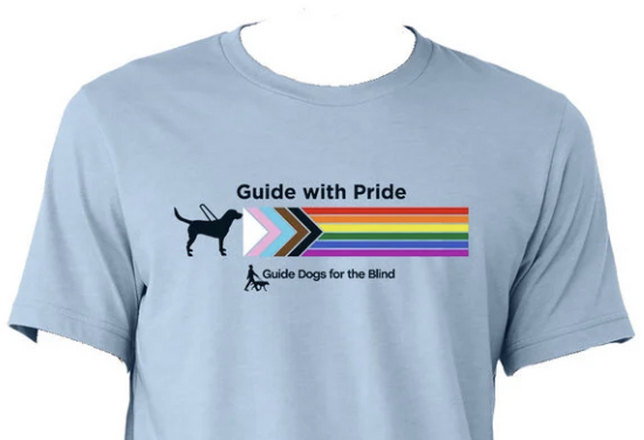
Looking at the “Guide with Pride” t-shirt, I began to wonder what it might be suggesting about the guide dogs’ original romantic inclinations, before they were spayed or neutered. Are there gay dogs? A glance at the Wikipedia page Homosexual behavior in animals revealed that same-sex sexual behavior is astonishingly widespread and has been documented among 1500 different species. Yes, including dogs and cats. Who knew?
Actually, scientists have known about such goings-on forever — or at least for the last 2300 years, since Aristotle first recorded lively same-sex hanky panky among pigeons, partridges, and quails.
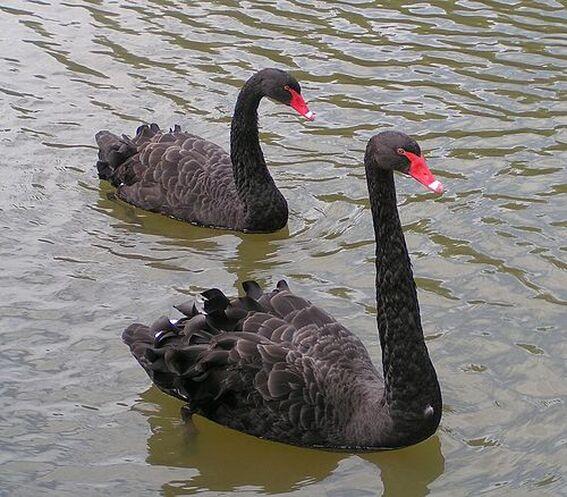
In 1911 a British Antarctic explorer documented homosexual behavior among penguins, but his report was considered too shocking for public release and was suppressed. Secret copies were circulated among scientists, written in a sort of code mixing English text and Greek letters to make it inaccessible to most readers. The report was finally published openly in 2012.
In these more permissive times, Wikipedia isn’t shy about sharing racy photos of same-sex frolicking by creatures ranging from lions to fruit flies. The steamy video of a pair of male Bonin flying fox bats cavorting on a tree branch gives new meaning to the the term party animals.
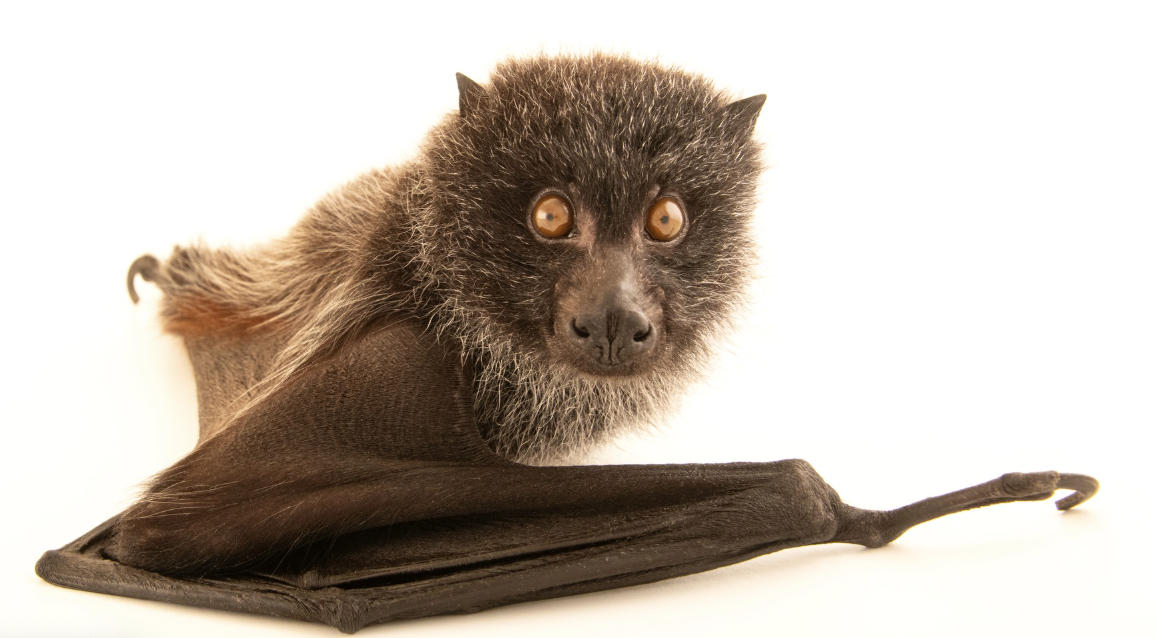
I don’t pretend to understand all the whys and wherefores of love — human, animal, or otherwise. But I do know love makes the world more beautiful, the hard times more bearable, and the best of times so joyful I wish I had a tail to wag.
“Our dogs help us find independence, confidence and self-worth,” said Emily, a musician and writer who lives in Florida with her guide dog, York. “They teach us that our lives have value. They help us reclaim our dignity and self-determination… And his love overwhelms me. It is as powerful as a symphony, as beautiful as a night full of stars. It’s a love I can never hope to measure or comprehend. But it’s a love I will spend my whole life trying to return.”

Leave a Reply