
Rich on the ferry arriving in Genoa
“Genoa? Last time I was there, it was full of prostitutes and muggers,” commented a friend upon learning Rich and I were planning to take a ferry there last summer. “Especially down by the docks.” Yikes!
Arriving shortly after dawn one August morning, Rich and I felt lucky to get off the ferry and across the wharf with our lives and our wallets. Fifteen minutes later, we were well on our way to being in love with Genoa.
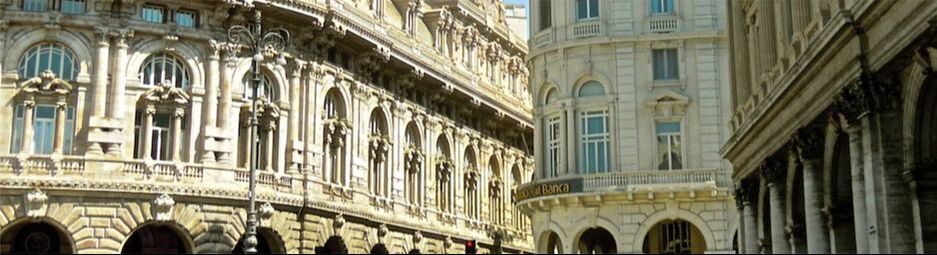
Strolling through the nearly deserted streets lined with magnificent old palaces and grand hotels, surrounded by charming if slightly gritty little back streets, we weren’t mugged or propositioned even once. We soon learned that Genoa has been making heroic and successful efforts to reduce the number of nefarious cutthroats per capita on the city streets. Apparently no one has read the memo on this, as visitors continue to stay away in droves, much to the frustration of those in the hospitality industry. They keep pointing out, to anyone who will listen, that city is safe, beautiful, and has all the elements of a major tourist destination – except, of course, actual tourists.
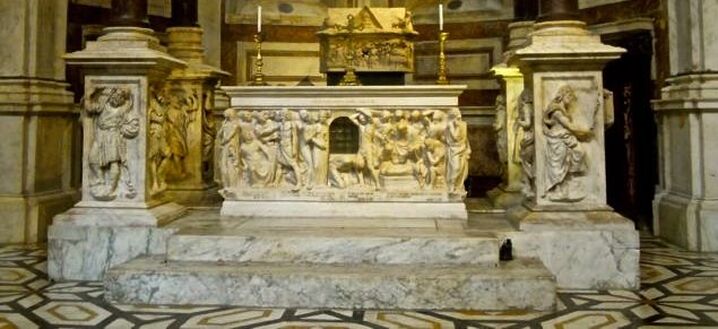
Among the things tourists would enjoy (if any of them ever went there) are the treasures acquired during the 500 years that Genoa was a mind-bogglingly wealthy port and financial center. The cathedral alone houses the actual platter on which Salome carried the head of John the Baptist after his decapitation, a splinter of the True Cross, and the Holy Grail. Not everyone is 100% convinced of the authenticity of these sacred objects, especially now that we know the Holy Grail was actually found by Indiana Jones, but nonetheless it’s an impressive collection. And the crown jewel of this treasure trove is the Ark of the Ashes of St. John the Baptist, which is kept in the high altar.
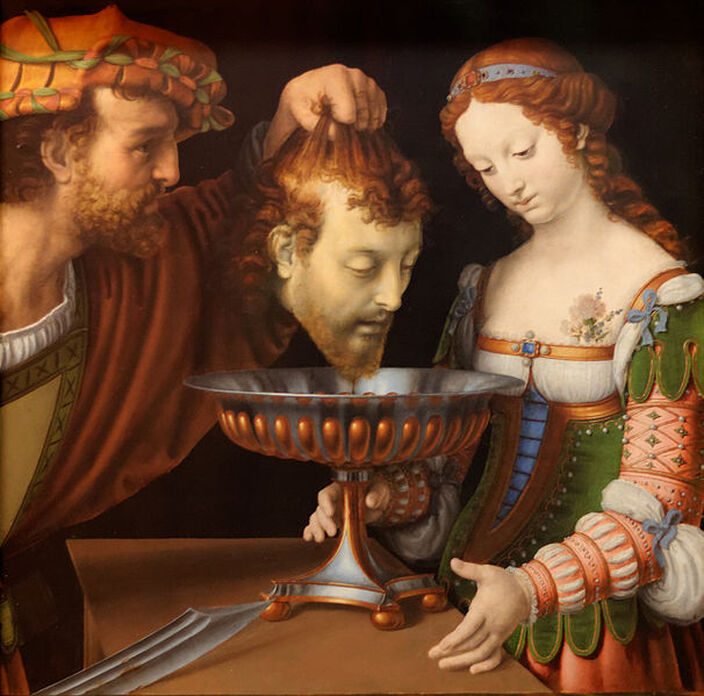
As you may recall, John the Baptist is the one who dressed in camel hair, lived on wild locusts and honey, baptized his cousin Jesus in the Jordan River, helped Him launch His ministry, and wound up having his head cut off and served on a platter at the request of Salome. All in all, a pretty colorful life.
He’s had a pretty vivid afterlife as well. His bones were buried in Samaria, dug up in 362 and partially burned; some of the remaining bones were carried off to Jerusalem, then Alexandria. His head, after many adventures, is now resting comfortably in the Umayyad Mosque in Damascus; in San Silvestro in Capite in Rome; and in the Residenz Museum in Munich. The Knights Templar also held one at Amiens Cathedral in France for a while, and yet others have been reported in Antioch, Turkey, and in a parish church in Tenterden, Kent.
Salome with the Head of St John the Baptist by Andrea Solario, early 16th century
In addition to six heads, St. John the Baptist apparently possessed at least three right hands, which are now variously enshrined in the Serbian Orthodox Cetinje Monastery in Montenegro; the Topkapi Palace in Istanbul; and the Romanian Monastery of the Forerunner. Yet more bits of his skeleton have turned up in Calcutta, in Egypt, in Nagorno-Karabakh in the Lesser Caucasus mountains, and as recently as 2010, in a Bulgarian church undergoing renovation.
So are the ashes in the Genoa cathedral
really
those of St. John the Baptist?
Does it matter?
Every year when they carry the Arc of the Ashes through the streets of the city in a grand procession, the citizens of Genoa know – if only for a moment – what it’s like to be touched by glory. That feeling is real, whether or not the ashes are. Growing up Catholic, I was surrounded by saints and relics and miracles. Since then, I’ve become something of a skeptic, but I’ve always been grateful for my early childhood training in believing impossible things. The world would be a drearier place without it.
All the same, if someone offers to sell you a sliver of the True Cross or the actual Holy Grail, I’d demand a
lot
of authentication.

Leave a Reply