
“This cannoli is absolutely — hey, is that a pigeon?” Some days my train of thought derails with remarkable ease.
“Give me your phone.” Earlier this year our young grandniece, who’d just arrived to take a job as a naturalist in Africa, was dumbfounded when a staff member at the lodge insisted she hand over her mobile. He added, “Otherwise it is too easy for a lion to sneak up on you unawares.”
And don’t we all hate it when that happens?
Some years ago, Rich and I were given equally helpful advice when we were dropped off in a remote village in Kenya for a volunteer work assignment. As our contact climbed back into his car with a merry wave, he casually remarked, “One more thing: watch out for leopards. They like to sit up in the trees and drop down on you as you pass under them.” As you can imagine, I spent every daylight hour obsessively peering into the branches overhead. I never did spot a leopard, and luckily, none spotted me.
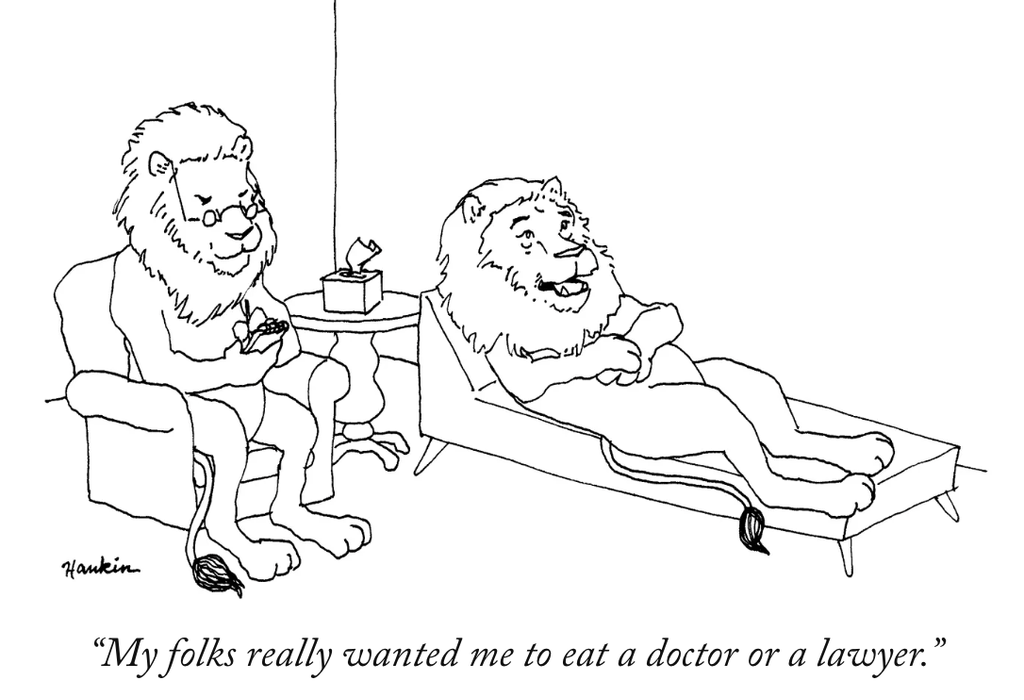
The primitive part of our brain reacts in 50 milliseconds (a quarter of a blink) to anything it suspects is a large, hungry beast eyeing us for lunch. “Your brain has a built-in negativity bias that was designed to keep your ancestors alive by constantly scanning for threats, problems, and danger, and it worked brilliantly for thousands of years,” explains the video 3 Habits That Physically Rewire Your Brain for Happiness. “The problem is that same ancient survival system is now running inside a modern life that has no tigers, no famines, and no genuine daily threats, but plenty of emails, social media, financial pressure, and comparison, and your brain treats all of it like a predator.”
Instead of scanning overhead branches, our eyes scour our screens for data, endlessly doomscrolling so we can brace ourselves for the next unwelcome surprise. And yet we still don’t always see it coming.
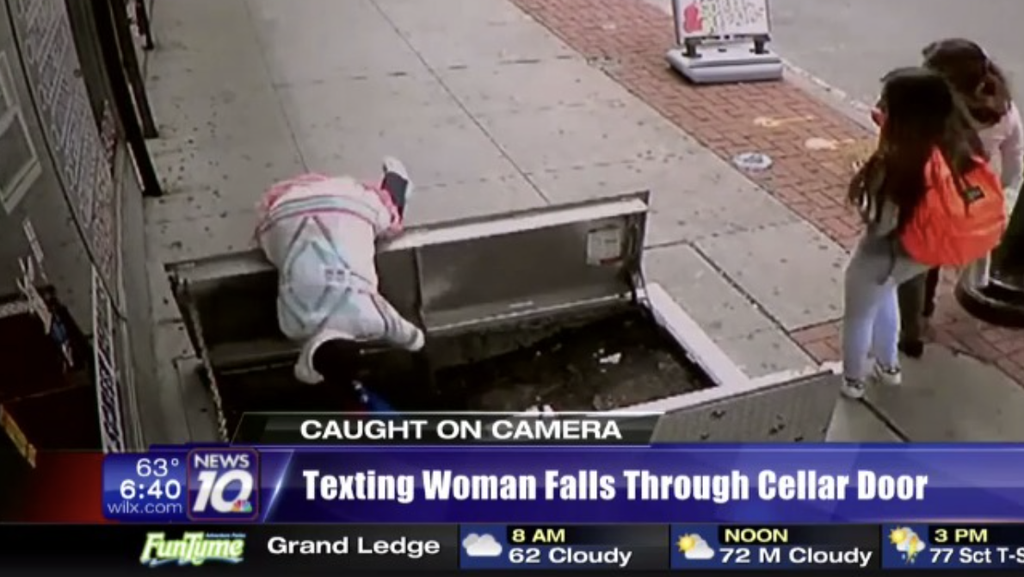
Most of us are spared that kind of pratfall, but who hasn’t tumbled into deep, dark rabbit holes of loony thinking? The internet has become such a noisy drama queen it’s hard to make any sense of it and even harder to look away.
In his book The Sirens’ Call: How Attention Became the World’s Most Endangered Resource, MSNBC anchor Chris Hayes says, “We have a country full of megaphones, a crushing wall of sound, the swirling lights of a 24/7 casino blinking at us, all part of a system minutely engineered to take our attention away from us for profit.” With so much bombarding our senses, trying to maintain coherent thought is “like trying to meditate in a strip club.” And we all know how tough that is.
So how do we reclaim our attention?
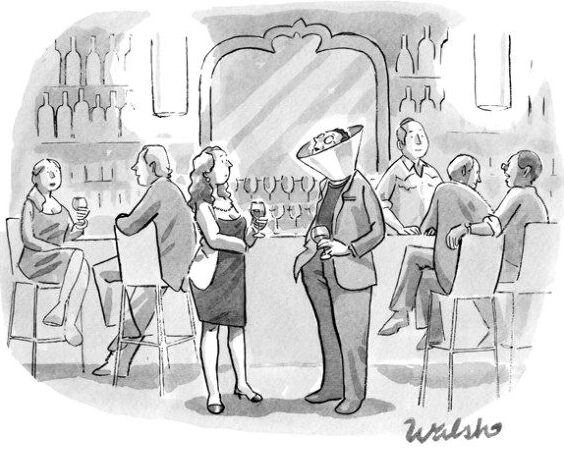
The 3 Habits video has a clever suggestion I call “The Stop Method.” I use it often and recently tried it on members of The Ideas Club.
The woman who volunteered to lead the experiment read aloud from the script, “It’s easy to get into a negativity spiral and harder to stop it. One handy method is called ‘negativity interruption.’ As the first step — and I apologize for this in advance — I’m going to try to put you all in a negativity spiral by reading three recent headlines and letting them sink in a minute.
“43 uncontained large wildfires rage across Pacific Northwest; 2.9 million acres burned
“New executive orders target birthright citizenship
“ICE funding gets big boost: $39 billion for operations, $45 billion for detention facilities.”
After pausing to let everyone descend into gloomy thoughts, she shouted, “Stop!”
We all jumped.
“Now look around and name (to yourself) three things you can see.” She gave us a moment, then asked, “What were some of those things? This is meant to anchor us in the present moment. Was this exercise useful in stopping the negativity spiral?”
It was surprisingly effective. Sitting in a dive bar filled with fifties and sixties memorabilia offered plenty to distract us from our dark thoughts. One participant remarked that just looking at the bartender’s outlandish body tattoos was enough to distract her from everything else in the room — and in her own head.

Distraction can be useful when we need to snap out of bleak thoughts. But often our biggest difficulty is staying focused on anything for more than a few seconds. We typically check email 77 times a day. Online we shift screens every 45 seconds. TV and film shots average four seconds. If we somehow manage to concentrate on a task, online and real-life disruptions are frequent, and studies show that after every disruption, it takes 23 minutes to resume focus. No wonder we feel so scattered.
Snippets don’t satisfy our basic human need for narrratives that help us make sense of our lives. For hundreds of thousands of years, we’ve used storytelling to share survival tips and develop the empathy that enables us to work together building communities and civilizations. One of our cleverer accomplishments was the invention of books so we could give complex ideas a permanent place in the human conversation. And they remain a powerful way of reclaiming our attention.
I was explaining all this the other night to neighbors stopping by the booth where some friends and I were raising awareness of the dangers of book banning.
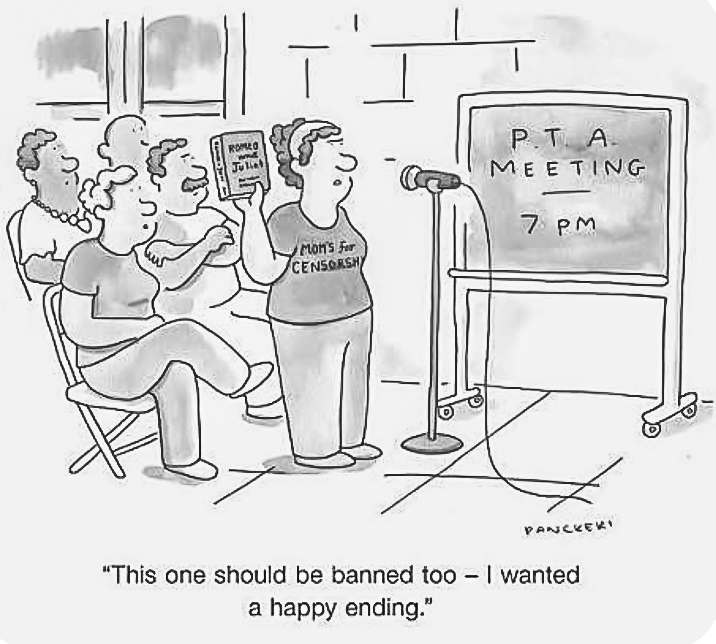
“I like to look at both sides of any issue,” said one neighbor, who was homeschooling his own children, didn’t allow TV in the house, and clearly wanted to explain why my arguments were full of holes. “Some books aren’t appropriate for some kids.”
“Of course not,” I said. “Nobody’s trying to assign Fifty Shades of Gray to second graders. But this —” I gestured at the piles of “controversial” classics such as To Kill a Mockingbird, The Color Purple, and Charlotte’s Web. “— is the collective wisdom of the human race. To ban these books in high school is to deprive kids of knowledge they may need to navigate the world.”
“Are you saying this — ” he held up Charlie and the Chocolate Factory, “— is the sum of human wisdom?”
“No, I’m saying that together, all of these books tell us something important about who we are.” He rolled his eyes and drifted over to the next booth, where they were giving away s’mores heated with a blowtorch (yes, it’s a thing now).
I watched him go, wondering what he did allow his kids to read. Are there books without naughtiness, sex, death, race, gender diversity, slavery, free thinking, or talking spiders? Like what? One Hundred Essential Jell-O Salads?
You can’t protect kids by raising them in ignorance. That’s as risky as letting them loose in the jungle with their eyes glued to an iPhone while leopards lurk overhead. By introducing us to characters like Anne Frank and Huck Finn, books teach us ways to figure out whether the ripple in the high grass is a stalking predator or simply a shifting breeze. They help us learn how to survive sorrow, feel the joy of a narrow escape, and understand why, in spite of everything, the point isn’t to distract ourselves from life but learn how to embrace it.
This video describes the Stop Method and other ways of reclaiming your attention. It‘s 13 minutes, considerably longer than my usual ending stuff, but it was such a hit with The Ideas Club I thought you might like a chance to see it, too.




Leave a Reply