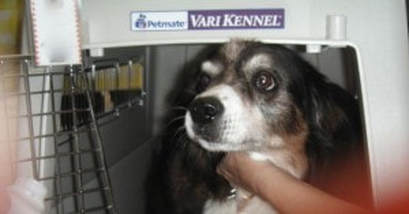



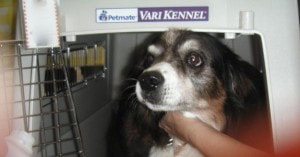

Eskimo Pie in her crate, shortly before we took her to Spain.
“We’re thinking of taking the dog with us when we go to Portugal for two months,” my sister-in-law said recently. “Like you did with Pie.”
Boy, did that spark memories!
When we lived in rural Ohio, Eskimo Pie hated to be left behind when we traveled. The moment packing began, she would give me deeply wounded looks, run get her favorite toy and place it tenderly in my suitcase, then stare up at me, giving a tiny tail wag, as if to say, “Please …. oh please ….?” It was a masterful performance, and if I wasn’t keenly aware that she regarded her time with our various house sitters as a non-stop party, I would have felt hideously guilty for deserting her. When we decided to relocate to Seville, she finally got her wish to join us on the road. She had to ride in the cargo hold, which is never fun for pets, was
lost in the Madrid airport
for four hair-raising hours, and then had to adapt to an urban setting. Not an easy transition. But once we got sorted, Pie added a lot of fun to our live-abroad adventure and seemed to enjoy herself, especially hanging out in outdoor cafes where bits of ham occasionally fell on the ground.
Before I could get too lost down memory lane, my sister-in-law asked, “Any advice?”
I shared what I could, but it had been more than a dozen years since we’d flown Pie to Spain, so I decided to consult a contemporary expert. My friend Ryan, who writes the
Jets Like Taxis
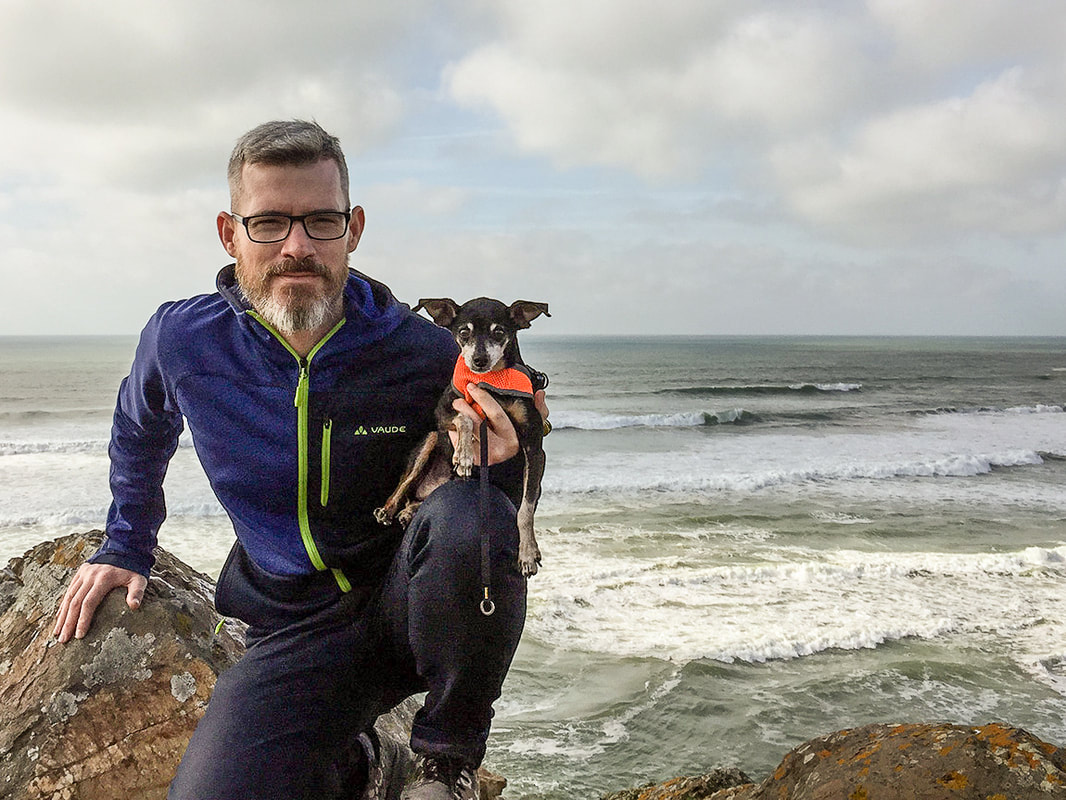
travel blog, roams the world with his wife Ang and their five-pound miniature pinscher, Louis. Here are Ryan’s thoughts about taking a dog on the road.
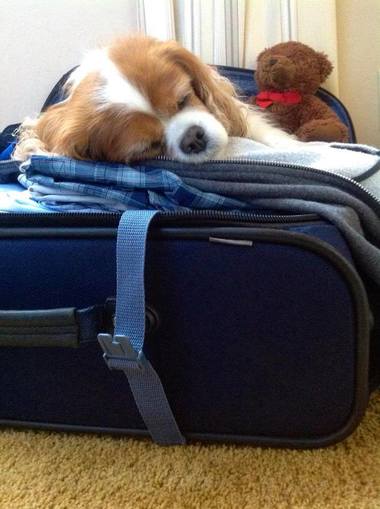
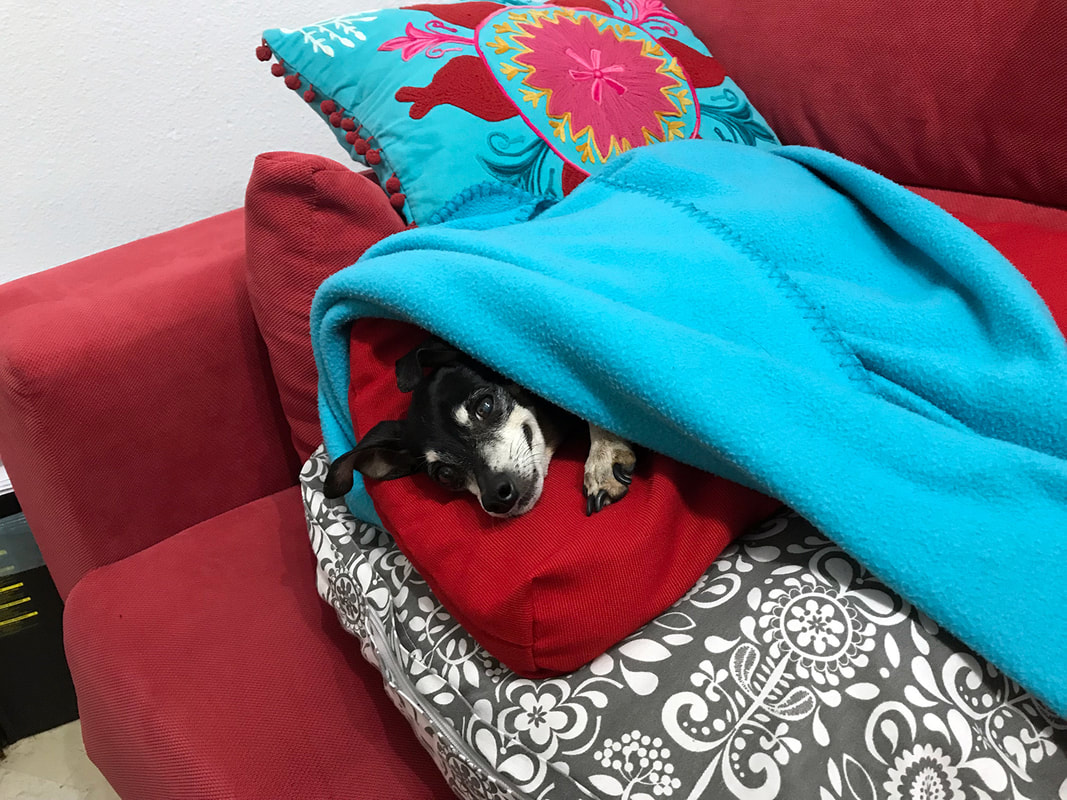
Morgan practices taking a Spanish siesta before heading to Seville with her humans, Anne and Ray.
Does travel affect Louis’s mood/personality?
Not really. He’s pretty easy to deal with when we’re mobile, and he does okay whenever we get to a new place. As he’s 15 years old now and has never been very adventurous, he only cares about comfortable places to sleep and going for a walk, the latter of which he never seems particularly excited to do, either.
Does travel with a dog affect your mood/personality?
It’s a bit stressful just because having a dog is like dealing with a toddler forever. After seven years on the road, we’re pretty used to it all and know what we have to do before leaving a country or entering another one. The only time it was terribly stressful was when we arrived at Chicago O’Hare and KLM told us they changed their policies and he had to go in the cargo hold. Ang was definitely not a fan of that. He’s tiny, it was his first international trip, and we were concerned for his well-being. It ended up okay, but we’d never put him in the hold again.
How can people decide if their dog is a good candidate for travel?
The more well-trained and respectable the dog is, the better. Dog size can be an issue, as bigger dogs are required to go in the hold. That costs more in time and money than taking a dog in the cabin, which is also costly. Some breeds are not allowed to travel by air. It’s always best to check airline websites and/or pet travel websites to see what breeds are allowed.
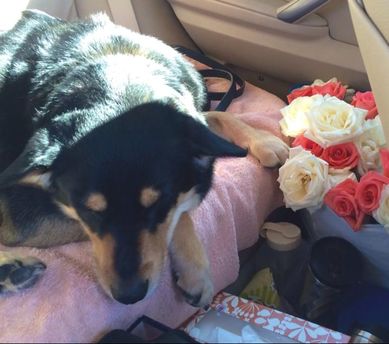
A bed of roses for Scout as Honey and Sandy drive from CA to AZ to celebrate their anniversary.
How does traveling with a dog affect your planning and mobility?
We always have to keep up to date with the airlines that do and don’t allow pets. Especially in-cabin. There are tons of regional European airlines that do
not
allow pets at all. This means more expensive flights and less competitive prices. As of now, the only ones I can think of that go from Spain are Vueling, Lufthansa, and Iberia, which recently started allowing pets again. There will be no EasyJet or Ryanair. In addition, one needs to keep up to date about quarantines. We have never traveled to Asia, Hawaii, or Australia because of pet quarantines. We will not even bother going to places that have quarantines, so we’ll have to wait until Louis heads to the dog park in the sky for that.
Is it harder to find accommodations?
Absolutely. Germany is really good about this, other countries, not so much. Spain is pretty bad. In the US, we know which hotels allow pets, but there are some chains that leave it up to the franchise owner. It can be a bit of a hunt. Airbnbs are the same way … you never know. A lot do not allow pets for all the obvious reasons, but some will if you talk to the owner. The type of dog makes a difference, too. Having an old, 5-lb. dog is not the same as a young, 75-lb. Rottweiler.
Does having a dog make it easier/more difficult to meet people on the road?
We definitely meet more people in our neighborhood and on the street near us since we walk him a few times a day. If it weren’t for this, we certainly wouldn’t know as many people in our immediate area as we do.
Ang and Louis
What are some of the best/worst moments of travel with Louis?
Worst is a four-way tie between the aforementioned KLM fiasco, getting attacked in San Angelo, TX, having teeth pulled in Staufen, Germany, and having surgery in Guanajuato, Mexico. All of which ended up okay. Best is just him being around. It’s always nice to have a little companion like that.
What document do you have to show to demonstrate your dog got the necessary inoculations?
In the EU, they have pet passports now, which makes everything soooooo much easier. We even use it in the US sometimes since it has everything we need in it. When he gets inoculated, it’s usually rabies/blah blah/I don’t know, we have a pet passport for that. Haha. So, in the pet passport, there are sections for stickers/signatures/dates for all the inoculations and everything. If we’re traveling from the US to the EU or vice versa, we just go to the vet and get everything done, along with a letter that says Louis is good to fly on whatever date our tickets are for. The EU and US have different date windows for when these things need to be done before flying, so it’s important to check with the airline and, in the US, the USDA website. Also, if you’re leaving the US with your pet for the first time, the USDA requires a visit to their local office with all of your vet paperwork to get approved and pay a small fee. They used to do this on every departure, but they recently changed it to be only the first time it happens.
After fleeing his home during the October fires in Northern California, Pokey had his first meal in an Italian restaurant. He keeps asking his humans, Karen and Ken, to take him back there for more meatballs.
Do you still need a different chip for international and for domestic US travel? Can you get both in the US? (We had to drive Pie to Canada to get her international chip.)
Yes, you can get both chips in the US. He’s had his US one forever; we got his international one before we left in 2011.
Do you medicate Louis before he gets on the plane?
We do not medicate Louis. I don’t know what the rules are for flying with big dogs in the cargo hold, but we can pretty much do whatever we want with him in-cabin, although he has to stay in his carrier. We used to give him part of a Benadryl, but that actually made him restless and aggressive. We stopped doing that and he’s totally fine. He obviously would rather be out of the carrier, but he has never really been a problem for us.
How do you find veterinary care if Louis needs it?
We find a local vet, but we usually ask our landlord, neighbor, whatever if they have a recommendation first. That’s always the best way to find a service, in my opinion.
Favorite story about travel with Louis?
I wish I had one! I don’t. He’s a lazy bum hahaha. I just like having him around.
For further information:
Details about specific airlines’ policies
FAA regulations affecting pets
Vaccinations your dog may need
Airline requirements for pet carriers
US airline policies and frequent flier miles rewards
How to get a pet passport
Have you taken your dog on any trips? How did that go? Any tips you’d like to pass along in the comments section below?
YOU MIGHT ALSO ENJOY
JETS LIKE TAXIS (Adventures with Louis)
WHEN DOGS FLY (Pie’s Madrid Airport Story)
SEVILLE (Pie’s Further Adventures Abroad)

Leave a Reply