
Next summer, Rich and I will walk out our door in Seville, stroll to the train station with our rolling luggage, and board a train to begin a journey that will last several months and cover thousands of miles. We won’t have any reservations anywhere, just a Eurail pass and an iPad full of information about possible destinations. We’ll wend our way by easy stages through Central and Eastern Europe, winding
up in Transylvania and some of the more obscure Balkan countries, seeking offbeat side trips and weird, wonderful stories and adventures. We hope to connect up with locals and expats all along the way. If you know someone in one of our destination areas – even better, if you ARE someone in one of our destination areas –
send us an email
and we’ll see about meeting up. I’ll post a map when we’ve firmed up the general route. We have decided to begin by taking the train to Barcelona, then the ferry across to Genoa, Italy. And here’s what I’ve learned about that destination city…
Nearly every Genoa tourism website starts off by pleading, “Please don’t rush through here on your way to Florence or Rome. No matter what you’ve heard about us, we really
are
worth a visit! Really! Please say you’ll stay!!!” OK, I’m paraphrasing a little, but that’s the gist. Apparently Genoa is the Newark of Italy, a place most people arrive in only to depart as quickly as possible for more glamorous destinations.
So what
does
Genoa have to offer? It’s a gorgeous old city with lots of historic buildings and museums, promoted with such awkwardly translated prose as: “
Thought then to the birthplace, even though few of them remembered their location, so that at first it was a walled marble plaque in memory above the entrance of a building facing.”
Hard to understand how that could fail to entice tourists…
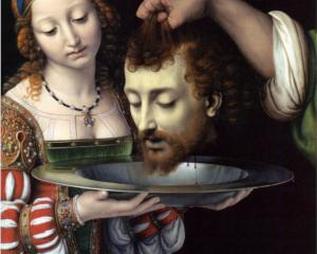
Struggling through the prose, I discovered some real (or possibly fake) gems. For instance, the Museum of the Cathedral of San Lorenzo houses the
actual platter on which Salome placed the head of John the Baptist
after his decapitation. Now THAT’S something worth seeing! Naysayers may question its authenticity, but I for one am ready to believe.
The museum also contains the
Ark of the Ashes of John the Baptist
, a splinter of the
True Cross
, and a chalice that was believed to be the
Holy Grail
when it was brought back from the Holy Land by a crusader. It’s easy to scoff at such ignorance today, now that we all know the Holy Grail was actually found by
Indiana Jones
.
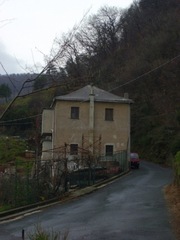
While some of its ancient relics may be suspect, Genoa does boast a genuine haunted house. Now known as the
Ca ‘de Anime (House of Spirits)
, back in the 18th century it was an inn situated on a lonely road outside of town.
The genial hosts were a family of robbers who killed their richer guests, relieved them of their possessions and buried the bodies nearby. The mysterious disappearances of so many of the inn’s patrons gave rise to rumors that the inn was haunted, but investigators later exposed the guilt of the robber family and executed them all on the spot. That’s when the real haunting began…
The inn remained vacant until a desperate family moved in during World War II. The new occupants managed to ignore mysterious sounds and inexplicable broken objects around the house, but when a strange girl seemed to materialize out of the 18th century, they fled the house never to return. Rich and I will be reviewing
The Exorcist
and
Poltergeist
in preparation for the visit.
But what about modern Genoan life? The region is famous for its salami and pesto, but what other pleasures could we expect at the Genoan table? I discovered
Giada De Laurentiis
‘ wonderful recipes for two regional favorites,
Orichiette with Sausage, Beans and Marsarpone
and
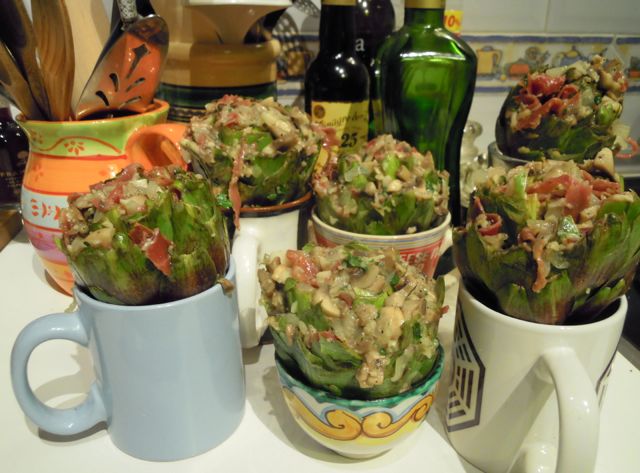
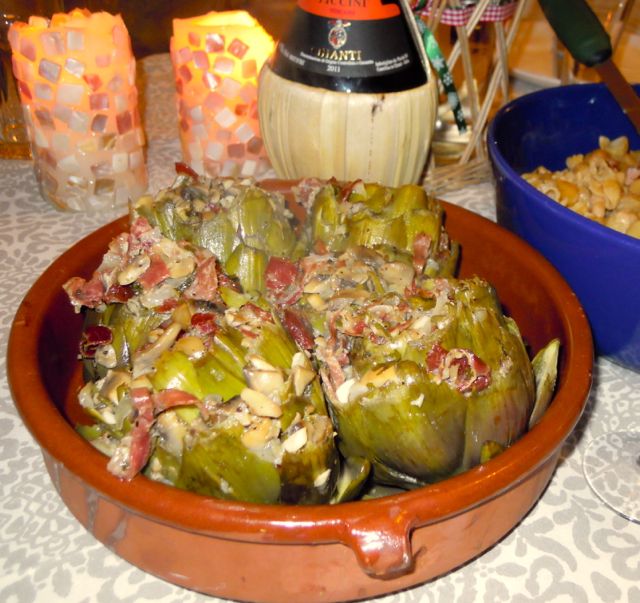
Genovese-style Artichokes
. The orichiette (pasta shaped like little ears) was delicious, but the true hit of the evening was the artichoke dish. We stuffed the artichokes with a mixture of garlic, onion, ham (we substituted good Spanish
jamon
for the prosciutto), Parmesan cheese and parsley.
Then we put them in a deep pot, wedged together to say upright in a pool of white wine, and let them simmer 45 minutes on the stovetop until they were tender and had soaked up the wine flavor.
Rich and I decided that Genoa may have its issues with public relations, artifact authentication and online translation programs, but when it comes to the pleasures of the table, it’s a city second to none. Looking forward to making your acquaintance, Genoa!
If you know someone living in Genoa – even better, if you are living in Genoa yourself – send us an
and we’ll see about meeting up. We’re looking for insider information about the city and its quirkier aspects. First round of drinks is on us.

Leave a Reply