

“Maybe the universe is telling you something,” my friend Enrique said yesterday, when I had poured out the sorry tale of
last week’s stuttering book launch
, plagued by bizarre tech glitches that temporarily prevented some people from downloading free subscriber copies or signing up to receive updates on my blog.
“But wait, there’s more,” I said, accepting another splash of verdejo in my wine glass. “Now Amazon Spain is refusing to send me copies of the paperback version of my book.”
“What? Why?”
“Apparently my book has a ‘limited purchase quantity.’ The first day I tried to order six copies, and they told me I could only order three. I did, and they came in today. When I went back later and tried to order more, it said ‘We’ve changed your purchase quantity to the maximum permitted.’ And that number was zero.”
Enrique, who runs one of the most successful publishing companies in Spain, was as flabbergasted by this turn of events as I’d been. “I’ve never heard of such a thing. It could be a paper shortage. I know Amazon uses massive rolls of paper.” He flung his arms wide to indicate the gargantuan roll size. “Maybe they just can’t get them now.” These days, Amazon and other publishers, including Enrique’s Lantia, take advantage of print-on-demand technology that lets you upload a file, hit a button, and produce a printed and bound paperback book in seven minutes. It’s little short of miraculous. If you can get the paper.
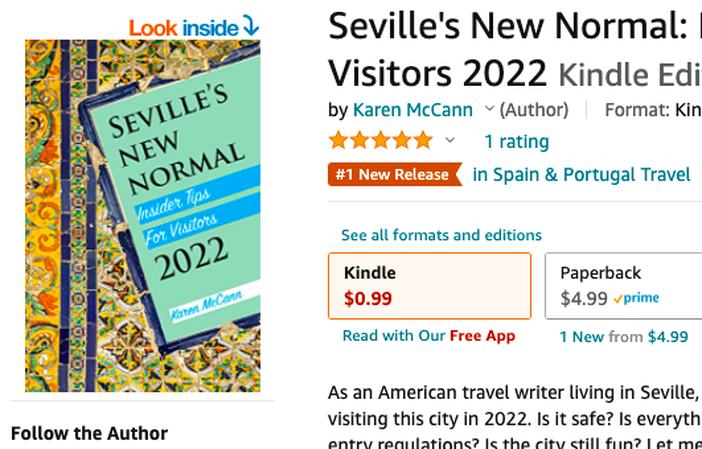
Fortunately, many of my readers have written to tell me they’ve successfully ordered the paperback in the US and the UK, where Amazon isn’t suffering from the same supply issues, and there’s no problem getting the Kindle version. In fact, sales of
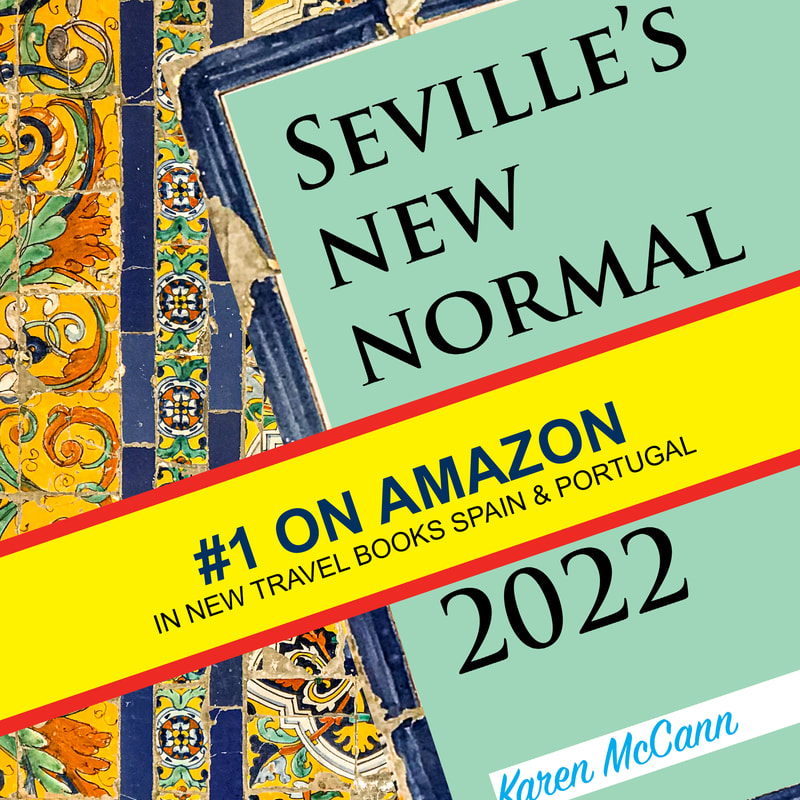
Seville’s New Normal: Insider Tips for Visitors 2022
have been brisk enough that it hit #1 on Amazon in new travel books about Spain & Portugal. So it’s officially a bestseller already. Thanks for that, everybody!
For me, the mindboggling annoyance of attempting to navigate Amazon Spain’s purchasing system was just the warm-up for researching today’s update on what it takes to visit Spain right now. I’d planned to include just a brief paragraph outlining the latest information, but fact-finding proved far more slippery than I’d expected.
For a start, it used to be helpful to Google “Spanish Embassy in the US — Going to Spain — Entry Requirements” but that site has now expunged nearly all mention of Covid, directing those inquiries to the Ministry of the Interior page, which never mentions Covid, and to a Health Ministry page that comes up blank. The Embassy’s home page has a link to Covid FAQs that contains no questions (let alone answers), just a suggestion that you consult your local consulate. If you click on the consulate link, you suddenly find yourself on
Travel Safe, the official Spain tourism website
. I’m almost getting the impression that Spain’s national government is hoping to distance itself from its Covid policies. Anybody else find that worrying at all?
According to Travel Safe, step one is filling out the
health control form
no more than 48 hours in advance to obtain a QR code attesting to your Covid status. (Oddly, there’s a separate form if you are arriving by ferry, but let’s assume for now you’re traveling by air or land.) Step two says that to determine the entry requirements, you have to find out if your country is designated low-risk or high risk. To find out your country’s status, there’s a handy link. That link takes you to (drumroll, please) another blank page.
So much for the official sources. Luckily I found
Travelling to Spain During Covid-19: Here’s What You Need to Know
by SchengenVisaInfo. This cleared up the question of which nations are currently designated as high-risk and low-risk (or, to put it in seasonal parlance, the naughty and nice list). Sadly, both the US and the UK are high-risk, so citizens of those countries (and many others) must provide proof of vaccination to enter Spain. The good news: Spain doesn’t require an up-your-nose Covid test in addition to the vaccine. The bad news: if you’re unvaccinated, you aren’t going to be visiting Spain any time soon.
No doubt there are scofflaws already trying to figure out how to circumvent these rules, possibly via private airstrips in the dark of night. Which may account for the rather startling news story I just saw about dogs being taught to pilot airplanes. Yes, you read that right. A UK reality TV show has taught Shadow, a rescue dog on the verge of being put down, how to steer an airplane. And for those of you who might be worrying about in-flight safety, let me reassure you that Shadow was kept on his leash every minute.
Sit. Stay. Steer. Good dog, Shadow!
In other news, some parts of Spain (but not Seville) now require Covid documentation to enter public places such as bars, restaurants, and nightclubs. The rules vary by region (
check regional requirements here
); most commonly, locals must present an EU Digital Covid Certificate, aka Covid passport, issued to EU citizens through the public health system. The rules are a bit fuzzier for visitors; most likely they’ll accept your printed USA Covid vaccination card or similar documentation. But before you pre-pay for a pricy event, such as a concert or Michelin-star restaurant meal, check the policy of the region and, if possible, the venue.
Here in Seville, the approach is much more relaxed. Covid passports aren’t required anywhere, although the government will soon make them compulsory when visiting people in hospitals and care homes. With almost 90% of eligible residents vaxxed, everyone correctly assumes I’ve had the good sense to get my shots, including my
vacuna de refuerzo
(booster).
“
Experts attribute Spain’s vaccine success, in part, to its widely trusted public health system
, which spearheaded the effort,” says the
NY Times
. “Politicians also played a big role, taking their doses with fanfare early on and avoiding politicized debate about the vaccine. Spaniards, for the most part, followed the health guidance of their leaders when it came to vaccines, masks and other precautions.” Salvador Illa, who oversaw the first year of Spain’s pandemic response, explains, “As far as vaccines go, in Spain there’s just a wide consensus among citizens — they follow the recommendations of the scientists.”
Wow. Confidence in the public health system. Leaders avoiding controversy. Trust in science. What a country! It’s comforting to know that if (Heaven forbid) Omicron or some other variant should require another vaccine, my neighbors will cheerfully line up, fully masked and two meters apart, to get it.
Maybe Enrique’s right and the universe is sending me a message. If only I could figure out what it might be! However, with so many problem-solving, brain-boosting challenges filling my days, it’s just possible my mental acuity will sharpen fast enough to let me figure it out before I go completely bonkers.
Thanks to all of you who wrote to me saying how much you enjoyed
Seville’s New Normal.
If you bought the book, I’d be grateful if you would leave a review on Amazon; this will boost the book’s visibility, making it easier for others to find. Unfortunately Amazon ignores reviews that aren’t associated with a verified purchase.
YOU MIGHT ALSO ENJOY
LEAVE YOUR REVIEW HERE
CALIFORNIA’S OFFBEAT TAKE ON THE HOLIDAYS
SEVILLE’S QUIRKY TAKE ON THE HOLIDAYS
Sign up here for updates and get a free copy of Seville’s New Normal in Microsoft Word.
Yes! Send me the free book & updates
Leave a Reply