






When I was a teenager, a student at a nearby high school asked his history teacher the inevitable question about why good Germans did nothing while the Nazis rose to power.
The teacher,
Ron Jones
, hit on a creative way to demonstrate the answer.
His classroom experiment began the next Monday with a description of the role of discipline in fascism. To illustrate his point, he had students adopt more formal postures and manners. The kids loved the game. Jones praised community over individuality and started treating his students like an elite group. They adopted a secret hallway salute that represented a symbolic wave.
The response was astonishing.
In days, most students were exhibiting blind obedience to Jones and a superior, sometimes hostile attitude toward non-members. Worse, Jones found himself acting more and more like a dictator. On Thursday Jones told the students that the project wasn’t a class exercise but a real-life movement in support of a political candidate. The kids were more enthusiastic than ever. On Friday, they eagerly assembled to meet their new leader.
Jones revealed there was no leader and no movement. He explained that in less than a week they’d been duped into acting like fascists. He played a video of Germans marching in disciplined ranks saluting Adolf Hitler.
The kids were shocked speechless. Lesson learned. Where were all the good Germans? Just look in the mirror.
I’ve always been a bit haunted by that story, knowing that it was only by the sheer luck of school districting boundaries that I wasn’t a member of Jones’s class. Would I have been transformed into a fascist in less than a week? I like to think that I would have been smarter and stronger than that. But I can’t be sure. Jones conducted his experiment at a high school in Stanford University’s hometown of Palo Alto. These were above-average students living an hour south of San Francisco in the spring of 1968, during the full flowering of the resist-authority sixties — and almost no one questioned, protested, or refused to participate.
Three years later and a few miles up the road, Stanford psychology professor
Philip Zimbardo
performed a similar, more notorious experiment. “I was interested in what happens if you put good people in an evil place,” he said. “Does the situation outside of you, the institution, come to control your behavior? Or do the things inside you — your attitude, your values, your morality — allow you to rise above a negative environment?”
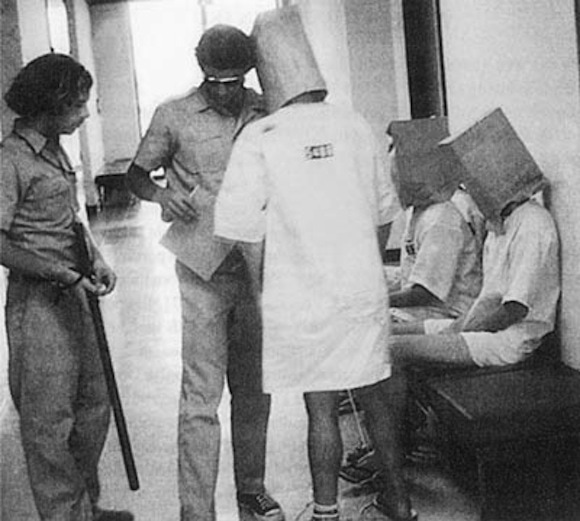
Twenty-four male students, chosen out of more than seventy applicants as the most psychologically fit, were randomly assigned as prisoners and guards for a two-week stint in a mock jailhouse constructed in the basement of the university’s psychology building. Zimbardo designed the experiment to make the prisoners feel disoriented, depersonalized, and helpless, told the guards not to physically harm anyone, and sat back to see what would happen.
I probably don’t need to tell you that events soon spiraled out of control.
Those playing guards became increasingly abusive, yelling invective, putting the other boys in hoods and chains and solitary confinement, punishing infractions with sleep deprivation, isolation, and loss of “privileges” such as clothing, mattresses, and use of the toilet. Zimbardo, like Jones, got caught up in his role; he allowed the cruelty to continue, even when some prisoners “went crazy” and had to be released.
On day five Zimbardo’s girlfriend, graduate student
Christina Maslach
, saw what was going on and raised such strenuous objections that the experiment was shut down the next day. More than 50 people had observed the prison conditions, yet Maslach was the only one who questioned its morality. Today the story is taught in psych classes throughout America and is the subject of a recent award-winning (and chilling) film.
After Zimbardo’s prison study went public, universities across America rushed to institute ethics regulations that would prevent such experiments from being conducted on students in the future. And rightly so. But we have learned something valuable from this science-project-run-amok: When normal is re-defined, our behavior tends to change with it.
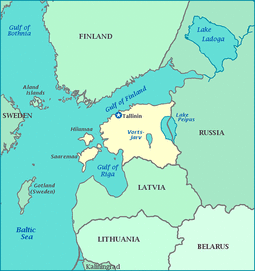
This is no surprise. In fact, it’s one of the reasons we travel: to place ourselves in new situations that make us think, feel, and act differently. Landscapes of breathtaking beauty can restore our sense of wellbeing. Standing in places where great evil was done raises uncomfortable but vital questions about human nature. Seeing successful social experiments in
Estonia
and
Finland
is inspiring. Studying history’s worst failures — Hitler, Stalin, and Vlad the Impaler, to name but a few — reminds us that our collective happiness depends on finding better, more humane ways to treat each other.
The world is constantly engaged in social experiments. Can we spot the failures? Will we know when it’s time to speak up and say, “Stop the madness!” as Maslach did? Or will we accept what’s happening, like the 50 good people who watched those boys being abused and did nothing? To find that answer, we first need to ask ourselves this: how is the new normal changing us?
IS THIS THE DAWNING OF THE AGE OF ESTONIA?
THE DEVIL’S FOOTPRINT
WHAT I AM NOT DOING ON VALENTINE’S DAY
Sign up for my blog here
Buy my books on Amazon

Leave a Reply