During one of our early visits to Spain, long before we’d ever imagined moving here, Rich rented a car to drive some American friends to a mountain village we’d heard was particularly quaint. It proved to be as adorable as I’d hoped, with slightly crumbling whitewashed houses, potted geraniums, and a small central plaza where grizzled old men sat taking their ease on a weathered park bench. As we zipped by, one of the men waved and shouted,
“Estrecho! Estrecho!”
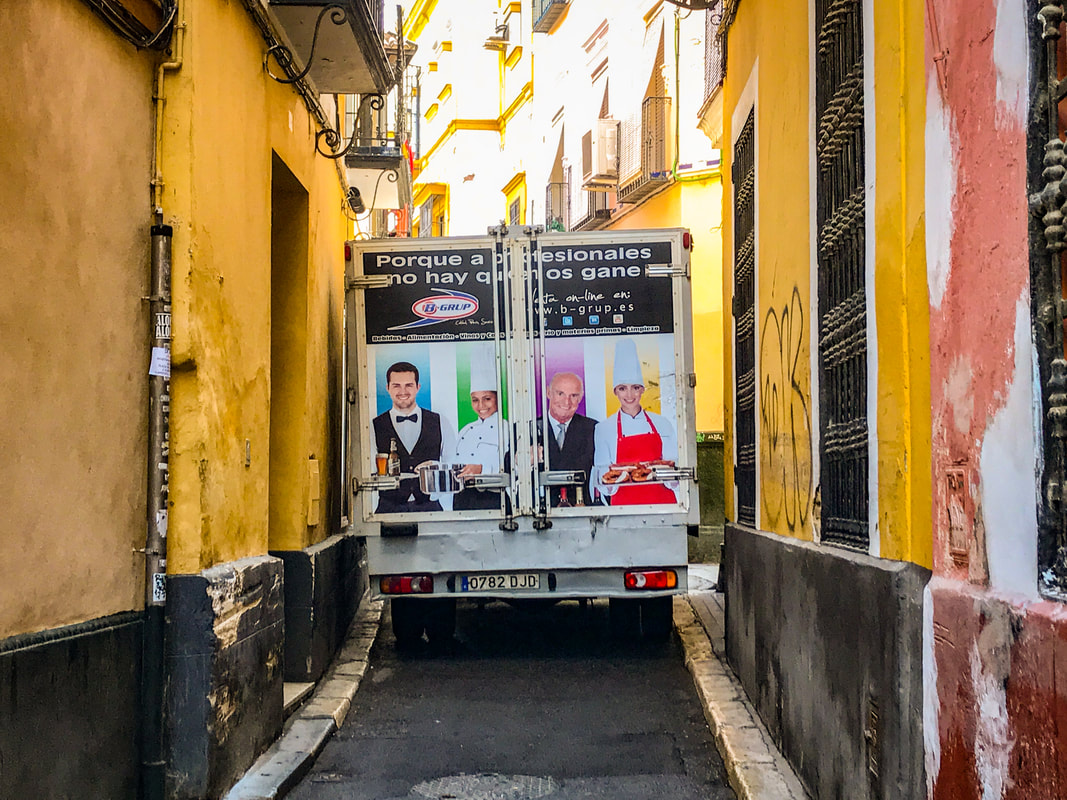
Hmmm. The word sounded familiar from my Spanish classes. A greeting, perhaps? I couldn’t quite put my finger on the meaning … It wasn’t until our rental car was wedged firmly between two stone walls at a bend in the ever-skinnier back lanes that it came to me. “Narrow!” I exclaimed. But of course by then it was too late to avoid disaster.
“What are we going to do?” asked one of our friends from the back seat. “Climb out the sunroof and abandon the vehicle? Call for a helicopter to airlift us out?”
But Rich is made of sterner stuff. He kept inching forward and back, under the amused gaze of every able-bodied resident of the village, until eventually, with considerable shrieking of metal and loss of paint, he worked the car free. We took another route gingerly back to the plaza, and there, beside the men’s bench, we noticed a very large sign advising everyone to park there and walk.
We now take such signs very seriously. In fact, we’ve made it one of our goals in life never to drive in Europe again if we can help it.
This is not a commentary on the difficulty of negotiating European roads and traffic. Oh sure, they can be a bit daunting, but hey, Rich and I are both hardened veterans of Boston’s back streets, New York City at rush hour, and those desolate Arizona highways where UFOs are so frequently spotted. I grew up in California’s car culture, in an area with very limited public transit, and cars really were the only practical way to get around. I bought into the belief that driving long distances is a uniquely American style of independence; it’s practically patriotic (as our gas companies and car manufacturers will be the first to tell you).
But now that I live in Spain, with excellent rail service to all of Europe and beyond, I’m delighted to abandon the “freedom of the road” in favor of the luxury of stress-free travel. I no longer wrestle with maps, panic when the GPS cuts out, or engage in heated discussions about why we missed our turn. I don’t need to try to figure out the meaning of road signs, comply with Byzantine parking restrictions, or fret about dings and scratches. Instead, I sit in civilized comfort with my coffee, Kindle, and relaxed travel companion, enjoying the scenery and chatting with fellow passengers.
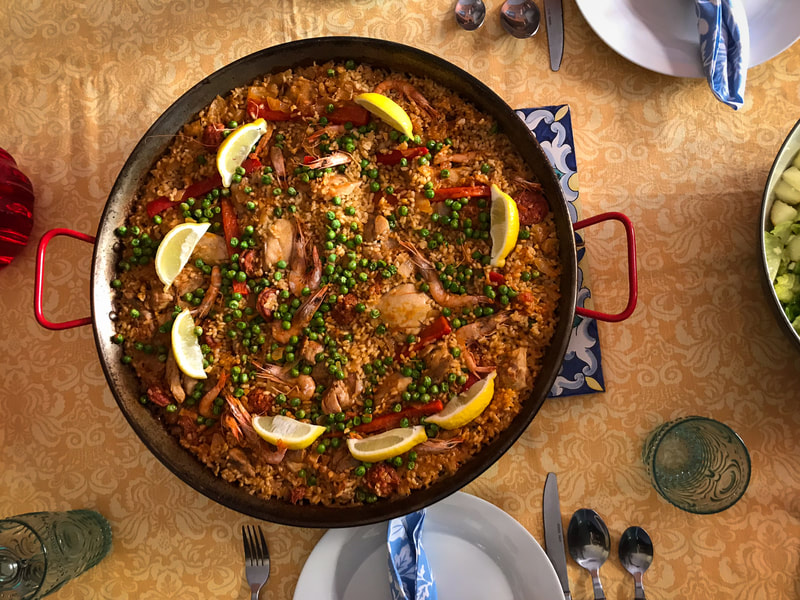
Rich likes to pass the time playing with his food. Try doing this while driving a car — or come to think of it, don’t!
Incredibly, many of my fellow Americans do not share my sentiments on the subject of trains, and 27 million of them will be renting cars this year during visits to Europe. Even our closest friends and relatives seem surprised we don’t think this is a sound idea. We often have to work very hard to dissuade them from renting a car at the Seville airport, driving it into our neighborhood in the center of town (a nightmare of Biblical proportions), seeking a parking place for upwards of a couple of hours, and finally giving up and driving to the city outskirts to deposit the car at a large parking garage, where it will remain for the duration of their stay.
“It just feels wrong not to have a car,” they tell us, after Rich and I have spent half an hour traversing the city on foot to collect them from the car park. “We don’t want to be an imposition.”
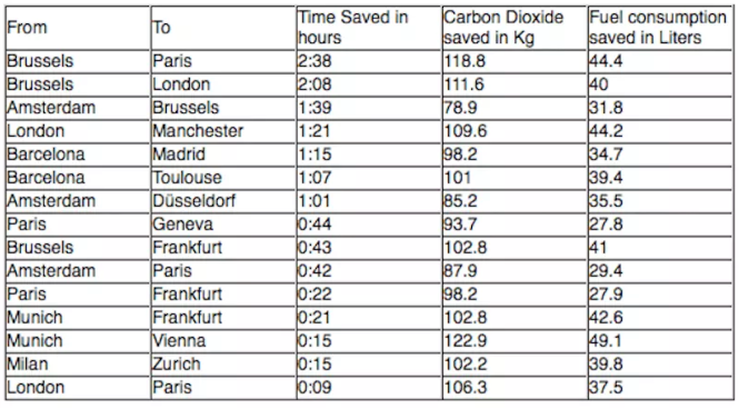
Another firmly embedded belief is that cars are somehow faster and more efficient than trains. In fact, if you’re traveling between European cities —from London to Paris, say, or Amsterdam to Brussels — you’ll find railways are not only quicker than driving, they’re often quicker than flying. Last September, when Rich and I took the
high-speed Eurostar from London to Paris
via the Chunnel, we shaved nine minutes off the time it would have taken by plane; not much, I’ll admit, but still, that was nine more minutes in Paris — and nine minutes we didn’t have to spend in a dreary airport lounge.
Average Time Saved Traveling by Train Instead of Plane
Source: Soul Travel, How to Reduce Your Carbon Footprint While Traveling
Another great thing about trains is that they connect to other forms of public transit such as ferries and buses, meaning there’s virtually no part of Europe you can’t reach. So how do you figure out what is the fastest way to get from Point A to Point B in unfamiliar countries? Rich starts his transportation research with an app called
Rome2rio
. You type in the city of origin and your destination, and it lets you know the time and cost of various transit configurations involving trains, buses, ferries, cars, and planes. Rich then consults the
DB Navigator app
for fuller details about stations, timetables, and where the train stops along the way, in case we want to consider an interesting detour or link up with a ferry port.
Don’t get me wrong; sometimes a car is the best option for getting where you need to go in Europe or anywhere else. But next time you’re sorting out transportation, before you automatically Google car rental agencies, take a moment to look at trains — and the ferries and other forms of transit they connect with. Railways make the journey far more interesting, offer a different kind of freedom, and remind us that travel is, at its best, a way to transcend our ordinary lives, experience the world more vividly, and recapture the rapture of being alive we may have felt in our younger years. As author Dave Matthes put it, “I’ve always felt that distant train whistles heard in the dead of night are the universe’s way of letting us know the best days are neither ahead nor behind us…they’re happening right now, cradled in the palms of our hands.” Let’s not allow them to slip through our fingers.
YOU MIGHT ALSO ENJOY
FINDING FABULOUS ROAD FOOD
EXPLORING FUNKY DIVE BARS
PACKING EXTRA LIGHT

Leave a Reply